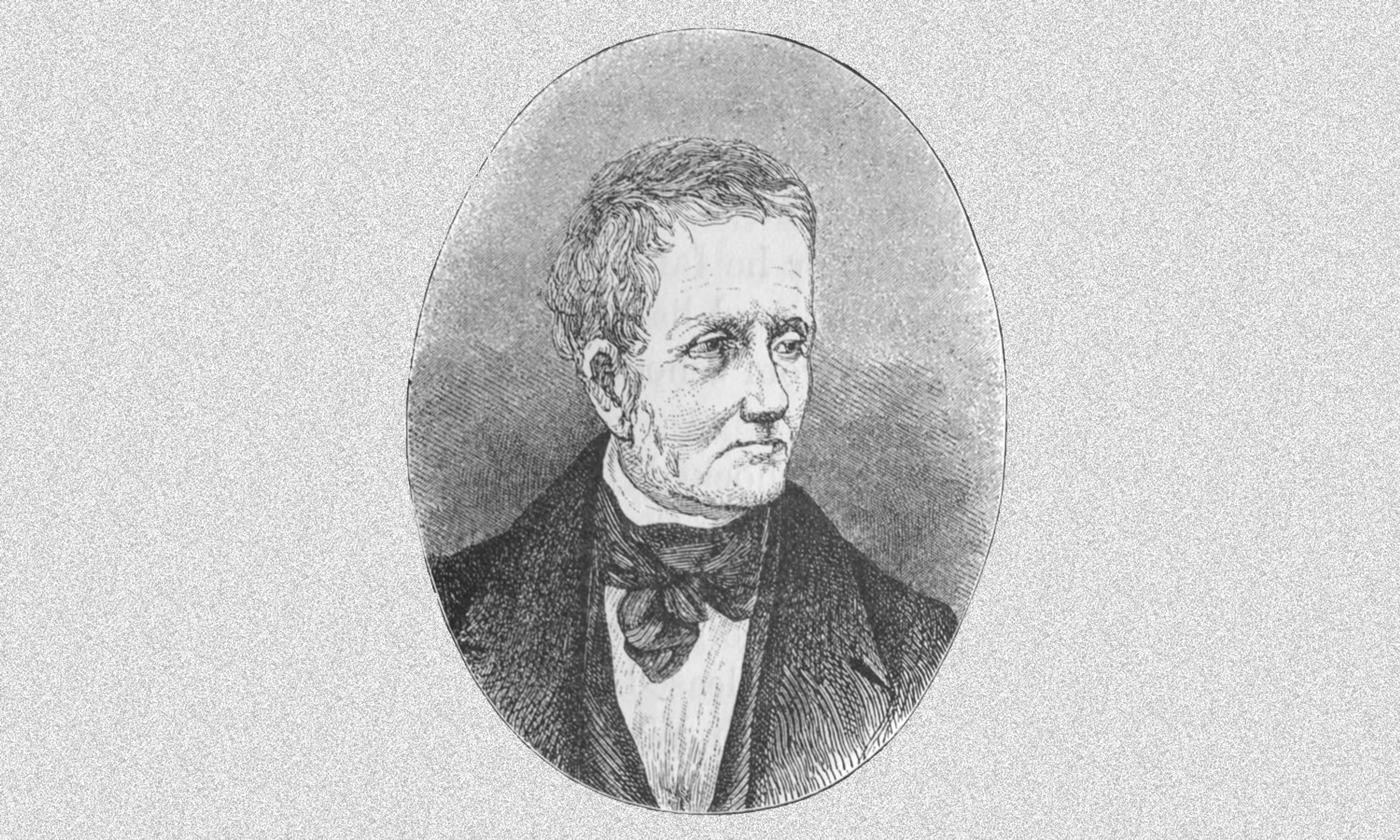
As is my habit, I sat down recently with a long-departed author for an interview. Thomas De Quincey (1785–1859), though most famous for Confessions of an Opium Eater (1821), was a considerable essayist and literary critic. Said to be unfailingly courteous, he was reputed to be an extraordinary conversationalist who never monopolized conversations. The answers here are his own words verbatim with a few tacit ellipses.
BAG: You’re concerned about the decline of rhetoric, aren’t you?
De Q: No art cultivated by man has suffered more in the revolution of taste and opinion.
BAG: Why do you say that?
De Q: There was a time when it designated the whole cycle of accomplishments which prepared a man for public affairs. From that height it has descended to a level with the arts of alchemy and astrology, as holding out promises which consist in a mixed degree of impostures wherever its pretensions happened to be weighty, and of trifles wherever they happened to be true.
BAG: Rhetoric in the collegiate sense is regarded as good; rhetoric in the political sense is regarded as bad. Is that what you mean?
De Q: We have in popular use two separate ideas of Rhetoric: one of which is occupied with the general end of the fine arts — that is to say, intellectual pleasure; the other applies itself more specifically to a definite purpose of utility, viz. fraud.
BAG: Am I right that you blame Aristotle for this duality?
De Q: By whatever name Aristotle might describe the main purpose of Rhetoric, practically, at least, in his own treatment of it, he threw the whole stress upon finding such arguments for any given thesis as, without positively proving or disproving it, should give it colorable support.
BAG: You seem to be charging Aristotle with sophistry. You think his rhetoric is more about effective argument than about truth-seeking?
De Q: The rhetorician exhibits his art by giving an impulse to one side, and by withdrawing the mind so steadily from all thoughts or images which support the other as to leave it practically under the possession of a one-sided estimate.
BAG: Is there any hope of redeeming the art?
De Q: There is a cause at work which will forever prevent the resurrection of rhetoric: viz. the necessities of public business, its vast extent, complexity, fullness of details, and consequent vulgarity, as compared with that of the ancients.
BAG: Please explain.
De Q: The political economy of the ancient republics, and their commerce, were simple and unelaborate; the system of their public services, both martial and civil, was arranged on the most naked and manageable principles. Suppose yourself an ancient Athenian at some customary display of Athenian oratory, what will be the topics? Peace or war, vengeance for public wrongs or mercy to prostrate submission, national honor and national gratitude, glory and shame, and every aspect of open appeal to the primal sensibilities of man.
BAG: We have our opportunities today, but Congress mostly shirks them. What we get instead is bathos. Is that what you find?
De Q: Rhetoric, if attempted on a formal scale, would be summarily exploded as pure foppery and trifling with time. Falstaff on the field of battle presenting his bottle of sack for a pistol, or Polonius with his quibbles, could not appear a more unreasonable plaisanteur than a rhetorician alighting from the clouds upon a public assembly met for the dispatch of business.
BAG: You’re also critical of professional writers, aren’t you?
De Q: They are distinguished by the most absolute carelessness. Whether in the choice of words and idioms, or in the construction of their sentences, it is not possible to conceive the principle of lazy indifference carried to a more revolting extremity.
BAG: How can you prove that?
De Q: Proof lies before you, spread out upon every page, that no excess of awkwardness, or of inelegance, or of unrhythmical cadence, is so rated in the tariff of faults as to balance in the writer’s estimate the trouble of remolding a clause, of interpolating a phrase, or even of striking the pen through a superfluous word.
BAG: That’s harsh.
De Q: The evidence is perpetual not so much that they rest satisfied with their own random preconceptions of each clause or sentence as that they never trouble themselves to form any such preconceptions. Whatever words tumble out under the blindest accidents of the moment, those are the words retained.
BAG: What can be done to help writers?
De Q: Half a dozen rules for evading the most frequently recurring forms of awkwardness, of obscurity, of misproportion, and of double meaning, would do more to assist a writer in practice, laid under some necessity of hurry, than volumes of general disquisition.
BAG: Would these include grammatical points?
De Q: It makes us blush to add that even grammar is so little of a perfect attainment amongst us that we have never seen the writer, through a circuit of prodigious reading, who has not sometimes violated the accidence or the syntax of English grammar.
BAG: How do you define style?
De Q: Style is the disentangling of thoughts or ideas reciprocally involved in each other.
BAG: Excellent. I’ve never heard it put that way. By the way, I announced at the outset that I’d included a few ellipses in the interview. I omitted quite a bit. You don’t mind, do you?
De Q: Nature sufficiently prompts all men to that sort of ellipsis.
BAG: Thank you, sir.
Alas, the time ran out before he could give his “half a dozen rules.” He seems never to have set them down. Perhaps he purposely left it to Orwell, who listed six in his “Politics and the English Language.” But that’s another column.











Comments