
If you’re in the market for an original blockbuster in this summer of post-COVID moviegoing — not a Marvel or DC production, not a Fast and Furious installment, but a story and characters you haven’t seen before — then your only real choice is The Tomorrow War, a science-fiction entertainment, starring Chris Pratt, with a delightfully insane hook: Thirty years in the future, an alien invasion has pushed the human race to the brink of extinction, leaving our descendants with no choice but to open a time-travel gateway back to 2022 and ask their parents and grandparents to come join the fight.
Unfortunately, despite all its special-effects battles and its (alleged) major-movie-star lead, The Tomorrow War isn’t actually playing in theaters, having gone direct to Amazon instead. Even more unfortunately, it’s pretty terrible. If I still kept my college drinking habits I would say that it seems well suited to a crowd of inebriates looking for something to howl at in the wee hours of the morning, but I’m too far away from that phase of life to speculate: Deploy at 3 a.m. at your own risk.
Still, a bad movie can be illuminating, and The Tomorrow War offers a certain clarity about several core problems facing Hollywood at the moment. The first problem is obvious from its platform: However mediocre it may be, a movie on this scale has no business going direct to TVs and laptops, because the only thing it has going for it is a sense of spectacle — and some nicely designed Cthulhu-level aliens — that’s tailor-made for cinema, and somewhat wasted otherwise.
Yes, because it’s pretty bad it probably wouldn’t have been a huge in-theater hit, but the theater business doesn’t just need its No. 1 hit movies; it needs the movie you settle for when the No. 1 hit is sold out on Friday night, or the one you hit up on a lazy Saturday afternoon when the rain spoils your pool plan. If those kinds of movies are now all destined for Amazon and Netflix, it’s hard for me to see how the theater business ever bounces back.
The second problem has to do with the question I teased above: Is Chris Pratt actually a movie star? He’s likeable enough, he transitioned from sitcom softness to a decent middle ground between action star and everyman, he headlined successfully in the Jurassic World and Guardians of the Galaxy movies — but can he open a movie that isn’t itself already a brand name? His misfire with Jennifer Lawrence in Passengers suggests otherwise, and now so does this new blockbuster’s direct-to-Amazon fate. But if a guy like Pratt isn’t really a star, then are there any male movie stars anymore — any younger ones, that is, after the aging Cruise-Neeson-Denzel-Keanu cohort? And if not, if basically nobody under 45 can open a movie unless they’re in a superhero costume or starring in a sequel, then why would Hollywood ever go back to making original content?
Which brings us to the final problem evident in The Tomorrow War: that in making so few original blockbusters, the movie industry seems to be forgetting how to do it.



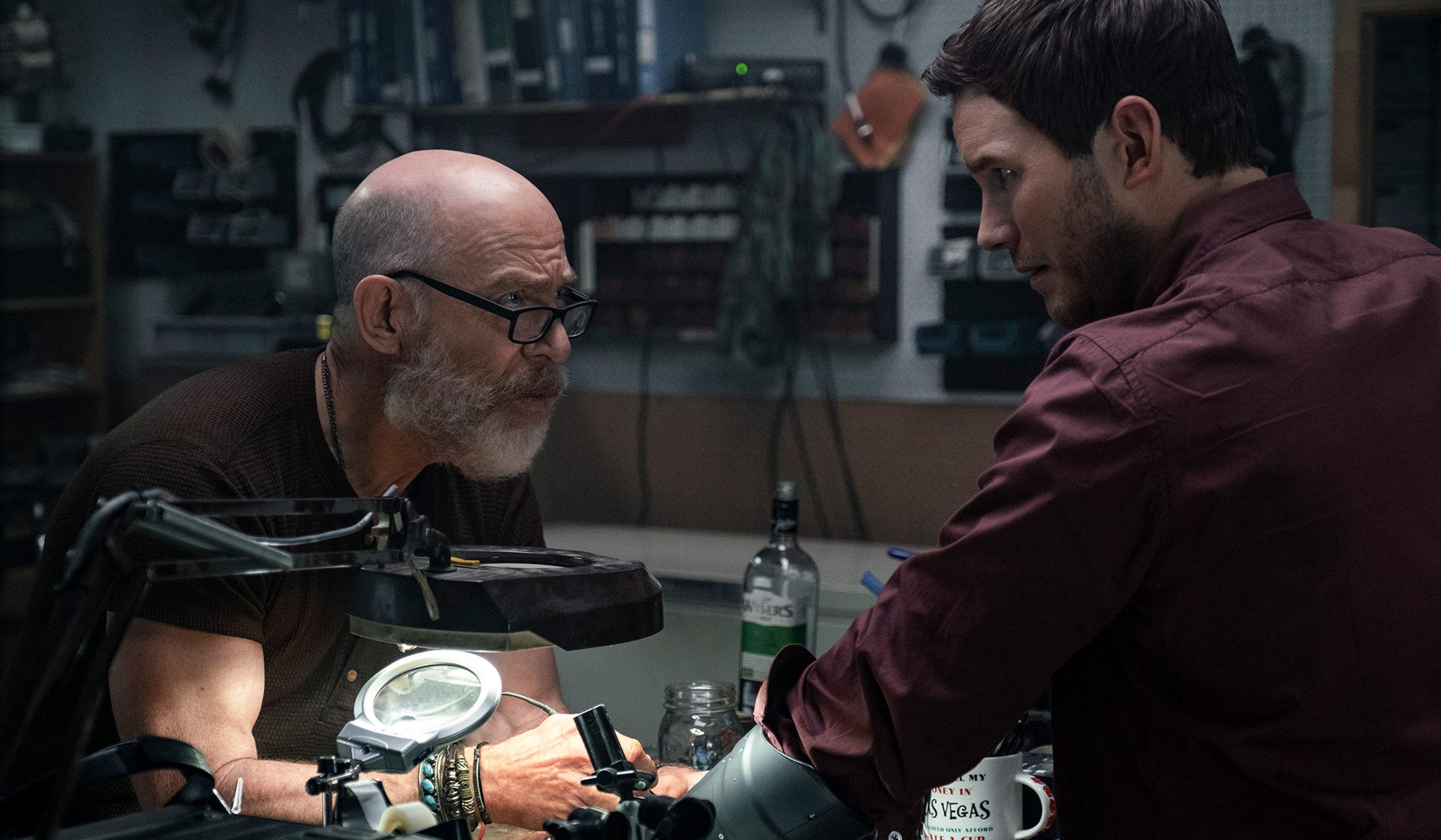






From left: Alexis Louder, Chris Pratt, Edwin Hodge, and Sam Richardson in The Tomorrow War.
Frank Masi/Paramount Pictures
Here it’s crucial to stress that the movie’s problems aren’t just a function of its insane premise. Back in the days of yore, by which I mean the 1990s, Hollywood regularly took ridiculous premises and spun them into action-movie gold. The Rock: A bunch of disgruntled U.S. soldiers take over Alcatraz, hoping to blackmail the White House into paying reparations to the families of their comrades killed in Cold War–era covert ops. Face/Off: A federal agent and a criminal mastermind surgically switch faces, so that we can watch Nicolas Cage play John Travolta and vice versa. Armageddon: A team of roughneck drillers are hired by NASA to blow up an asteroid in time to save the Earth from, well, Armageddon. Con Air: Well, okay, Con Air wasn’t just ridiculous, it was also pretty bad . . .
. . . but that’s the thing: Even what seemed like a bad action movie in the late 1990s didn’t manifest the sheer laziness that defines The Tomorrow War’s approach to world-building, the indifference with which it approaches the tangled implications of its time-travel premise, the remarkable bathos with which it veers from family values to apocalypse and back.
One issue with the movie, though, may say less about changes in Hollywood than it does about changes in public attitudes writ large. In those 1990s action flicks, there was usually an attempt to have institutions playing some kind of constructive role: However absurd or silly the concept, at least somebody in the bureaucracy seemed to know what he was doing, even if he was being played by John Cusack or Billy Bob Thornton.
Whereas in The Tomorrow War the government is almost completely absent: There’s a secretary of defense who’s a figure of fun, but in the present and future alike it’s just Pratt’s soldier-turned-teacher-turned-soldier, his family, and some pals he makes along the way. When he needs a volcano expert, he turns to a kid in his high-school class. When it comes time for the final confrontation, he risks the entire future of the human race on the assumption that asking for any kind of governmental help would be a waste of time.
And this, maybe, speaks as much to our shared expectations as to any failure of screenwriting: After the last two decades of institutional decay, we tend to assume that even given three decades to prep for an alien invasion, all our government would do is give up and fall apart.











Comments