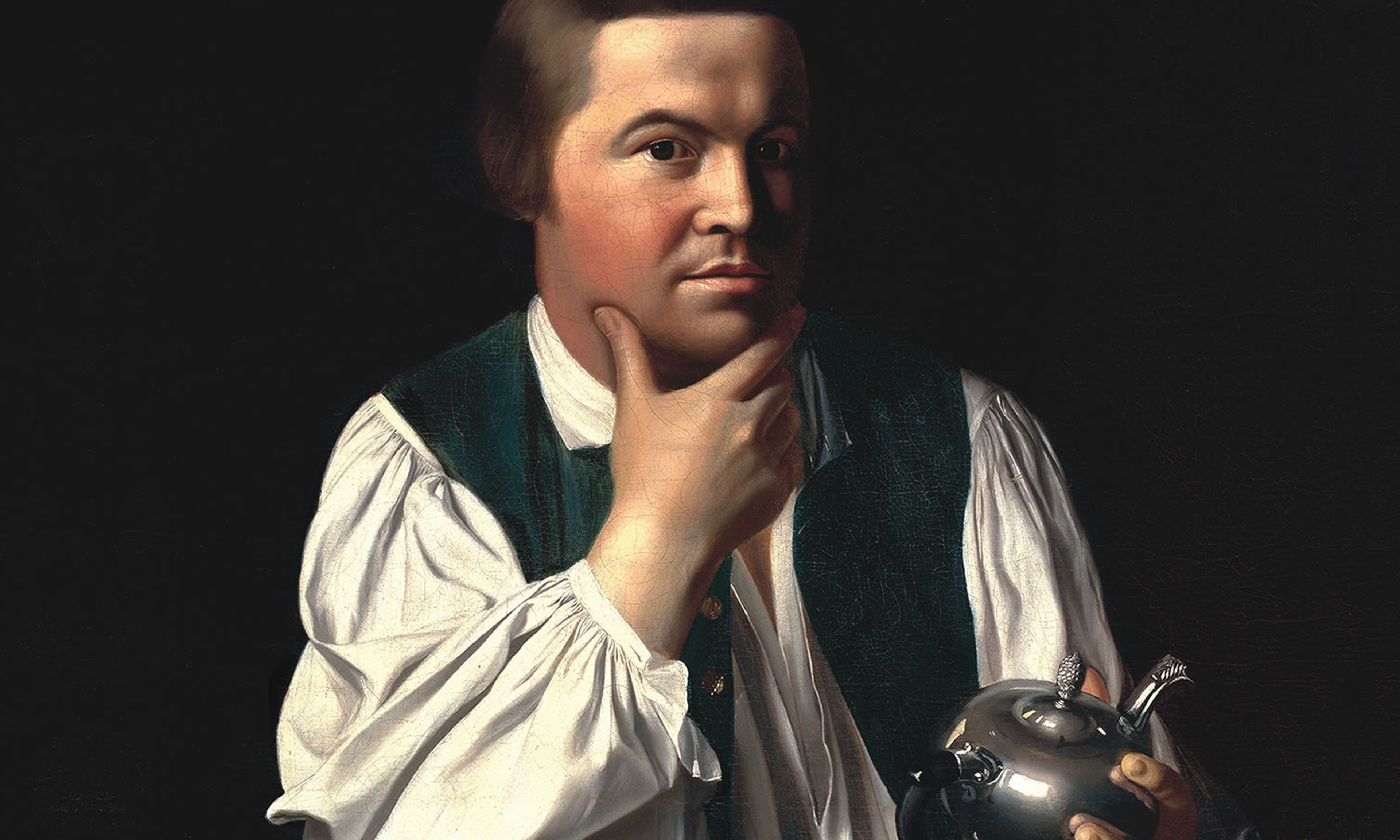
What do Paul Revere and Martha Stewart share? They’re both icons of American craft. Glenn Adamson’s new book, Craft, is the best amalgam of aesthetics, history, economics, and technology I’ve read. Craft is a vast topic. Anything made by hand is eligible to be called craft, from Revere’s silver teapot, engraved with a coat of arms and topped by a pineapple-shaped finial, to Stewart’s pineapple ham, enhanced by country mustard and 40 cloves.
Craft’s a thing, like a Gustav Stickley armchair, but it’s also a way of making a living.
Men and women who make things with their hands are often seen as the best of America. They’re self-sufficient, patient, trustworthy, creative, and impressively adept.
Adamson is the greatest decorative-arts curator of his generation. He’s a nuts-and-bolts connoisseur but also an academic and critic. When he was a graduate student in the 1990s, the field of craft history didn’t exist. His rigor, catholic taste, and readable style effectively made the field, and in a way suitable to craft itself. Craft is an incisive, scholarly book, to be sure. He debunks lots of myths. We really don’t know, for instance, whether Betsy Ross made the first American flag, but it’s unlikely.
That said, it centers the makers, almost never scholarly people, so it’s not an abstract story. He presents them as people we can see, people of passion and grit, often people in constant battle with mass production and throwaway culture.
Revere and Benjamin Franklin anchor the first part of the book, which establishes the ideology of craft, its cult, and its Achilles’ heel, which is that craft takes too much time for too little value. Revere’s portrait by John Singleton Copley, done in 1768, is an icon in American art history. On the eve of revolution, Revere is presented as the thinking man who works with his hands. He’s shown as he creates, wearing his everyday clothes. He’s an independent artisan. He takes silver mined from the earth and through fire and the physical force of a hammer makes the teapot he holds. He’s ingenious. Artisans, the backbone of colonial small business and the day’s Main Street, were the aristocracy of labor.
He’s making high-end goods, though. Even middle-class Bostonians managed to own a few silver spoons, but Revere’s teapots were for the rich. And Revere put craft aside before too long. After his famous midnight ride and in a sign of new times, he bought and operated a factory making harness fittings, buckles, and copper sheathing for ships, and casting cannons and bells.
Not quite mass production, but not quite made by hand. Another revolution was under way, and this one didn’t leave crates of tea floating in Boston Harbor. In 1798, Eli Whitney introduced the concept of interchangeable parts to the gunmaking business. Adamson calls this “the holy grail of mass production.” The assembly line was around the corner. Craft changed forever.
The cult of the handmade, the unique, the custom-made collided with economies of scale. Standard goods all looked the same, but they were reliable, and the buyer knew what he was getting. As transportation improved, the local craftsman seemed irrelevant.
Some among Adamson’s cast of characters are well known, like Revere and Stewart; most others, not. Isaac Newton Youngs was a Shaker and a jack-of-all-trades. He was an expert tailor, mason, clockmaker, and carpenter, as well as an obsessive diarist whose writing sometimes turned to doggerel verse. “An endless list of chores and notions, to keep me in perpetual motion,” he wrote.
Shakers were utopians for whom virtue, egalitarianism, workmanship, and control were intertwined. Craft for the Shakers, the Amish, and the Inspirationists helped build the road to salvation. God supplied the blueprints. Youngs was at his best as a clockmaker, Adamson tells us. Shakers awaited the end of the world, so time was of a special essence. Since the world was going to end, children were useless. “A strategic error,” Adamson calls it, since the world never ended and the Shakers disappeared. It’s one of many of Adamson’s mordant takes on the irony of American crafting.
Caroline Shawk Brooks was a sensation at the 1876 Centennial Exposition. She made life-size, purportedly hyperrealist sculptures from butter. They were exhibited in a building reserved for women artists. They were a huge hit, but let’s face it, Brooks’s fame came from cultural biases. She was celebrated for craft that wasn’t useful. Given that women crafters were confined to the women’s building, they were taken less seriously.
Thomas Day was a black cabinetmaker born in 1801 in North Carolina. A free man, he opened his own business in the 1820s in Milton, on the border with Virginia, making custom staircases and mahogany furniture throughout the region, much of it for slaveholders. Day himself owned slaves. His work is still to be found, and it’s exquisite. When he married a black Virginia woman, he needed to petition the legislature for permission for her to move to North Carolina. A dozen fellow craftsmen in the region, all white, vouched for his character.
Day himself eventually went bankrupt, partially because the Civil War poisoned opportunities for free blacks in the South, but mostly because high-end craftsmanship doesn’t, as a rule, pay. Sometimes, Adamson approaches the issue through the prism of race. Booker T. Washington embraced artisan training as the key to black self-help and empowerment but, as W. E. B. Du Bois noted, Washington’s students at Hampton University couldn’t support themselves.
Learning to “make your own bed,” literally, to fabricate a bed and mattress, was all well and good in promoting confidence, but the money was in mass production, Du Bois argued. Washington was a magnet for philanthropy, but the rich donors who flocked to his causes might have understood that they were paying to produce not independent, self-supporting black men but anachronisms.
Race figures altogether too much in the book. Adamson is an exuberant thinker, and we’re in a time when race is at the center of everything. I fault his editor, who I feel didn’t ask “Isn’t this book about craft?” enough.
Aileen Osborn Webb, who married a Vanderbilt, founded the American Craft Council, which enhanced opportunity for rural crafters. Her group helped to create what we know as the designer-craftsman and the studio-art movement. Wendell Castle’s one-man atelier, aiming for custom crafting and unique or editioned craft, returned us, in a way, to Revere’s teapot, a luxury good. Yet in a way it didn’t. The critic Barbara Rose criticized much of the studio-art movement for absurdist fanaticism. Its craftsmen produced objects divorced from everyday life, such as chairs we can’t sit on. They’re decorative.
My favorite part of the book treats the Arts and Crafts movement in America. William Morris saw the Arts and Crafts movement in Britain as deeply ideological, political, and socialist. Power, he said, lay “with the workers rather than the possessors of hereditary culture or immense wealth,” and crafters played their role by making practical things for themselves or to barter.
Gustav Stickley took some of this seriously. His furniture has gravitas, massive proportions, and simplicity. It’s mostly oak, a ubiquitous wood but one that stands the test of time. It makes a statement, but what sort of statement? It’s ethical furniture, to be sure; but ethical in aesthetics in that it’s not ostentatious, and morally ethical because it merged discipline, creativity, sensitivity to materials, and the pride that comes with making something durable and beautiful. Makers in the American Arts and Crafts movement were characterful in that they worked using old-fashioned tools and simple materials. Buyers, too, lived well but sturdily. Class was nowhere to be found. Craft was a means of individual improvement. Proponents of the movement, many of them rich, saw it this way and also felt that the assembly line emptied men’s heads and invited crazy ideas like socialism and revolution to fill the void.
Authenticity is another double-edged sword. Part of the craft ideology is the protection of old ethnic traditions, and this is good. Gullah basket-weavers in South Carolina still use forms and tools dating to this insular culture’s distant past, but their use of sweetgrass, palmetto, and pine needles is recent. Colonial Williamsburg, a Rockefeller family project, is planned, orderly, tidy, and was until very recently free of even a hint that exploitation is a big part of the place’s history.
So much of post-war design and production is conformist and standardized, but Adamson tells us we’re in a craft renaissance. The costs of direct marketing have never been lower, because of the Internet. People want bespoke goods, a big change from a time when anything not from a supermarket, department store, or big-box store was suspect. The do-it-yourself craze advanced in the 1950s, Adamson reports, via teenagers fiddling with cars to create a hot-rod look.
It’s everywhere now. The AIDS quilt project created what he calls “craftivism.” Each quilt is individualized. At three by six feet, it’s the size of a grave. Stitched together for a protest rally, the quilts evoke a big cemetery as well as suggest that action comes from unity. Craft can be political in other ways. Crafting is ecologically correct. In the 1960s and 1970s, communes embraced craft as an anti-industrial, anti-capitalist means to live.
How much of the American way of crafting is romance, and how much is wishful thinking? This brings us to Martha Stewart. Craft might have more weight as an idea than as an actuality, Adamson suggests. Stewart’s recipes, gardens, and table settings seem great, but how many of us have the time, energy, and determination to pull them off? “Dreaming is an awfully good thing, dreaming, fantasies, aspirations,” she once said. “Aren’t those a big part of life?”












Comments