The great American writer Shirley Jackson’s classic 1948 short story “The Lottery” is a work that can be read, interpreted, and reinterpreted for every season. The basic storyline — telling of the process by which a village selects an ordinary citizen, in this case housewife Tessie Hutchinson, for a collectively administered death by stoning one summer day — is so striking, so strange, that it inevitably invites readers to think metaphorically: “The Lottery” has been credibly said to reflect the cruelties of the Red Scare, the evils of anti-Semitism, and the persistence of a mob mentality.
Perhaps every generation is entitled to its own reading of “The Lottery,” and ours is no exception. The story of an individual victimized by the horde has much to offer our present moment of extreme division, when the temptation to condemn our adversaries can be almost irresistible.
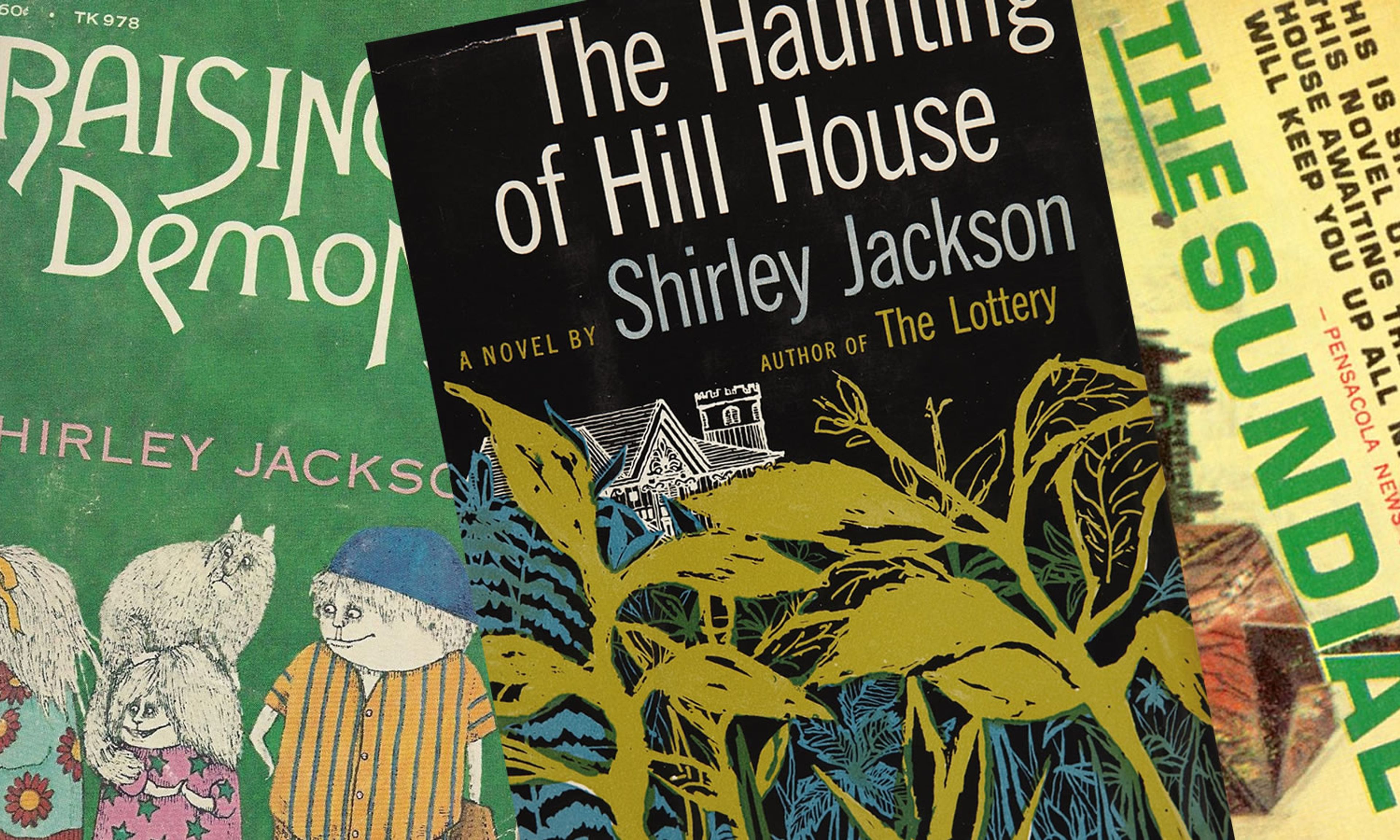
Jackson, who was born in 1916 and died in 1965, was also the author of the frightening, fantastical novels The Sundial (1958) and The Haunting of Hill House (1959), but “The Lottery” — with its keen sense of what it’s like to be excluded or vilified — seems likely to stand as her most enduring creation. A new collection of Jackson’s previously unpublished letters — selected and edited by Laurence Jackson Hyman, her eldest son — again demonstrates just how profoundly the author seems to have identified with the central figure in “The Lottery.”
Given Jackson’s instinct for the supernatural, it’s no surprise that the letters presented here show a writer besotted with the weird and arcane — there are references to a haunted music box, the ghost-riddled Winchester Mystery House in San Jose, Calif., and witchcraft — but more telling are the glimpses into the soul of a solitary, even inscrutable woman who once described herself as inhabiting a “lovely imaginary country.”
This is reflected in the very nature of the correspondence: Jackson’s letters were abundant, with the author churning out page upon page about her life, work, and mental state, but highly concentrated in their intended audience. This in itself is notable. “The letters are addressed to a relatively small circle of regular correspondents,” writes Bernice M. Murphy, who consulted with Hyman on the book, in an introduction. Among the most frequent recipients of Jackson’s missives were her husband, the critic Stanley Edgar Hyman (prior to their marriage in 1940); her parents, Leslie and Geraldine Jackson; her children (Laurence, Joanne, Sarah — called Sally — and Barry), when they were away from home; and her literary agents, Bernice Baumgarten and Carol Brandt. In writing so openly, and at such length, about herself to such a limited group, Jackson comes across as a person eager to express herself but in the rather sad position of having too few people to address.
In a letter to Stanley in the early 1960s that expressed her dissatisfactions with the state of their increasingly contentious and confused marriage, Jackson speaks plainly about her condition. “the truest name for it is loneliness,” she wrote, in the all-lowercase typing style she preferred. “i am so lonely now that i am shocked when i remember being a child and a adolescent; i thought i was lonely then.” Indeed, the earliest letters gathered here illustrate that Jackson, whose parents moved among the upper classes of San Francisco (where Shirley was born) and later upstate New York (to which she moved as a teenager), was a puzzlement to her family. While Leslie and Geraldine’s side of the conversation isn’t preserved for posterity, they seem to have been confused by their daughter’s idiosyncrasies, especially before they won her fortune and glory.
In a 1938 letter to Stanley, Jackson offered an imitation of her mother: “she says: now, darling, please for my sake put on a decent dress and do something with your hair, and you might even do your fingernails something quiet if you can, and will you be polite to my guests.” In another letter to Stanley, from the same year, Jackson scoffed at the mere idea that she was a member of high society: “going to be a debutante yeah. i’m going to count the days and minutes till september.”
Yet it would be mistaken to view Jackson simply as a free-spirited nonconformist butting up against conventional society (a superficial characterization endorsed here by the title given to the first chapter of letters, “From Debutante to Bohemian”). While Jackson was surely at odds with her parents’ milieu, and perhaps never fit in anywhere else, she evinced enough respect for the mainstream to express outrage when, before their marriage, Stanley, visiting Shirley at home and not expecting to encounter her parents, ran off without saying a word: “i resented your making a damn fool out of yourself and creating the worst impression possible.”
Indeed, Jackson’s bifurcated perspective — her unwillingness to join the ranks of either the “debutantes” or the “bohemians” — also comes across in letters in which she tried to work out her youthful political convictions, which were regarded rather dubiously by her intensely anti-communist father. In another letter to Stanley from 1938, Jackson expressed an admirable degree of equivocation about socialist ideas then popular among young artistic types. “do i have to shout and wave my arms in favor of the revolution, or else oppress the poor proletariat? must i be one or the other?” wrote Jackson, whose resistance to being co-opted by any mass movement arguably informs works such as “The Lottery.”
Jackson’s independent streak included her decision to maintain, concurrent with her career as a serious writer of macabre fiction, a sideline chronicling the satisfactions of the domestic life as she and her family lived it in New England. Her books Life among the Savages (1953) and Raising Demons (1957) presented households teeming with children and activity as something of a paradise on earth. While these works must be scrutinized in the context of the troubled Jackson–Hyman union — which was marred by Stanley’s extramarital affairs — Jackson’s expressed enthusiasm for raising a family seems to have been entirely authentic, at least if this correspondence is any indication.
Writing to her friend Louis Harap in 1944, Jackson refers with delight to the escapades of young Laurence, comparing his escapes from his crib to “Humphrey Bogart going over a prison wall” and his surprising strength to that of boxer Joe Louis. “he’s got too much energy for us. now, when he takes his nap we both go to sleep too,” Jackson wrote, but she seemed to thrive on that very energy. (Midge Decter, a friend of the couple, once recalled of the Hyman household: “It was full of life, full of kids, full of bustle.”) Even after their brood had expanded to three, Jackson expressed a desire for more: To her parents, she wrote in early 1951 that what she wanted most was twin boys. “we haven’t decided yet, but will have to soon, because sally broke the high chair and stanley says he will not bother to fix it again unless it will be used by a new baby,” Jackson wrote, in the acerbic but warm tone characteristic of many missives. (Their fourth child, Barry, was born later in 1951.)
Because her family was growing at the same time that her career was taking off, Jackson’s letters often paint a picture of a chaotic, disordered life, one in which run-of-the-mill stresses compete with problems of a more rarefied sort, such as finagling over contracts, meeting (and breaking) deadlines, and simply writing. “i am having a fine time doing a novel with my left hand and a long story — with as many levels as grand central station — with my right hand, stirring chocolate pudding with a spoon held in my teeth, and tuning the television with both feet,” she wrote to Ralph Ellison in 1949. Jackson’s letters offer a peek under the hood of how a successful writer at mid century managed to get along — in short, by selling boatloads of stories (“we always manage to spend more than we’ve got, because money seems to come so easily, for stories and articles,” she wrote in 1948) and accepting the occasional check from Mom and Dad.
For a long while, Jackson seems to have managed these discordant elements — home life balanced with literary life; grotesque fiction balanced with pleasant maternal tales — but that changed in the mid 1950s, when, suffering from overload, or what she referred to in one letter as “a brew of nervous tension,” she started using tranquilizers. From there, her decline accelerated, and in a 1963 letter to her parents, she admitted that she could not bear to cross the threshold of her front door (an agoraphobic condition that had improved before her sudden death at age 48).
Books of letters are highly variable in quality — piles of unedited, largely un-footnoted correspondence can test even dutiful readers’ patience — but this volume, like Flannery O’Connor’s collected letters in The Habit of Being, gives us a major American writer of mid century accounting for herself in her own words. As much as she was a loner, Jackson was nonpareil — warm enough to note with undisguised pleasure the developing personalities of her children, and off-kilter enough to regard, with a strange sense of the macabre, the removal of her teeth and the acquisition of dentures as a joyous occasion. This book, so shaggy and diffuse, cannot resolve Jackson’s contradictions, but it does, gloriously, illuminate them.












Comments