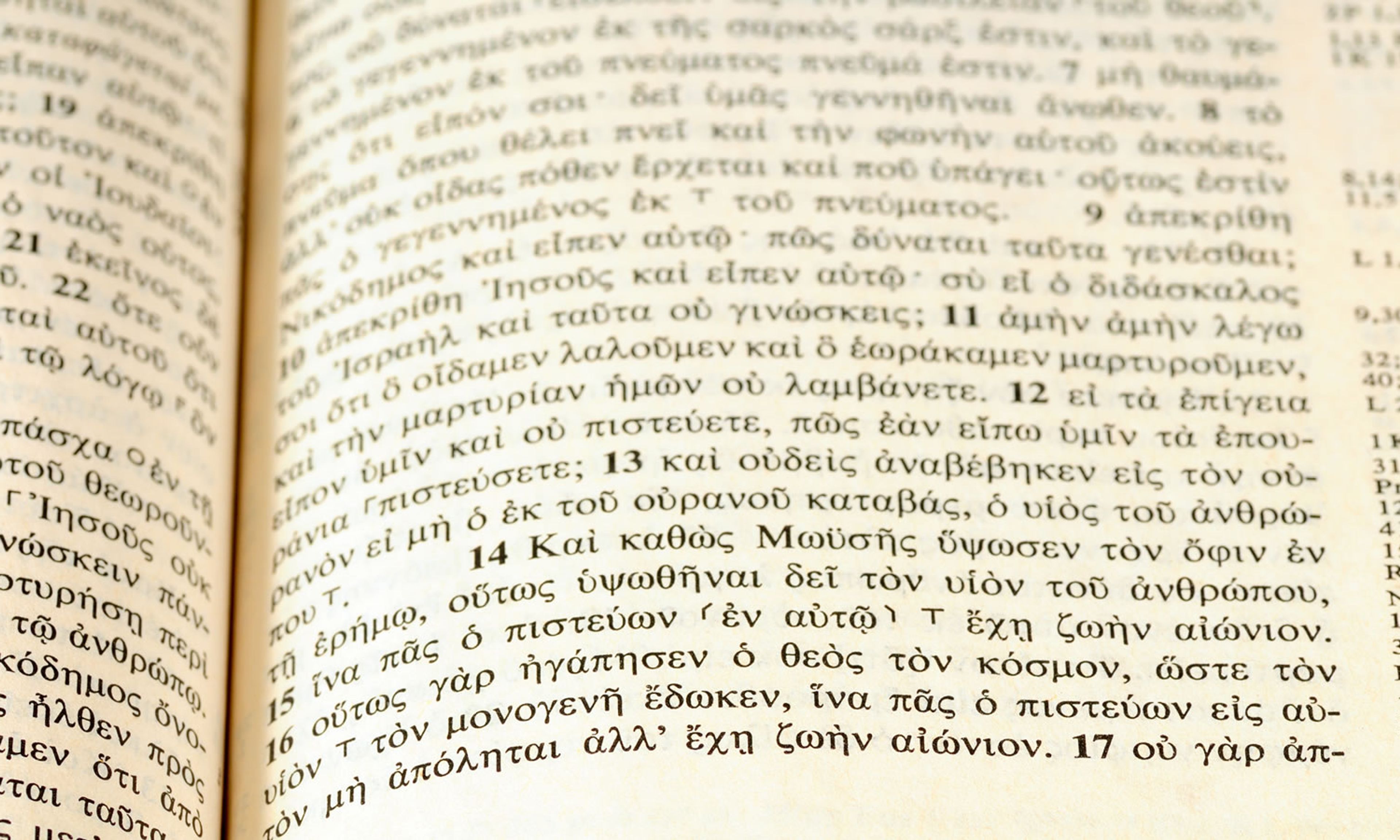
‘At the inauguration was the true account, and this true account was with god, and god was the true account.” So Sarah Ruden begins her translation of John’s gospel, giving the famous first line of the prologue a new sound, which will disappoint readers who expect scripture to delight their ears. For us Anglophones, the verse as translated in the Douay-Rheims and then the King James Version (“In the beginning was the Word . . .”) has acquired the comforting familiarity of a school motto. Reading Ruden’s discussion of the passage, one wonders: Has that sonorous English always been a misleading representation of the underlying Greek?
One could argue. Ruden is ready to give reasons for her word choices but also to acknowledge the limits of her confidence in any of them. Let the epistemic humility that guides her in this work, her English translation of the canonical gospels, be for us a lesson in how to read the Bible. In her introduction, glossary, and endnotes, she demonstrates due modesty about what she, like any of us, can state as a matter of fact, without hedging, when talking about anything in any of the four books. Their Greek is uneven and in many places already a translation, we assume, of Aramaic, the native language of Jesus’s milieu in Galilee and Judea in the first century a.d. In other places, the Greek of the gospels is informed by that of the Septuagint, whose first two words, Ἐν ἀρχῇ, are those of John’s prologue as well. Behind the Septuagint, in turn, is the Hebrew of the Old Testament, whose translation into Greek, the lingua franca of the eastern Mediterranean world in the several centuries before and after Christ, likewise wobbles in spots. What a tangle.
John 1:1 in Ruden’s translation is as good a passage as any to illustrate the character of her effort, a combination of scholarly scrupulousness and literary sensitivity. I take back what I said earlier about the sound. The more you reread her version of the sentence, the more your ears grow used to it. As your cognizance of the traditional, conventional translation recedes into the background, its music fading, you can begin to appreciate her reason for writing, to take the first surprising word first, “inauguration.” The more common translation is “beginning.” The Greek word behind it is ἀρχῇ. A “tricky term,” she calls it. It “can indicate ‘firstness’” not only as a chronological matter but also “in the sense of authority and governing leadership. At the opening of John’s Gospel, for instance, the stately word ‘inauguration’ (echoing similar connotations of a Hebrew word in Genesis 1) seems warranted.”
Stately? The classic “in the beginning” is more elegant, but it invites the reader to interpret the phrase exclusively in the temporal sense, whereas Ruden aims to do justice to what she sees as certain sociopolitical connotations, which include a streak of royal purple. “At the inauguration” — okay, I get it.
As for “the true account,” her substitution for that old standby “the Word” annoyed me even after the umpteenth rereading. Surely most readers understand that the Word is not a word. The expression “the Word,” for ὁ λόγος, has aged into the status of a term of art in Christian metaphysics. Please, don’t mess with it, I thought, contemplating her misstep, as I saw it.
Then I changed my mind. We may have always understood that the definition of “the Word” encompasses more than the naïve interpretation of it would allow. We may be aware that “mind” and “reason” are high on the list of rough synonyms for it. For some of us, though, Ruden’s observation that λόγος was associated with numerical even more than with verbal reasoning comes as a fresh insight:
Logos can mean merely “statement” or “speech,” but it also has lofty philosophical uses, especially in the opening of the Book of John, where it is probably connected to the Stoic conception of the divine reasoning posited to pervade the universe. The essential connotation here is not language but the lasting, indisputable, and morally cogent truth of numbers, as displayed in correct financial accounting: this is the most basic sense of logos. “True account” is among the translations that can be justified on occasion.
Leibniz imagined a characteristica universalis, as he called it, a language in which ideas and their relationships could be expressed with perfect precision and comprehension regardless of one’s native tongue. Frege worked up a Begriffsschrift, “a formula language, modeled on that of arithmetic, for pure thought.” Bertrand Russell and other analytic philosophers of the 20th century built on that groundwork a network of impressive edifices in formal logic. What would have been available to the authors of the gospels and to their readers in the first and second centuries after Christ were, for example, Aristotle’s syllogistic logic and the propositional logic of Stoic philosophers such as Chrysippus. It was rudimentary by comparison with later developments, but it was enough to suggest a mental or spiritual plane where truth is clear because both the music and the clatter that are by-products of our communication in natural languages are muted.
“Words” is what the plural λόγοι becomes in the King James Version at Matthew 24:35, “Heaven and earth shall pass away, but my words shall not pass away.” Ruden’s translation: “The sky and the earth will pass away, but the things I tell you will never pass away.” That’s less misleading, “the things I tell you,” but does it need to be so prosaic? It fails to impart the full depth and height of λόγος as she describes it, “the idea of a mathematical accounting that can be checked against real objects and events and must come right in the end.”
Through her careful treatment of the term she puts to rest some questions that nag the literal-minded reader of less rigorous translations: Which words would never pass away, the English words in translations, or the Greek words in the early manuscripts? Or the presumably Aramaic words behind the Greek? In any case, how would we know the exact meaning of the words after the language they belonged to changed too much or died, leaving us where we find ourselves now, attempting to infer the sense with varying degrees of certainty, wondering how much of the information they once conveyed may have been lost in the mists of time? Fret not. His words may pass away and may have done so already. (We could try to reconstruct the Aramaic, assuming that that’s what he spoke in the given passage, but we would only be speculating.) What will endure forever is the substance of his message, the living water mixed in the rivers and rapids of the natural languages that have been its carrier.
“An inward-looking, self-confirming set of writings,” Ruden calls the gospels. They are “not constructed to make a logical or aesthetic case for themselves; the case is Jesus, so the words don’t stoop to argue or entice with any great effort, as if readers were supposed to have the choice to yawn or say ‘What?’ or turn up their noses in the manner of an ordinary audience.”
She objects to characterizations of the gospels “as crude and lacking in charm and nuance,” though a few pages earlier she describes them as “ruggedly composed.” For their architectural analogue, see the Church of the Holy Sepulchre in Jerusalem. For polished Italian marble, go to Rome. The gospels deserve to be measured by their own standards, not those of classical prose stylists. “From their beginnings to their ends,” Ruden proposes, the gospels “somehow work.”
Note that she writes “sky” for the Greek word that in conventional translations becomes “heaven.” She tends to give the primary, concrete meaning of terms that after centuries of Christian theology have lost much of their original, multivalent punch and become over-spiritualized. For “the Holy Spirit,” she writes “the holy life-breath,” a homely rendering, but it has the advantage of reminding readers that the third person of the Trinity takes his name from the mundane Greek word for breath and wind.
“I hope readers will pursue my translation almost without pausing,” she writes, “which is what a scroll invited: you would unwind it at one side while you wound it back up at the other, like a roll of film.” Pastors are wont to advise the faithful to adopt the same attitude when reading any book of the Bible in any translation. The Bible, however, tends to resist. It demands that we sit with it, that we ask it to repeat itself, and that we wait and ponder before asking it to repeat itself again.
The gospels are among its most accessible books, and yet they too are slow reading. We consult commentaries, concordances, maps. We read multiple translations for the different windows they provide into that dense world where God meets human, sky meets earth. Like all translations, Ruden’s thought-provoking version of the gospels is an interpretation. It’s not the only translation you should work with, but it’s one of them. Add it to your library.











Comments