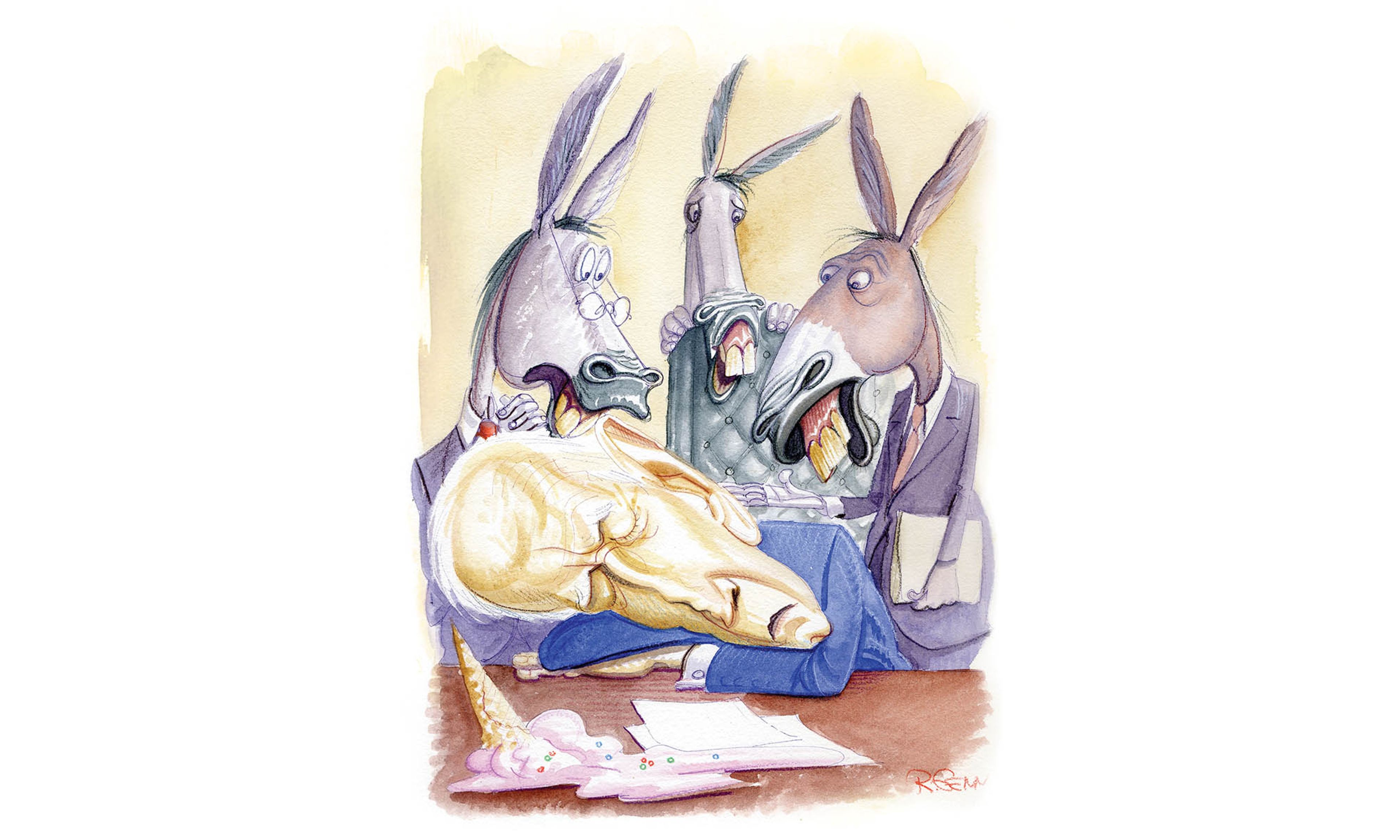
• China’s birth rate keeps dropping and those pandas aren’t going to raise the average.
• The off-year elections went poorly for Republicans and for pro-lifers. Ohio voters, by double digits, put a deceptively worded pro-abortion amendment into the state constitution. Virginia Republicans had hoped to take the state senate and instead lost the state house — while trying to blunt the attacks on them over abortion by saying their goal was to ban most abortions only after 15 weeks of pregnancy. The simplest explanation for that result is that the state is now blue. And Andy Beshear, the Democratic governor of Kentucky, held on to his office, although Republicans retain the power to override his vetoes. There are many possible lessons here, some specific to each locale, but an important common factor may be that in recent years Democrats have gained some supporters who regularly show up to vote, while Republicans have gained some supporters who vote less frequently. If so, it will be a long-term problem for Republicans, but perhaps not one in the presidential election of 2024.
• A new New York Times/Siena poll showing Donald Trump beating Joe Biden in the swing states Arizona, Georgia, Michigan, Nevada, and Pennsylvania has set off a Democratic panic. Polling increasingly finds Trump unpopular but Biden equally or more so, as the public tires of high prices, an insecure border, and foreign crises. Majorities also consider Biden, who turns 81 in November, too old to serve another term. David Axelrod, former chief adviser to Barack Obama, acknowledged the obvious: Biden might well lose in 2024, and as his party’s default nominee he needs to decide “whether that is wise; whether it’s in HIS best interest or the country’s” to run again. Another Democrat, Bill Kristol, explicitly called on Biden to step aside. What we’re seeing is nothing particularly new: Biden’s job-approval rating has been underwater since the Afghanistan-withdrawal debacle, and the “right track”/“wrong track” poll responses have been terrible throughout his term. The risks of nominating the elderly, rambling Biden for another four years have been obvious for a long time; in 2019, there was considerable talk about Biden being a “bridge” or “transition” president. But he may end up serving as a bridge back to Trump.
• Then again, shouldn’t Republicans be worried about their 77-year-old? Most of Trump’s rude jibes and absurd boasts fit into the persona he has crafted and maintained since he rode down the escalator in 2015. But lately he’s been spinning into the weird zone. At the Freedom Summit in Orlando, he claimed to have won every state in 2020. “Think of it,” he said, “every state.” James Monroe actually did that, but it was 1820, and who doesn’t confuse himself with James Monroe? Then consider Trump’s insult moniker for hostile reporter Maggie Haberman, “Maggot Haberman.” Older insults — “Sloppy Steve” (Bannon), “Low Energy Jeb” (Bush) — were rude without being actual fighting words. But to compare someone to a corpse-eating grub recalls the outsider art of mental patients. At a recent rally, Trump also said that Biden was trying to arrest his opponents and that he would therefore have the same power. Reportedly, he privately counts among those opponents his own former attorney general Bill Barr and chief of staff John Kelly. Does the GOP want to go with someone who is fraying away in public?
• Mike Pence bowed out of the presidential race. The former vice president was doomed by doing his constitutional duty on January 6, 2021. His rating among Republicans slid after that day until, despite being a rock-ribbed conservative who was smack in the middle of the consensus on the right for almost the entirety of his career, he had become radioactive in his own party. This was perverse, but Pence can take comfort in knowing that his faithfulness to the Constitution will be long remembered and that if he had bowed to Donald Trump’s pressure, the president’s campaign to overturn the election results would have become a genuine constitutional crisis. Having concluded that his presidential campaign couldn’t win, Pence got out rather than take any of the vote share from other non-Trump alternatives. Several remaining candidates should prayerfully consider his example.
• Dean Phillips is running for president. Of the United States. He’s a third-term Democratic congressman from Minnesota — don’t feel bad if you didn’t already know that — and his primary challenge to Biden is odd because he appears to have no policy differences with the incumbent: FiveThirtyEight found that in 2021–22 he voted for Biden’s preferred position 100 percent of the time. Phillips’s reputation for being a bipartisan moderate merely reflects his amiable demeanor. On paper, he is what Democrats say they want — the policies and mindset of Joe Biden but in a younger, healthier body. Yet there is no sign so far that any segment of the party is excited about Phillips’s candidacy. You can probably go back to ignoring him.
• After weeks of musical chairs over who was going to be the next speaker of the House, Representative Mike Johnson (R., La.) was the last one to grab a seat before the music stopped. Johnson had the fewest enemies and was not suspected of knifing any of the prior contenders. He practiced as an attorney before serving in the Louisiana legislature and getting elected to Congress in 2016, and he is a talented man and a staunch social conservative. Yet he has very little leadership experience in Congress and faces an enormous political, legislative, and fundraising challenge. Unfortunately, his kowtowing to Donald Trump and embrace of claims that the 2020 election was stolen aided his ascension. He will have a honeymoon period with the rabble-rousers in the caucus. When the dust settles, however, he will face the same reality that doomed Representative Kevin McCarthy: Republicans aren’t going to get what they want with Democrats in control of the Senate and the White House.
• Pathological liar and member of Congress George Santos (R., N.Y.) faces 23 criminal indictments. His former campaign treasurer, Nancy Marks, has pleaded guilty to wire fraud, aggravated identity theft, making false statements, and obstructing federal campaign regulators. Santos is entitled to the presumption of innocence in a court of law; his congressional colleagues are entitled to conclude that he is a nonstop embarrassment and expel him from the House. That would require a two-thirds majority, a high bar to clear. Six other House Republicans from New York, who are among those facing the toughest reelection odds in 2024, introduced an expulsion resolution. It failed, in part because some Democrats joined Republicans in thinking conviction necessary before expulsion. As a political matter, Republicans may be better off without Santos in the long run. Then again, the long run for Santos is likely to be next year.
• “I was trying urgently to get to a vote,” said Jamaal Bowman (D., N.Y.) in a statement explaining why he had pulled a fire alarm in the Cannon House Office Building in late September. “He was not attempting to delay the vote” on legislation to avert a government shutdown, said his office. There was simply “confusing signage” on an exit door, and he thought that yanking the fire alarm might open it, allowing him to dash to the House chamber. Republicans, instead of trying to get to the bottom of the matter, “need to instead focus their energy on the Nazi members of their party,” Bowman’s office also said (in a statement he later disowned). Capitol Police, having surveillance video that shows Bowman pulling the alarm and then walking away, saw things more clearly, and Bowman was charged with a misdemeanor. “I am responsible for activating a fire alarm,” he admitted. “I will be paying the fine issued.” And with that, D.C. and the media yawned and moved on.
• Democrats on the Senate Judiciary Committee are abusing their investigatory powers simply to campaign against Leonard Leo and Harlan Crow. (Crow has donated to National Review Institute, and the institute has received grant money from a nonprofit network that was established by Leo.) Dick Durbin, Sheldon Whitehouse, and their committee will reportedly vote within the next two weeks to subpoena Leo and Crow, as well as Robin Arkley II, who is targeted over a fishing trip with Justice Samuel Alito 15 years ago. The topic is their friendships with Alito and, primarily, Justice Clarence Thomas. They are not casting any similar net for friends of the liberal justices who bankroll their travel. The pretext is that the committee needs this information to draft legislation imposing a code of ethics on the Supreme Court. The reality is that the committee already drafted that legislation, voted on it, and declared it a “comprehensive” solution; that it has no prospect of becoming law; and that it is flagrantly unconstitutional because it interferes with the inner workings of the judiciary and allows lower-court judges to supervise the Supreme Court — indeed, to do so in ways that may intimidate the justices from exercising their own constitutional duty to supervise the lower courts. But the subpoenas will please the senators’ donors, which is apparently all that matters.
• Mark Meadows, the onetime congressman who became President Trump’s last chief of staff, wrote a memoir. All Seasons Press paid him $350,000 for the privilege of publishing it. The book follows the line that the Democrats stole the 2020 presidential election from Trump. According to a news report, however, Meadows is singing to prosecutors, saying that he never believed the stolen-election claims and that Trump, for that matter, didn’t either. All Seasons Press has pulled Meadows’s book from the market and is suing the author for $3 million. If Meadows plotted to deceive, he deserves his tangled web.
• More than any other, one phrase has become a hallmark of the reports published in the aftermath of mass shootings in America: “The suspect was known to authorities.” So it was in Maine, where, in late October, a man killed 18 people and wounded many others. For five months before the shooting, the perpetrator had been suffering from deteriorating mental health, experiencing paranoia, and hearing voices in his head. At one point, he warned his fellow Army Reserve enlistees that he intended to carry out a spree killing. At another, he was involuntarily committed to a psychiatric hospital in New York. Despite all this — and despite an explicit warning from the Army Reserve — the sheriff’s office in Sagadahoc County, Maine, declined to invoke the state’s “yellow flag” law, which permits law enforcement to temporarily confiscate firearms from those suspected of mental instability if a medical official and a judge sign off on the request. Given the remarkable number of guns in circulation, the openness of American society, and the relative unpredictability that attaches to the time and place of mass shootings, these sorts of crimes are among the most difficult to prevent. But they are made much more so when the clear warning signs are ignored.
• It’s good to have an ally in the White House. The United Auto Workers has consistently failed to unionize workplaces in right-to-work states and has suffered as more car production has shifted to those states. The union was the subject of a yearslong Department of Justice investigation for fraud and corruption that ended with a consent decree in 2020. Twelve top officials, including two former presidents, were convicted on fraud charges and sentenced to federal prison. The UAW operates under the jurisdiction of a court-appointed monitor. In a 2022 report, the monitor noted that the UAW’s cooperativeness had “veered sharply in the wrong direction” and that there were still 19 ongoing investigations. The failing and corrupt union has nonetheless earned the support of President Biden, who joined striking workers and endorsed their demands for a 32-hour workweek, the return of defined-benefit pensions, and a wage increase of over 40 percent. The deals the UAW actually struck with Ford, Stellantis, and GM don’t include the shortened workweek, do establish higher 401(k) contributions instead of defined-benefit pensions, and provide a wage increase of 25 percent, with cost-of-living adjustments on top of that. The UAW also won the right to strike if any automaker shuts down a plant, and it got Ford to promise to recognize it at new plants in Michigan and Tennessee without a union election. This contract will widen the gap in competitiveness between the Big Three and foreign carmakers doing business in the U.S. But as the Great Recession demonstrated, if the Big Three play along with the federal government, especially on labor and environmentalism, it will bail them out if necessary.
• Given that the wind does not always blow (the problem known in the industry as “intermittency”), wind power is a poor replacement for the reliable energy of fossil fuels or nuclear power. To provide necessary alternative sources of power will add to the cost. But that will not be the only reason that wind power’s costs are set to rise. Ørsted, the Danish company that is the world’s largest developer of offshore wind energy, is walking away from two large projects off the New Jersey coast. Meanwhile, BP is looking again at two projects off New York. The Biden administration’s goal — 30 gigawatts of offshore capacity installed by 2030 — looks unlikely to be met. What’s happened is that economic reality — in this case, higher interest rates and other cost pressures — has collided with politically driven industrial planning. As so often, the result is a mess. With climate policy-makers still setting the agenda, taxpayers and consumers will be forced to clean up the mess — one hopes not in the dark.
• A committee of the American Society for Reproductive Medicine has expanded its definition of “infertility” to include anyone who, because of his or her “status,” requires medical interventions “in order to achieve a successful pregnancy either as an individual or with a partner.” The previous definition applied to a man and a woman of childbearing age who had failed to conceive after one year of regular sexual intercourse without contraception because of an underlying “disease” or “condition.” The redefinition makes as little sense as expanding the meaning of “female” to include males who wish to be female. Two males, two females, or a single person are experiencing not infertility but the biological fact that human reproduction requires a male and a female. Desires cannot change this, but they can now overwrite previous limits on what health-insurance companies will pay for. Making IVF, surrogacy, and artificial insemination more affordable will further reduce mothers and fathers to their gametes and separate more children from at least one of their parents.
• Sam Bankman-Fried, founder and former billionaire CEO of the now-bankrupt cryptocurrency exchange FTX, was found guilty on seven counts of fraud. FTX collapsed when markets realized that the company’s assets were largely a mirage and Bankman-Fried had been using customer money on everything from risky crypto investments to Super Bowl commercials to political donations. (The only person who gave more to Democrats in the 2022 cycle was George Soros.) The prosecution relied on the argument that, while cryptocurrency is new and can be difficult to understand, Bankman-Fried’s conduct was no different from fraud through more familiar financial instruments. About $8 billion in customer money was stolen and frittered away. FTX had a wide-ranging social agenda, with many at the company saying its ultimate purpose was to change the world through the “effective altruism” of its affiliated nonprofit foundation; getting to those sunny uplands apparently required luxury real estate in the Bahamas, naming rights to an arena, and ads on MLB umpires’ uniforms. It turns out that moral compromises made in the purportedly selfless pursuit of money aren’t so different from ones made in the selfish pursuit of money.
• “The soft bigotry of low expectations” aptly characterizes the attitudes of school officials who, upon confronting evidence of their failure to help students meet educational standards, abandon those standards in the belief that their students are not capable of meeting them. Rarely if ever do these grandees consider the possibility that they are to blame. So it is in Oregon, whose board of education voted to extend a pause on enforcing graduation standards in math, reading, and writing proficiency until at least the 2027–28 school year, on account of their allegedly discriminatory effect on “historically marginalized” students. Not that it matters right now anyway, for students in Portland, at least: The Portland Association of Teachers is, at time of print, still on strike, closing all schools in the state’s largest district. The graduation-standards pause was introduced during the Covid-19 pandemic, a time of widespread and extended school closures, especially in blue states. Data have since confirmed what many suspected would happen: The closures hurt student performance and increased racial gaps in learning. Oregon’s standards — for students, and for school-board members — ought to be raised.
• Congress has been embroiled in a debate over how to go about funding aid for Ukraine and Israel. Some legislators want separate bills for each country, others want one for both. The House of Representatives has passed a bill funding Israel but cutting the IRS. Senate Majority Leader Chuck Schumer (D., N.Y.) has said this bill would not pass the Senate; President Joe Biden has said he would veto it. The path isn’t nearly as important as that Congress, one way or the other, expeditiously provide the support. We have a great many problems with the Biden administration’s approach to each of these theaters, but it is correct in seeking to repel a two-pronged offensive against the West by hostile actors aiding one another. Israeli forces fighting Hamas in Gaza while staving off Hezbollah — another Iranian proxy, in the north — need help quickly. Ukraine is struggling to keep up the pressure on the Russian military. While time may seem less essential in a 21-month-old war nearing the end of the fighting season, halting the flow of weapons to Kyiv could lead to the Ukrainian military’s collapse. The procedural arguments are comparatively minor. What matters is that both allies be able to continue their just fights.
• Olga Nazarenko lived in Ivanovo, Russia. She was an anti-war and pro-freedom protester. She put a Ukrainian flag on her balcony. She put ribbons in blue and yellow — the Ukrainian colors — on her backpack. Police repeatedly removed the flag and the ribbons. She replaced them. At a protest, she held up a sign that said, “All but very bad people want to live in peace.” Underneath that sentence was “God save Ukraine.” Earlier this year, she told Novaya Gazeta Europe (the Russian paper in exile): “What’s happening in Russia and Ukraine now is much worse than what’s happening to me. I can’t stay silent or I wouldn’t be able to look at myself in the mirror.” She has died at 48. “Doctors say the injuries she suffered suggested a severe beating and falling from a great height,” reported NGE. Olga Nazarenko leaves a husband and two children. The courage of some Russians, as throughout the Soviet period, is almost unfathomable.
• Nasrin Sotoudeh is one of those women with almost unbelievable courage and dignity. She is an Iranian human-rights lawyer, often in prison. On October 24, she received the Civil Courage Prize, which is given by the Train Foundation in New York. The prize, as the foundation explains, “honors the extraordinary few among us who resolutely pursue freedom for many despite the consequences to themselves.” Recipients “are people who stand between oppressors and the rest of us.” Five days after she received this award, Sotoudeh was beaten and arrested in Iran. She was attending the funeral of Armita Geravand, who was apparently murdered by the “morality police” over a headscarf violation. She was 17 years old. Sotoudeh is back in prison — the hellish Evin Prison — once again. Remember her.
• A British pro-life activist, Isabel Vaughan-Spruce, was confronted by police after standing outside an abortion facility in Birmingham, England. Vaughan-Spruce has had several run-ins with police because of her silent thoughts while standing within the abortion clinic’s legally protected buffer zone. Previously she was charged with and fully acquitted of violating the Public Space Protection order, which prevents protest, including prayer. In September, the U.K. home secretary wrote to the British police to remind them that the act of silently praying is “not unlawful.” On this occasion, October 18, a police officer asked her: “Are you praying for the lives of unborn children?” The police confirmed to Fox News that they had issued Vaughan-Spruce a “written warning.” Pray for Britain — that, thankfully, is still allowed.
• The American Ornithological Society is charging ahead with a plan to change the monikers of U.S. (and some Latin American) birds named after people. It claims this is necessary because many of those people allegedly had connections to slavery — or were just white men. According to an NPR story, everything “really started to change in 2020, when police officers killed George Floyd in Minneapolis. On that same day, a white woman in Central Park called the police on [a] black birder, . . . claiming he was threatening her.” Witnesses to these events no doubt thought, “Bewick’s wren is the cause of racial strife in America.” But with the avian eponyms now canceled, a golden age of racial harmony will finally commence.
• “Why You Don’t Need to Rake Leaves,” read a headline in the New York Times. For generations, people have thought that the raking of leaves was good for the yard — necessary for the yard, in fact. Scientists now, however, say otherwise. Many of us have long chafed at the chore of raking leaves, fall after fall. Now the science has spoken, and we say: Thank you.
• Thanks to the smart work of a middle schooler, we may soon have a better fire alarm. According to Business Insider, twelve-year-old Shanya Gill created “a fire-detection device that could identify fires faster than an average smoke detector and send a text to users to alert them of a fire.” Her invention, which uses a thermal camera and a Raspberry Pi computer, was chosen out of 65,000 entries (all from middle schoolers) in the Thermo Fisher Scientific Junior Innovators Challenge. She hopes to use her $25,000 in prize money to launch her invention as a commercial product. Good for her, although it won’t do anything for Representative Bowman.
• John Lennon played the piano and sang a wistful ballad into a boombox in his Upper West Side apartment one day in the late 1970s. He called the song “Now and Then.” Years later Yoko Ono, Lennon’s widow, gave the tape to the three surviving Beatles, who added their contributions to two other Lennon demos and released them as singles in the 1990s. They tried to work up “Now and Then,” but the quality of the original sound was too poor. George Harrison called it “rubbish.” Fast-forward a few decades. New audio-restoration technology has enabled engineers to isolate Lennon’s voice from the piano music and clarify it. They mixed it with tracks from the abandoned effort to salvage the song in 1995 and then with new parts from the two surviving Beatles, Paul McCartney and Ringo Starr, as well as with bits and pieces from some of the band’s early classics. Their label, Apple, has now released it as the Beatles’ last recorded song and paired it with their first, “Love Me Do,” on a double-A-side single. “Now and Then” isn’t their best work, but its existence matters more than its quality, as one critic noted. Let it be.
• If you looked up “old-school basketball coach” in the dictionary, you might find a picture of Bobby Knight, glowering at you over his red sweater. Underneath his relentless driving of his players and the notorious outbursts of temper that eventually cost him his job, he was also an innovator who did for basketball what Bill Walsh did for football. Knight’s creation, the motion offense, choreographed passing and screening to overwhelm defenses’ capacity to react, changing the sport. An NCAA head coach for 43 years, highlighted by three decades at the helm of the Indiana Hoosiers, Knight retired as the winningest coach in college-basketball history. As a head coach, he won three NCAA titles (one of them capping an undefeated season), an NIT title, and an Olympic gold medal in 1984. Knight had an eye for talent: After coaching Michael Jordan in the Olympics, he declared Jordan — still years from establishing his legend — the best basketball player he had ever seen. He also recruited Larry Bird. Knight passed on his legacy by coaching other influential figures including Mike Krzyzewski, Isiah Thomas, Quinn Buckner, Steve Alford, and Randy Wittman. He died in Bloomington at 83. R.I.P.
A War and Its Fronts
The Hamas War, inaugurated by the terrorists’ rape-and-murder assault on Israel on October 7, plays out in three theaters: Gaza, Europe, and the United States.
Israel launched its ground invasion of Gaza, splitting the strip in two to surround the ganglion of Hamas’s headquarters in Gaza City. Without the help (so far) of diversionary attacks from Iran’s other proxy, Hezbollah, or Iran itself, Hamas is reduced to two defenses: concealment and propaganda. Its network of tunnels, built over years in part by diverting humanitarian aid showered on Gaza, is intricate and fortified, but Israel has resolved to penetrate and purge it. So Hamas resorts to pity-mongering and lies.
Ordinary Gazans have perished in the fighting, and more will. A cease-fire, so loudly demanded, would help only Hamas. Hamas puts military targets beside or beneath civilian structures; when these are hit, the exaggerations pour forth. Israel was alleged early on to have bombed Al-Shifa Hospital, killing 500; the weapon in question was an errant Gazan rocket, which hit the parking lot, killing something closer to 15.
Western journalists, some of whom needed to be shown footage of Hamas carnage in Israel before they would consider it substantiated, gravely repeat Hamas claims about Gaza until fact-checking knocks them down. Hamas visuals, by contrast, are often obviously risible: One Hamas actor has appeared as a casualty or a grieving survivor in numerous videos, as if he were a stock-company favorite. A Hamas still image, quickly taken down, showed a bleeding child saluting beside his dead mother. His hand, however, sported six fingers. Some worry about images generated by artificial intelligence; this one was done by artificial stupidity.
Europe, an important spectator by virtue of wealth and proximity to the Middle East, has been rocked by pro-Hamas demonstrations. Germany’s vice chancellor, Robert Habeck, a Green Party politician, delivered a nine-minute online address, sober and passionate, explaining Germany’s obligation to defend Israel’s right to exist and excoriating Hamas’s brutality.
In Britain, meanwhile, London has been paralyzed by pro-Hamas marchers, up to a million at a time. Their biggest demonstration is planned to mark November 11, Remembrance Day, the holiday that commemorates the Commonwealth’s dead in World War I. British police, unable to contain them effectively, have instead been harassing the handfuls of pro-British demonstrators who huddle on the margins. The government of the country that perpetrated history’s greatest mass killing of Jews is behaving better than the government of the country that fought it for six years.














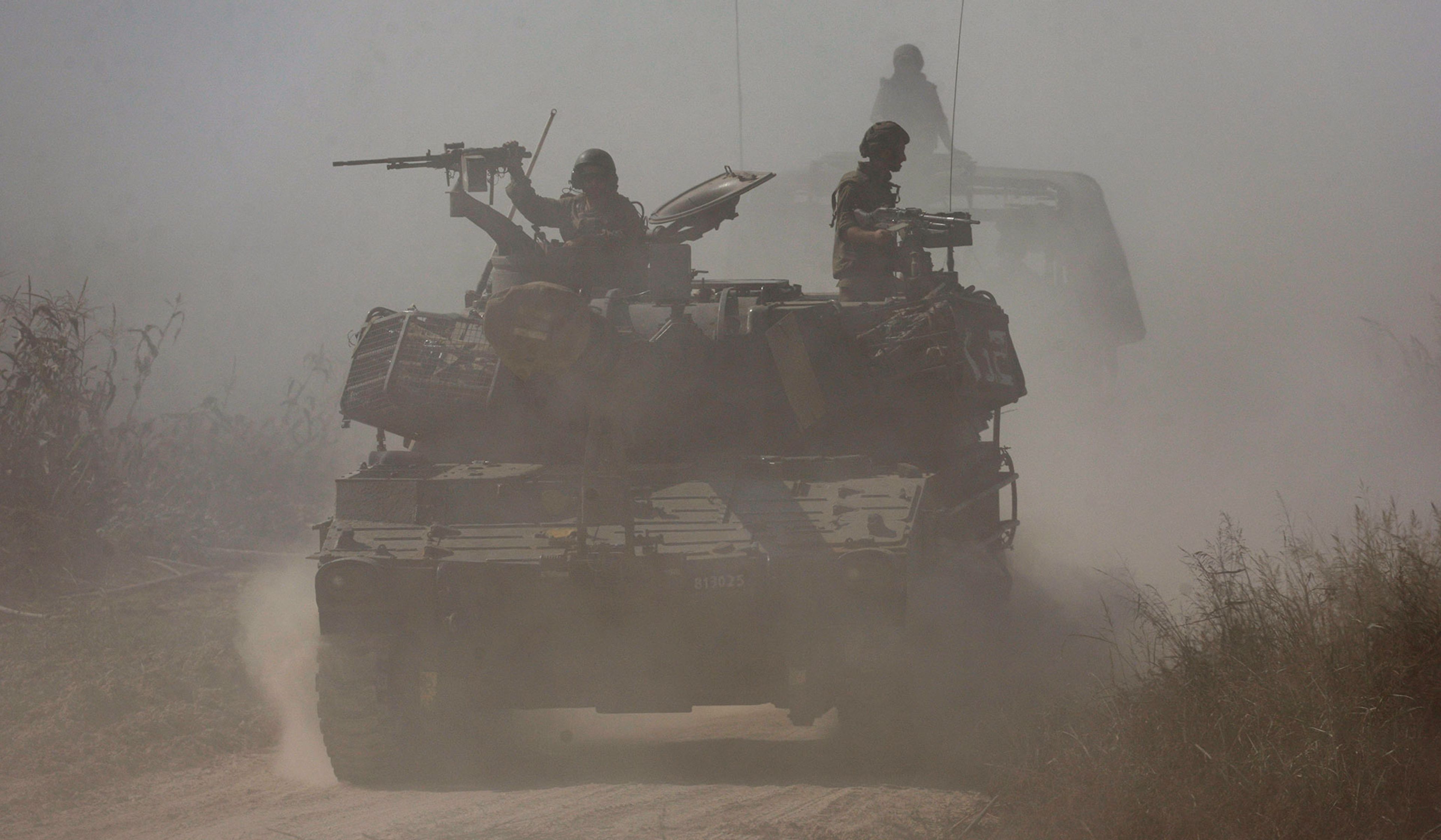
Israeli soldiers operate inside the Gaza Strip amid the ongoing ground operation of the Israeli army against Palestinian Islamist group Hamas, in a handout picture obtained by Reuters November 7, 2023.
Israel Defense Forces/Handout via Reuters
The United States under the Biden administration has had Israel’s back, more or less. The president’s initial response to October 7 was forceful and correct, and two carrier groups were dispatched to the eastern Mediterranean to deter Iran from entering the war. But Biden’s call for a humanitarian “pause” in Israel’s assault, given in answer to a protester at a campaign event in Minneapolis, suggested unwelcome irresolution.
Biden is feeling pressure from his party’s left. Representative Rashida Tlaib (D., Mich.) openly defends the eliminationist slogan, “From the river to the sea, Palestine must be free” (of Israelis, that is); that stance contributed to the House’s decision to censure her, but most Democrats voted against it. Demonstrators in Washington swarmed the White House fence and daubed its marble gates with red, bloody-looking handprints. Barack Obama provided the cool face of demagogy when he said in a podcast interview that “all of us are complicit to some degree” in the ongoing battle. When the complicity awards for Middle Eastern chaos are given, Obama — who funded Iran, and first drew and then ignored a red line in Syria — will take high honors.
College campuses have seen a carnival of antisemitism, from pro-Hamas flag-waving to harassment of Jewish students. This has provoked donors’ revolts here and there: The University of Pennsylvania has seen numerous wealthy alums, not all of them Jewish (e.g., Jon Huntsman), withholding donations unless the administration mends its ways. Hedge-fund manager Bill Ackman has engaged his alma mater Harvard with detailed and relentless critiques.
Ships at sea and angry letters do not address the heart of the matter. DEI (diversity, equity, and inclusion) bureaucracies at colleges have to be dismantled; they have nothing real to do, and so mischief-making is their only option. The “decolonization” paradigm, the newest thing after poststructuralism, will also have to go. Since it is unlikely that scholars will default to sense or tradition, they will have to find some new (and one hopes less pernicious) fad to share with their charges.
The other source of Americans supporting terror is immigrant communities from the Middle East. Not everyone in them loves Hamas, but perhaps half of all Hamas-lovers in the United States hail from them. Their impact is diluted by America’s relative remoteness, larger population, and greater square mileage as compared with Europe. Even so, one folly of open borders is visible today on our streets.
The Stat
$2.25 trillion — the size of the U.S. manufacturing sector in 2023, according to the Bureau of Economic Analysis.
Contrary to the narrative about a puny and shrinking U.S. manufacturing sector, manufacturing contributed about $2.25 trillion in output to the U.S. economy this year. Other than the sharp decline due to the Covid pandemic, U.S. manufacturing output has been trending upward, adjusted for inflation, since the end of the Great Recession, increasing from about $1.9 trillion in 2010. So has employment, which has increased from about 11.5 million workers in 2010 to 13 million workers today. As Colin Grabow of the Cato Institute pointed out in a recent article, if the U.S. manufacturing sector were a country, it would have the eighth-largest economy in the world. The U.S. has about 4 percent of the world’s people but does 16 percent of the world’s manufacturing, trailing only China and contributing more than Germany, Japan, and South Korea combined. Grabow calculated that in 2019 the U.S. was by far the leader in manufacturing output per worker, at $142,000. In second place was South Korea at $98,000. China’s manufacturing output per worker was only $19,000. In 2021, China’s population was 323 percent higher than the United States’, yet its manufacturing output was only 95 percent higher. The United States is a manufacturing powerhouse, and its leaders and pundits should stop pretending it isn’t.
by Dominic Pino












Comments