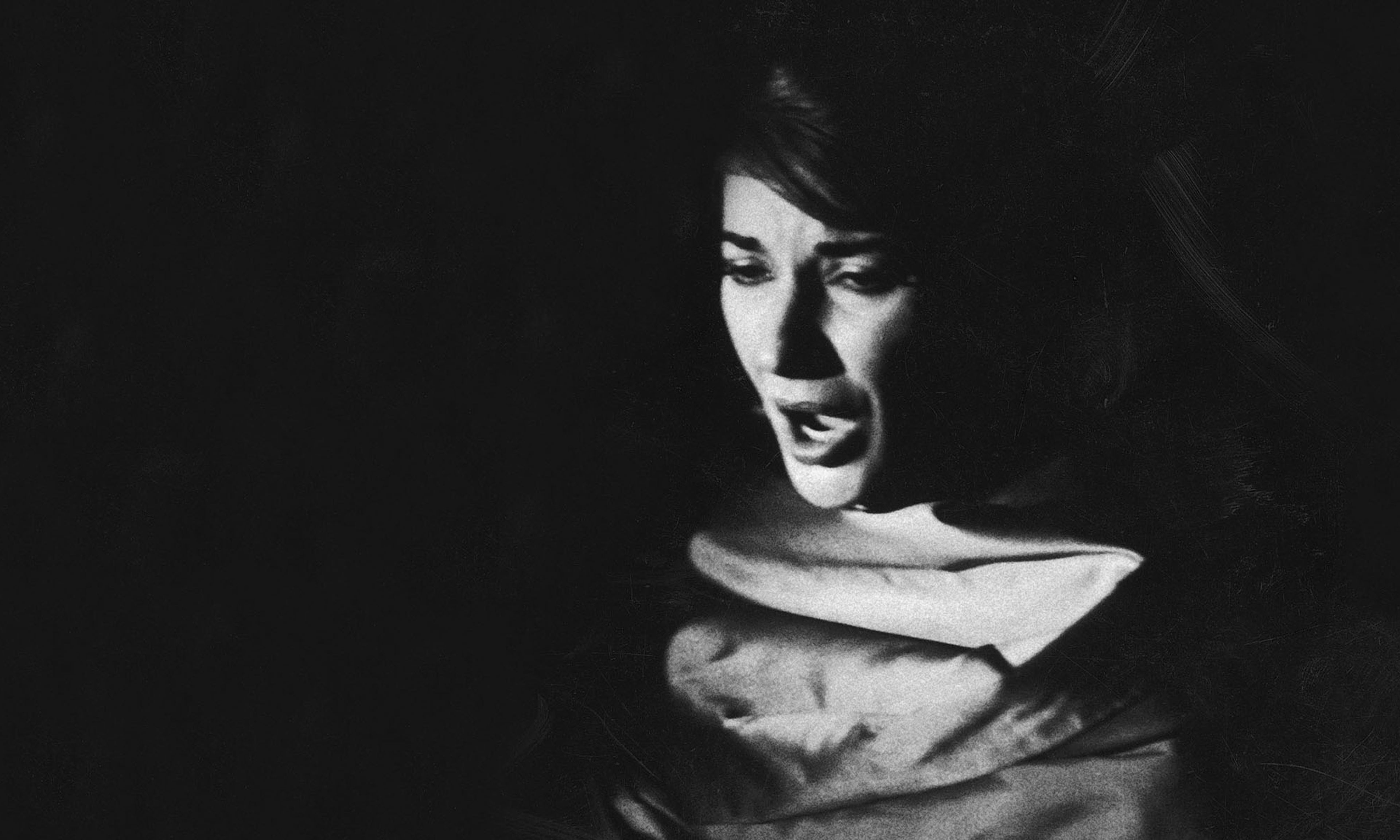
Maria Callas was born on December 2, 1923 — so the world is marking her centennial. “The world”? Well, pockets of it. The classical-music world, certainly, and the opera world, more certainly than that. Several classical musicians gained general fame in the 20th century — fame beyond their immediate sphere. Callas was one of them. Others include Caruso, Toscanini, Horowitz, Bernstein, and Pavarotti.
How about now? Maybe John Williams, the movie composer (not to be confused with John Williams the Australian guitarist). Maybe Plácido Domingo. But few would appear on the cover of Time magazine or its present equivalents.
(Callas was on the cover of Time in the last week of October 1956 — in the middle of the Hungarian Revolution, the Suez Crisis, and the climax of an American presidential campaign.)
Now, Callas was a celebrity, in addition to a singer or musician — she appeared on the gossip pages as well as the arts pages. She was glamorous (after 1954 or so). She was involved in scandals. She ditched her husband for Aristotle Onassis — who would ditch her for Jacqueline Kennedy. Callas’s last years were tragic, or at least pitiable. She died young, or youngish — at 53 in 1977.
She was, in a sense, a classical-music–world Marilyn Monroe.
Celebrity aside, Callas was a stunning musician, of whom other musicians were in awe. Even today, musicians bring her up, when discussing greatness. These include musicians who were born long after she died. I have been interviewing musicians for many years, especially at the Salzburg Festival. “Callas” comes up like clockwork. I will cite a few examples from this year alone.
In August, I interviewed Marco Armiliato, the Italian conductor, before an audience in Salzburg. On the topic of sopranos, he said there were two periods: Before Callas and After Callas. She established new standards.
Two days later, I did a podcast with Lea Desandre, the young French mezzo. When I asked about singers who had inspired her, she began with Callas — as though it were obvious. One of Callas’s leading qualities, she said, was “sprezzatura.” When Callas did something in an aria or a role, it seemed naturally right.
Back in May, I podcasted with Riccardo Muti, the dean of Italian conductors (and of conductors in general, you could argue). He spoke of Callas as the one who got away — or the one for whom he was too late. In 1974, when he was in his early 30s, he wanted Callas to appear in an opera he was leading: Verdi’s Macbeth. He let this desire be known. She got word of it — and called him up.
She was honored, she said. “Ma è tardi.” (“But it’s late” — too late.) In this, she was echoing the words of the title character in another Verdi opera, La traviata. The character utters them as she is dying.
“This is something I always carry with me,” said Muti, about his phone call with Callas. “The more distant this event becomes, the more it seems in my brain like a dream.” Callas is mythical, to a degree. But she was also very much real.
She was born in New York City, to which her parents had recently immigrated. They were Greek. At birth, she was Maria Kalogeropoulos. Her father shortened the family name to “Kalos,” then “Callas.” Maria’s mother was a stage mother. And a nightmare. It’s remarkable that Maria was as normal, or as stable, as she was (and her life was usually stormy).
At 13, Maria went with her mother to Greece and stayed there until she was 21. Her singing teachers were astounded by her. Such talent had rarely been seen, or heard. Some in Athens called her “The God-Given.” Callas was talented, yes — very. But she also worked like a fiend. She was an exceptional combination of talent and discipline.
When she left Greece, finished, more or less, the world was her oyster.
She had uncanny musical intelligence. Even conductors were in awe of this (and they have the reputation of not being in awe of anybody, except themselves). Leonard Bernstein once referred to Callas as “the Bible of opera.”
She had uncanny theatrical intelligence. Luchino Visconti, the film director, began directing operas because she was in them. Callas was the very definition of a “singing actress.”
The conductor Carlo Maria Giulini said that Callas embodied the “trilogy” of opera: “words, music, and action.” Personally, I wish she had brought this trilogy — or two of the three: words and music — to songs. She was not a song singer. She was an opera singer.
But in this field, opera, she could hardly have been more versatile. She sang dramatic-soprano roles: not excluding Wagner’s Brünnhilde and Isolde. She also sang bel canto roles. Indeed, she played a major part in the revival of bel canto: the operas of Bellini, Donizetti, et al. She was a powerhouse and she was a ballerina, so to speak — a vocal ballerina. A model coloratura.
Imagine a football player who excels at being an offensive lineman and a halfback, both. (And a placekicker, when needed.)
Rossini was once asked, “What are the three things that a singer most needs?” He answered, “Voice, voice, and voice.” (There’s a different kind of trilogy.) What about Callas’s? Her voice is the subject of endless controversy and thousands of articles. Some hated it, thinking it ugly. (Some still do.) Some think it is a magnificent expressive tool. I am in the latter camp.
Ideally, a voice will flow seamlessly from bottom to top, or top to bottom. Callas’s had three distinct registers. (There we go with threes again.) Indeed, she herself would refer to “my three voices.” Yet each of those voices was fantastic, offering an array of colors and timbres. In mezzo arias — Carmen’s, Delilah’s — Callas sounded like a mezzo.
She was heavy and homely. In 1953 and ’54, however, she underwent a great weight loss: shedding 80 pounds (or “half a person,” as Arianna Huffington once said to me). (Arianna Stassinopoulos Huffington is Callas’s fellow Greek American and a Callas biographer.) “An Ugly Duckling Is Now a Swan,” read headlines.
How did this weight loss affect her voice? That, too, is the subject of a thousand articles. The soprano Joan Sutherland said that, if you did not hear Callas before 1955, you did not hear her real voice. Whatever the case — whatever the cause — Callas suffered a vocal decline.
She developed a wobble, a lamentable vocal affliction. Marilyn Horne, the great mezzo, once told me what her little daughter said, when listening to Callas: “Why does she have a wiggly voice?” Another great mezzo, Christa Ludwig, told me about recording Norma with Callas in 1960. Callas was having a terrible time, with the wobble — but she taught young Ludwig so much, about the art of singing. Even in a simple recitative, said Ludwig, a world of understanding was in her voice.
I did not hear Callas, in the flesh. I was too late. But I have ample testimony from those who did hear her.
One day, David Pryce-Jones, my friend and colleague, did me the favor of inviting Andrew Porter to lunch. Porter was an illustrious — a venerable — music critic and scholar. He was in his 80s when I met him. I asked whether he had a favorite singer. Almost before the words were out of my mouth, he answered, “Maria Callas.” He recalled a particular performance at Covent Garden — when Callas took the audience into a different realm, gobsmacking it.
There are, of course, plenty of Callas recordings — studio and live. Some musicians record “true.” They sound like themselves, on recordings. They are faithfully represented. Others are not so lucky. I think of Olga Borodina, the Russian mezzo-soprano. She is one of the greatest singers of our time. I’m not sure you can tell, on recordings.
I attended my fair share of Leontyne Price recitals. There are a few recordings — pirates, made illicitly by attendees — that convey what it was like. Five years ago, a pirate of Alicia de Larrocha, the pianist, turned up on YouTube. It was from 1974, at the 92nd Street Y in New York. Excitedly, I emailed a younger pianist friend of mine, saying, “This lets you know what it was like. It tells you why we all went nuts. You can sense the electricity. You can understand why the hair on our arms stood up.”
Callas recordings? I have a feeling they let you know. I believe that she, or enough of her, comes through. Even in the studio recordings.
If she had lived in a previous century, she’d be a myth — the way Maria Malibran and Jenny Lind are. The way — branching out from singers — Liszt and Paganini are. But because Maria Callas lived in the 20th century, she is more than a myth: She is real. We can hear her forevermore, on vinyl or whatever the current technology is. Not as good as being there. But so much better than nothing.
Callas is still a celebrity, too. Next year, a biopic will come out, directed by Pablo Larraín and starring Angelina Jolie.
But back to music — strictly music, no celebrity. I once asked Jeffrey Hart, the National Review editor and professor of English — and an expert on modernism — “Is Hemingway overrated?” (I suspected he was.) “No,” Jeff answered, decisively, “underrated.” When it comes to Callas: Believe the hype. She was as great as her most ardent fans think.












Comments