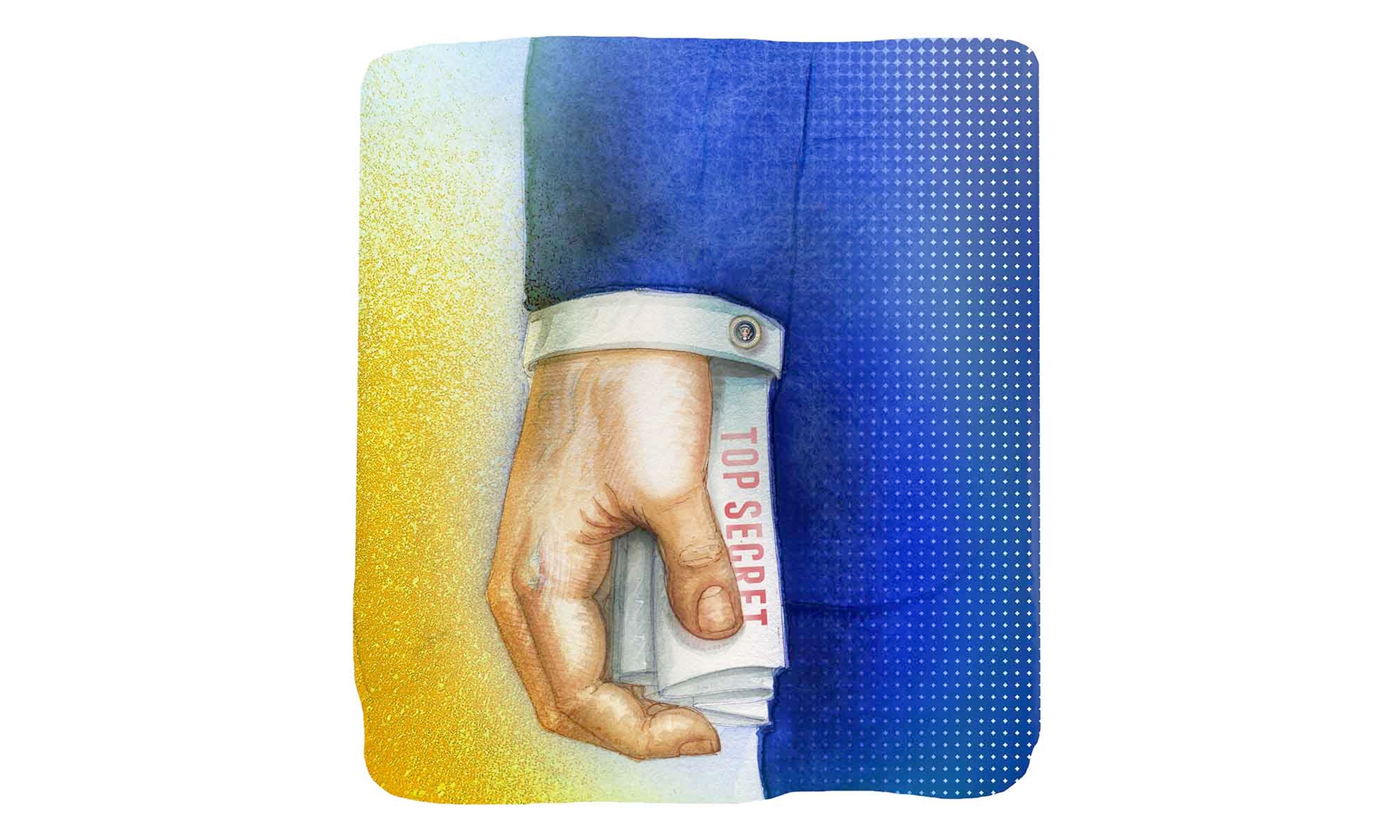
On January 8, 2023, one thing seemed dead certain: Donald Trump was going to be indicted for his grossly negligent mishandling of national-defense secrets — in the main, classified documents he illegally retained at his Mar-a-Lago resort in Palm Beach. It was no longer a question of if, but when.
Now that prospect is unlikely, at best. For that, the former president can thank his nemeses, Hillary Clinton and Joe Biden. The Obama Justice Department’s failure to charge Clinton in her email scandal, despite her years-long mishandling of intelligence (to say nothing of her BleachBit destruction of tens of thousands of government records), left Biden’s DOJ little daylight to rationalize that Trump’s offenses were so beyond the pale that prosecution was warranted. Despite this challenge, prosecutors mobilized through the latter months of 2022, seemingly convinced that they could justify charging the former president. That sliver of daylight was closed on January 9, however, when CBS News reported the first of a humiliating series of revelations that President Biden has for years been illegally retaining classified information in multiple unauthorized locations — not only from his days in the Obama administration but also from his decades in the Senate, which ended 14 years ago.
At the time of that stunning disclosure, prosecutors were meticulously building a criminal case against Trump. Their conduct signaled they were serious about charging him, notwithstanding the political strife that would accompany an indictment of a former president and current presidential candidate.
Besides the Mar-a-Lago documents caper, prosecutors are still exploring the potential of charging Trump based on his actions before, during, and after the January 6, 2021, Capitol riot. Contrary, however, to the portrayal of Trump by the Democratic-controlled House January 6 committee as the mastermind of an insurrection, the Justice Department has been unable to connect Trump to the violence in a criminally actionable way. (Trump’s impeachable political and moral culpability does not a criminal case make.) Prosecutors have charged over 900 Capitol-riot defendants, but they have not alleged that Trump was even an unindicted co-conspirator. Their Trump probe therefore centers on whether his “stop the steal” campaign was so bogus that it crossed the line into being a corrupt obstruction of Congress’s constitutional duty to count state-certified electoral votes. Such a prosecution would target the legal theories of John Eastman, the constitutional-law scholar on whom Trump relied. Attorney General Merrick Garland no doubt grasps that criminalizing frivolous political and constitutional claims would set a promiscuous precedent, so he has thus far resisted bringing such a case.
In stark contrast, the Mar-a-Lago documents case seems like a sure win that Trump handed prosecutors on a silver platter. The evidence that he mishandled intelligence — i.e., he illegally transported national-defense information, retained it in unauthorized locations, caused it to be exposed to unauthorized persons, and refused to return it to government safekeeping upon request — is overwhelming. So, it appears, is the proof of related crimes, such as misleading and obstructing the grand jury investigating the documents case.
Throughout his term, the former president notoriously hoarded classified documents in the White House residence, even occasionally inviting West Wing visitors, including the Washington Post’s Bob Woodward, to peruse such highly sensitive mementos as his correspondence with North Korean dictator Kim Jong-un. The DOJ opened an investigation in early 2022 because, after a year of wrangling with the National Archives and Records Administration (NARA), Trump had returned from his Mar-a-Lago estate some 15 boxes of materials that were found to contain 184 classified documents. Of these, approximately 25 were classified at the top-secret level — meaning, under federal rules, intelligence “the unauthorized disclosure of which reasonably could be expected to cause exceptionally grave damage to the national security.”
When Trump proved resistant to the DOJ’s request that he surrender any other sensitive intelligence he might have stockpiled, prosecutors issued a grand-jury subpoena, demanding production of all documents bearing classification markings. In June, Trump and his representatives responded by producing about 37 classified documents. Far from claiming Trump had declassified these materials (a claim that Trump would later make publicly but that his lawyers refrain from repeating in court because there is no evidence supporting it), two of his lawyers handed them to the government officials in painstakingly wrapped packaging befitting secret contents. The lawyers averred — falsely, as it turned out — that there were no other such documents on the premises.
Additional investigation appeared to confirm the FBI’s suspicion that this was not the case. The DOJ therefore sought a court-authorized warrant to search Mar-a-Lago. Upon a magistrate-judge’s finding probable cause of three felony offenses, including that Trump was retaining sensitive intelligence in an unauthorized location and obstructing the government’s investigation, a warrant was issued. On August 8, the FBI seized roughly 100 additional documents marked classified. Prosecutors have since told reviewing courts that some were designated at the “highest levels of classification and restricted distribution.”
In total, then, the government recovered over 300 classified documents from Mar-a-Lago, spanning several hundred pages of national-defense intelligence. Investigators suspect that others remain missing, citing the recovery of folders from which the corresponding classified documents had been removed and have not been found. (Classified documents are customarily stapled into folders that clearly brand them as such.) In a belated effort to show cooperation, Trump’s counsel caused a search to be made and reported around Thanksgiving that two more classified documents had been located in a West Palm Beach storage facility that has also been used for retention of Trump’s presidential records.
By then, prosecutors appeared to be mobilizing toward an indictment. Although the Justice Department habitually lies low in the last two months of a political campaign (under a loose guideline counseling against enforcement actions that could sway elections), there had been significant under-the-radar activity. Prosecutors gave immunity to compel testimony from Kash Patel, a current Trump aide who had served in the administration and who had publicly claimed that Trump declassified the Mar-a-Lago documents en masse. That would not help Trump even if it were true: Under the Espionage Act, documents need not be classified for their unauthorized retention to be actionable. They just have to be related to “national defense,” and classification markings merely strengthen the prosecution’s case that documents are indeed national-defense intelligence. The salient point, though, is that the DOJ does not like to grant immunity; it does so only when prosecutors are determined to make a case against a person higher in the pecking order than the immunized witness.
Moreover, the DOJ went to court to require former Trump White House counsel Pat Cipollone and his deputy Patrick Philbin to answer questions before the grand jury. Normally, as the executive branch’s lawyer, the DOJ argues in favor of robust executive-privilege confidentiality. That Biden’s Justice Department was willing to set a precedent that could hurt Biden and future presidents signaled, again, that a Trump indictment was in the works.
Finally, while Trump’s defense lawyers hoped prosecutors would look favorably on their voluntary Thanksgiving disclosure that more classified documents had been found, they were met with the opposite reaction. On December 8, the DOJ asked a judge to find Trump in contempt for sustained defiance of the grand-jury subpoena. That motion is still pending. Meantime, on November 18, Garland used Trump’s formal declaration of his presidential candidacy (announced shortly after the November 8 midterm elections) as a pretext to appoint a special counsel to take over the Trump investigations (of both the Mar-a-Lago documents and January 6).
There was no real basis for this appointment of Jack Smith, a former federal prosecutor who has been working on war-crimes cases at The Hague. The key driver of a special-counsel appointment, besides concrete evidence of crimes, is a conflict of interest. There is no genuine conflict in the Biden Justice Department’s investigating Trump — or for that matter any Republican, and nearly any Democrat. That’s why DOJ prosecutors, rather than a special counsel, had been investigating Trump for two years. Conflict would arise only from the Biden Justice Department’s being in the position of investigating Biden, a top Biden official, or a member of Biden’s family. On that score, since Biden took office, the DOJ has been investigating his son, Hunter Biden, in an influence-peddling scandal that implicates the president himself. Despite that blatant conflict, Garland had refused to appoint a special counsel.
The naming of a Trump special counsel was a political calculation, implying Garland’s expectation that the former president would be indicted. In his 2024 campaign, Trump claims that Biden is using the Justice Department as a political weapon to sideline his main competition. Garland responsively appointed Smith to project an illusion of detachment between the incumbent president, who has said he will seek reelection, and the seemingly inevitable indictment of the former president, who would seek to defeat him.
Though Garland ceaselessly poses as a nonpartisan institutionalist, he has proved to be an operator. Here, even as he appointed the Trump special counsel, he well knew but concealed that Biden was enmeshed in his own classified-information mess.
The first batch of Biden documents, some of which were designated top secret, was found on November 2 by the president’s private attorneys in his office at the Penn Biden Center, a think tank in Washington, D.C. With Republicans poised to retake at least one congressional chamber, and the subpoena power that comes with its control, the center — established after the Biden family’s Chinese benefactors poured tens of millions of dollars into the University of Pennsylvania — was apt to be a target of the GOP’s post-midterm probes of alleged Biden-family corruption. That probably explains why Biden suddenly decided to empty his private office and have lawyers, rather than movers, do the packing. The unwelcome discovery of classified documents was doubly alarming: Biden’s think tank did not open until February 2018, although he appears to have begun using the space a few months earlier; therefore, the classified documents must have been stored in some other unauthorized place during the previous year, Biden’s term as vice president having ended in January 2017.
While Biden claims to have “self-reported” and been “transparent,” his private lawyers reported their discovery to the White House, not to law enforcement. The White House, in turn, notified NARA, clearly hoping the documents could quietly be restored to the government’s files. Alas, NARA’s inspector general got wind of the Biden documents and, on November 4, reported the matter to the Justice Department — just as it had done after classified documents were found in the first 15 boxes Trump surrendered to NARA.
The Biden Justice Department and White House kept the matter quiet through the midterms. There is reason to believe they never intended to acknowledge it publicly.
The FBI did not open what was played down as a “preliminary inquiry” until November 10 (two days after the midterms). Biden did not name a special counsel; he instead assigned Chicago U.S. attorney John Lausch to weigh whether such an appointment was warranted. The Biden scandal was kept under wraps even as Garland named the Trump special counsel. Indeed, in an inexplicable lapse, the DOJ declined to have the FBI participate in additional searches of Biden’s private locations, such as his two Delaware residences, even though it knew that the Biden lawyers conducting these searches lacked security clearances. (As we go to press, news has broken that the FBI did conduct a search of Biden’s think-tank office, with his consent, in mid November.) Like Biden himself, the DOJ appears to have acted with gross negligence, causing classified information to be exposed to unauthorized persons — exactly the offense for which Trump and Biden are under investigation.
On December 20, classified documents were discovered in the garage of Biden’s Wilmington, Del., home. Yet no announcement was made and no special counsel appointed. The scandal exploded into public consciousness on January 9, when CBS reported, based on leaks, that classified documents had been found in Biden’s private office on November 2. Obviously unprepared and reeling, the Biden White House quickly conceded the accuracy of the CBS story. But notice: CBS’s January 9 report made no mention of the December 20 garage discovery. Figuring CBS did not have that piece, the administration did not disclose it, hoping the story could be contained and dismissed as what the White House framed as a one-time “inadvertent misplace[ment]” of classified documents at Biden’s office, which the president supposedly had promptly “self-reported.”
Three days later, however, on January 12, still more classified documents were located by Biden’s private lawyers in the den of his Wilmington home. This highlighted not just the incompetence of Biden’s efforts to gather all the national-defense intelligence in his possession but his carelessness in hoarding classified documents for years, in multiple locations. With the press now all over the story, Garland had no choice but to name a special counsel (Robert Hur) for the Biden-documents investigation. Finally, on January 20, on the second anniversary of Biden’s inauguration and over two and a half months after the first discovery of classified documents in his think-tank office, the FBI searched his Wilmington home. Still more national-defense intelligence was found, some of it stemming from Biden’s time in the Senate — even though senators are not permitted to remove documents from the Capitol Hill SCIFs (secure compartmented information facilities) where they must go when they wish to review classified records.
It is too early to assess Biden’s offense, but let’s stipulate that, by degree, it is less condemnable than Trump’s, which appears to involve grand-jury obstruction. Still, in kind, the two cases involve the same crime: felony mishandling of classified information. Legally, Biden cannot be prosecuted at this time. Under long-standing Justice Department guidance, a sitting president may not be indicted; that would have to await his exit from office. Politically, if Biden is not indicted — and, special counsel or not, the Biden Justice Department is not going to recommend that outcome — then Trump could not be indicted absent a monumental abuse-of-power scandal that would cause Biden even more damage than has his mishandling of intelligence.
The failure of the Obama-Biden Justice Department to charge Hillary Clinton left prosecutors very little margin for justifying a Trump classified-documents indictment. Biden’s mirror-image offense closed the margin. The more recent bombshell that reputed choirboy and former Trump vice president Mike Pence also retained classified information at his Indiana home lends an “everybody does it” element to a scandal already fading into farce.
On January 8, a Trump indictment seemed like a sure thing. No more.












Comments