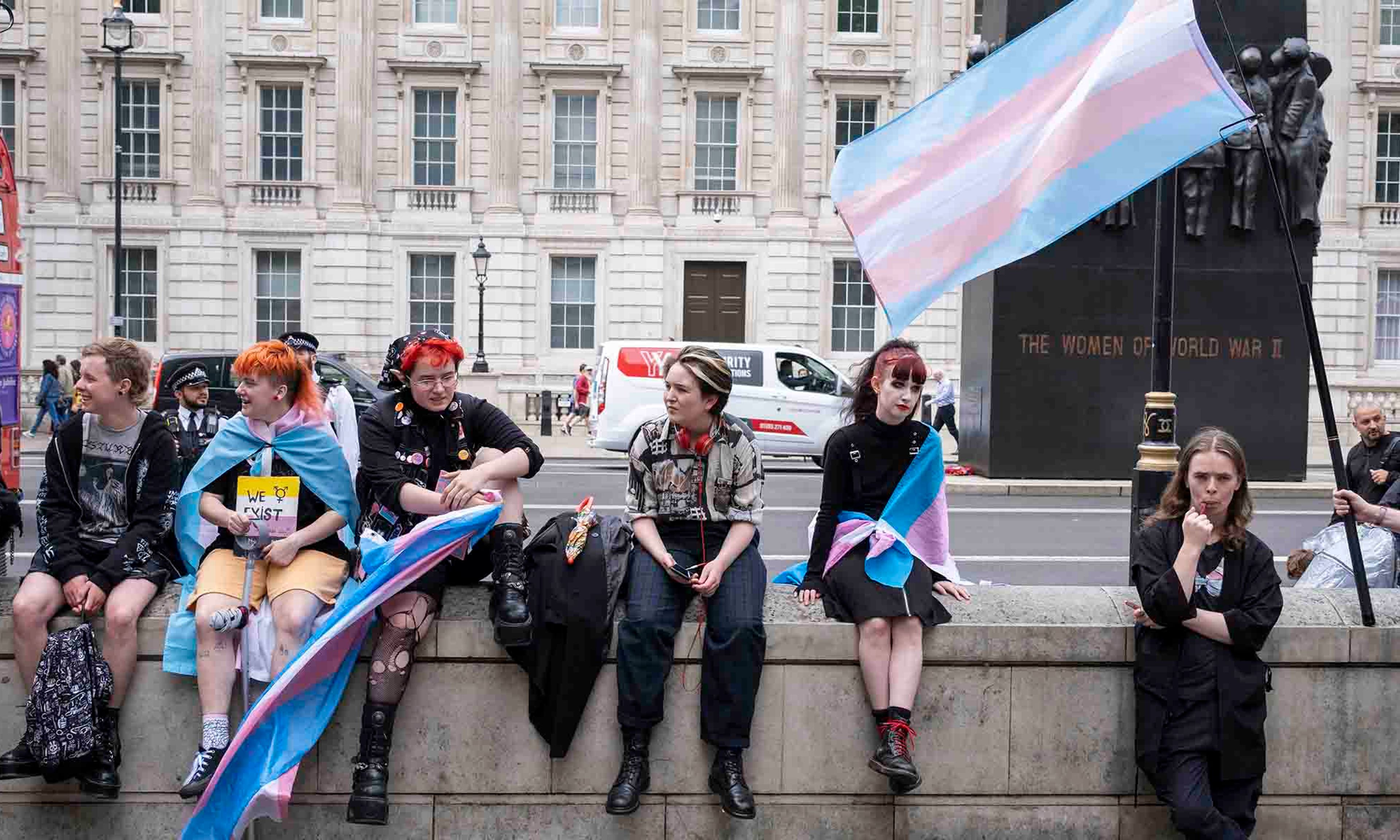
Transgenderism is the belief that every person has a “gender identity” (an inner sense of being male, female, something else, or in between) distinct from his or her sex and that, when the two conflict, gender identity should take precedence. It is perhaps surprising that this idea has caught on. And yet it has. According to Pew Research, over 5 percent of Americans under 30 identify as transgender or nonbinary, compared with 1.6 percent of the total adult population and just 0.3 percent of those over 50.
Both those alarmed and those pleased by this trend agree that the mainstreaming of transgenderism has encouraged more people to declare themselves trans. What is disputed is whether the trend has mainly encouraged the true transgender population to make itself known. Or has it mainly encouraged transgender identification among those who are not transgender (either because “true trans” does not exist or because it can be confused with underlying mental-health conditions)?
This distinction would not matter if the claims of transgender rights did not conflict so drastically with women’s sex-based rights, or if those identifying as transgender weren’t being treated with drugs and surgeries that render them infertile and risk lifelong sexual dysfunction. But they do and they are — so it does.
In 2018, Lisa Littman, then an assistant professor at Brown University, published a study in the science journal PLOS One that examined parental reports of “sudden or rapid onset of gender dysphoria, appearing for the first time during puberty or even after its completion.” This gender dysphoria was unlike those historically observed in children, which were very rare and affected mostly young boys. Moreover, symptoms appeared to occur after prolonged social-media and internet use and “in the context of belonging to a peer group where one, multiple, or even all of the friends have become gender dysphoric and transgender-identified during the same timeframe.”
Littman posited peer and social contagion, defined by the American Psychological Association as “the spread of behaviors, attitudes, and affect through crowds and other types of social aggregates from one member to another,” as one contributing factor in the rising number of gender-dysphoric youth. Much to her surprise, activists were incensed by the suggestion. Under pressure, PLOS One temporarily rescinded the paper, eventually reissuing it with a highly unusual “correction notice” that offered no correction. What it offered were “additional clarifications and context for the article in response to questions raised during the post-publication review of this work,” which mostly reiterated the limitations Littman had acknowledged in her original version, i.e., that her paper relied on parental (not patient) reports and that “additional research” was needed to further support her hypothesis. For years, liberal journalists and clinician activists searched for ways to discredit Littman’s theory. In August 2022, NBC News declared the case closed, citing a new study, published in Pediatrics, the flagship journal of the American Academy of Pediatrics, that allegedly proved that “‘social contagion’ is not driving an increasing number of adolescents to come out as transgender.”
On closer inspection, however, the study cited by NBC News proved nothing of the sort. Its lead author, Jack Turban, an assistant professor of psychiatry at the University of California, San Francisco and a transgender activist, had relied on faulty statistics. According to the CDC survey data that Turban examined, in 2017 and 2019 there were more male-to-female than female-to-male transitions. Since Littman had hypothesized that more (biological) females presented with gender dysphoria, Turban argued that Littman’s hypothesis could be dismissed. However, the CDC had not asked survey respondents whether they had been registered as male or female at birth. The questionnaire’s designer acknowledged this issue and underscored the “uncertainty as to whether transgender students responded to the sex question with their sex or gender identity.” Yet Turban et al. assumed that the survey participants had all responded with their sex. Moreover, they failed to address in any meaningful sense the other evidence suggestive of social contagion: that gender dysphoria appears in “clusters” disproportionate to the national average, and that there are increasingly visible numbers of “detransitioners,” or individuals who end up abandoning their transgender identity after having transitioned.
In less politicized contexts, researchers are more willing to entertain the possibility of social contagion. During the pandemic, unprecedented numbers of teenage girls worldwide began presenting tic-like disorders. The doctors treating them were taken aback. Like gender dysphoria, tic-like disorders had always been more common among young males. And, as with gender dysphoria, the girls that the clinicians were seeing had experienced a sudden onset of symptoms despite having no prior history of such disorders. Researchers found that this phenomenon was a “mass psychogenic illness,” a social contagion, linked to TikTok. Young females are more sensitive to peer influence, especially regarding body image, and as much as three times as likely as their male counterparts to suffer from anorexia, bulimia, and self-injury.
Over a ten-year period, Britain’s gender-identity youth clinic saw a 4,400 percent increase in referrals for gender-distressed adolescent females seeking medical transition, compared with a 1,000 percent increase among males. Before 2011, gender-dysphoric boys outnumbered girls two to one. Today, gender-dysphoric girls outnumber boys three to one. If the rise in transgender identification were the result only of society’s becoming more tolerant, we would expect to see similar increases in transgender identification across generations and between the two sexes. But that’s not what has happened.
There are regional disparities, too. In May 2022, in an opening monologue for his television show, Bill Maher observed that the proportion of Americans who identify as LGBTQ has roughly doubled in each generation. “If this spike in trans children is all biological, why is it regional?” he asked. “Either Ohio is shaming them, or California is creating them.” California’s rate of transgender identification among young people is nearly 38 percent higher than the national average: Nearly 2 percent of those aged between 13 and 17 identify as transgender. There are striking disparities even within the state. For instance, 6 percent of young people in the Davis Joint Unified School District identify as transgender, which is nearly 4.3 percentage points higher than the national average and three times California’s average.
Some transgender activists have argued that the current increase in transgender identity is like the increase of left-handedness observed in the mid 20th century. Once children were no longer punished for being left-handed — as they had been for roughly 250 years, partly because it limited their ability to work after the Industrial Revolution — left-handedness gradually became more common. Yet its rate of occurrence was roughly the same in 1760 and in 1960, before and after left-handedness had been suppressed, whereas only a tiny minority of children struggled with gender dysphoria before 2010.
Four years after her bombshell PLOS One study, Littman published a survey of 100 “individuals treated for gender dysphoria with medical and/or surgical transition who subsequently detransitioned.” She found that 55 percent of respondents felt that they did not receive “an adequate evaluation from a doctor or mental health professional before starting transition.” Detransitioners often speak of a myriad of factors behind their initial desire to transition, among which is peer influence.
One American detransitioner, 24-year-old Helena Kerschner, who began identifying as transgender while still in school and began medical transition at 18, says she “turned to the Internet” after experiencing social isolation. “I never thought about my gender or had a problem with being a girl before going on Tumblr,” she said. Another American detransitioner, Chloe Cole, began transitioning when she was 12 years old, went on puberty blockers and testosterone by 13, and had her breasts removed at 15. All of which she had come to regret by age 16. Similarly to Kerschner, she says that “social media introduced this idea that I could be a boy.”
Before transgenderism (previously known as “transsexualism”) was common, the thinking was that, because of the grueling nature of “sex change” drugs and surgery, only someone completely convinced of his need to transition would be willing to incur the difficulties. But nowadays, in a culture that prizes victimhood and in which transgenderism can boost one’s social status, transgender identity can seem to an unpopular young person to lead to an easier life. The medical downsides, meanwhile — loss of fertility and sexual function — are not fully comprehensible to adolescents, known for their impulsivity and disregard for the long term.
Many apply a double standard when it comes to teenage psychology. In an article about children and tattoos, Cora Breuner, a pediatrician at Seattle Children’s Hospital and a professor at the University of Washington, told the New York Times that tattoos are “a permanent mark or a symbol you are putting on your body,” and said, “I don’t think kids under 18 have that kind of agency to make a decision.” Yet in an article about gender transitions for minors, also for the Times, the same Dr. Breuner endorsed transition procedures. Similarly, the Scottish government recently introduced a law that would allow people as young as 16 to change their legal gender in a matter of months, with no need for a medical diagnosis of gender dysphoria. Meanwhile, the Scottish Sentencing Council advises judges to keep in mind, when sentencing offenders under age 25, that “research shows that young people . . . are generally less able to exercise good judgement when making decisions [and] are more vulnerable to negative influences such as peer pressure and exploitative relationships.”
Because there is no objective diagnosis or evidence for transgenderism, activists must rely on self-identification alone. But if self-identification by children and adolescents can be demonstrated to be unreliable, the gender-affirming model, which proposes permanent medical and surgical interventions for what may be only temporary psychological problems, becomes unjustifiable for underage patients.
This is the concern that prompted Sweden’s National Board of Health and Welfare to update its recommendations for the treatment of children with gender dysphoria. The health board concluded that because of the “continued lack of reliable scientific evidence,” “the uncertainty that follows from the yet unexplained increase in the number of care seekers, an increase particularly large among adolescents registered as females at birth,” and the “new knowledge that detransition occurs among young adults,” “the risks of puberty suppressing treatment and gender-affirming hormonal treatment currently outweigh the possible benefits” and should be used only in “exceptional cases.”
Similarly, the British government commissioned a leading pediatrician, Hilary Cass, to conduct an independent review of the National Health Service’s gender-identity youth clinic, which resulted in the clinic’s closure on safety grounds. Cass warned of the “lack of consensus and open discussion about the nature of gender dysphoria and therefore about the appropriate clinical response.” Tellingly, she referred to the patients in question as “gender-distressed and gender-questioning children,” and not as “trans children.” Writing in the British Medical Journal, one British physician applauded Cass’s report, noting “the apparent element of social contagion in teenage girl peer groups.”
In the wake of mounting clinical concern coming from Europe, some activist clinicians in America have tried to stake out a moderate position in the debate. In 2021, two prominent gender-affirming clinicians, Erica Anderson and Laura Edwards-Leeper, wrote an article in the Washington Post complaining about “sloppy” care. They explicitly mentioned the potential contributing factors of “social media, Internet and peer influences,” as well as “social/peer relationships.” Marci Bowers, a prominent gender-affirming surgeon, has made similar concessions. Most recently, Bowers told the New York Times’ Michelle Goldberg that “there are people in my community who will deny that there’s any sort of ‘social contagion’ — I shouldn’t say social contagion, but at least peer influence on some of these decisions. I think that’s just not recognizing human behavior.”
Does transgenderism — arising spontaneously within the individual — reflect reality (i.e., we are what we “feel” we are and “gender identity” trumps sex)? Or does transgenderism — subject to external influence — merely attempt to resolve underlying psychological conditions by suppressing reality? If it is the latter, then there is no justification for expecting women to accommodate in their sports, services, and spaces males who identify as females, nor is there any justification for the broad application of gender-affirming treatment for gender-distressed youth.
In the early days of treating gender-distressed patients, clinicians knew that their patients were not, in any real sense, of the sex with which they identified. They were concerned primarily with whether greater resemblance to the patient’s preferred sex — achieved at a huge physical cost — would help ease the patient’s dysphoria. In 2019, Ray Blanchard, an American-Canadian sexologist who has treated transsexuals for decades, told National Review that he rejected the notion that everyone has a “gender identity.” He finds the concept of gender identity useful only in the context of “cross-gender identity,” which he defines not as “a normal ‘gender identity’ which has found itself lodged in the wrong body,” but as “a constant preoccupation with, and unhappiness about, the individual’s gender.”
In other words, to some experts in the field of gender dysphoria, there is no such thing as “true trans.” There are simply those for whom the psychological benefit from transition outweighs the physical cost, and those for whom it does not. Since such outcomes cannot be predicted, treatment poses a significant risk to the patient. From decades of research, we know that if they do not transition, over 80 percent of children with gender dysphoria grow out of it by the end of adolescence. And we know that adolescents are much more susceptible to peer influence and much more likely to make poor or impulsive decisions.
The social-contagion hypothesis has invoked the ire of many activists because it undermines a central claim of transgender ideology, renders its policy agenda unjustifiable, and casts a long shadow of doubt over so-called gender-affirming care. In Europe, the legitimacy of the social-contagion hypothesis has already been accepted. America is catching up.












Comments