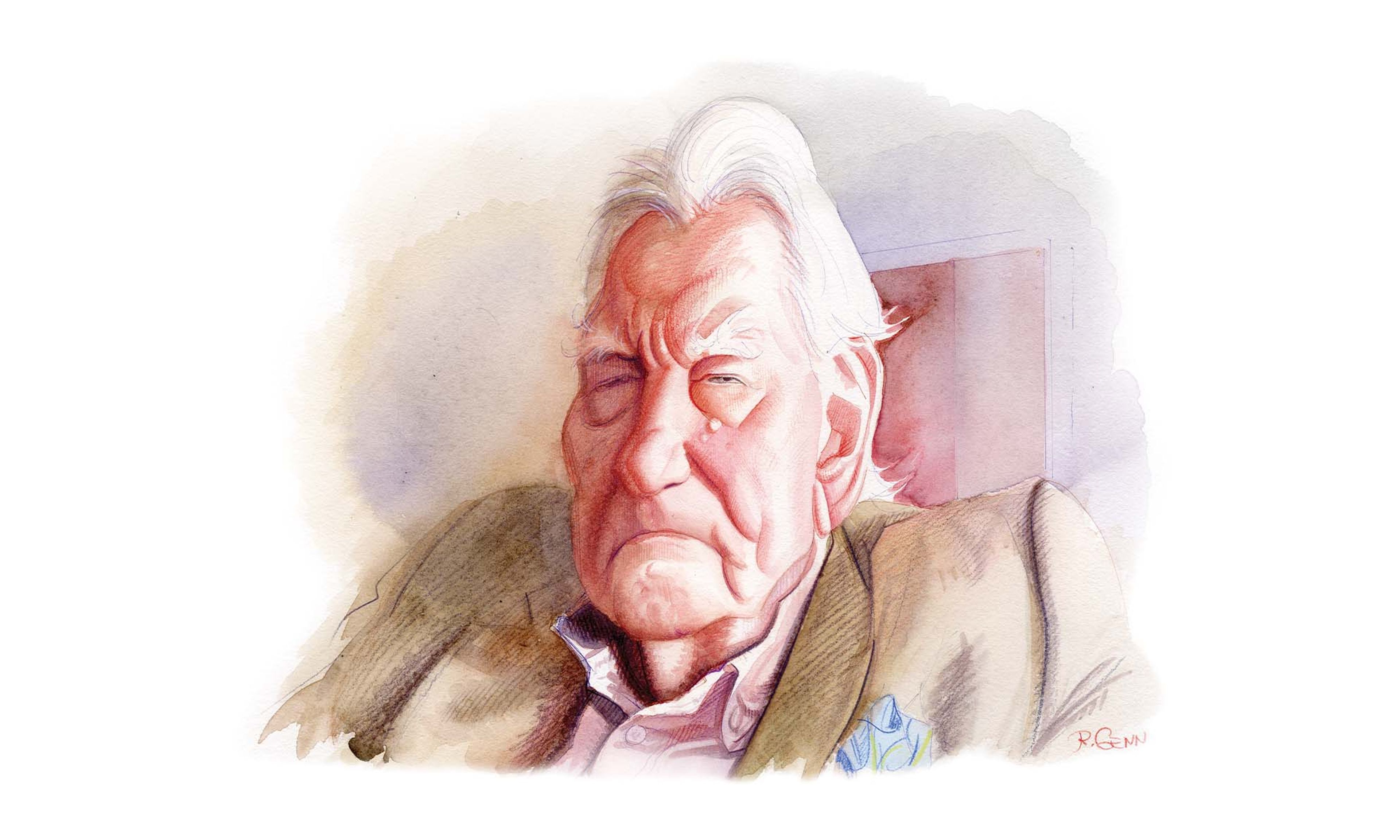
If he had written only histories, he ought to be known as a great historian. If he had written only biographies, he ought to be known as a great biographer. If he had written only essays and columns — you get the picture.
His bibliography tells me that he wrote two novels, in 1959 and 1964. I can’t imagine they are bad.
In his biography of Mozart, he writes that the composer “had the great gift of being able to start as soon as he sat down to write, as well as terrific powers of concentration.” He further writes that Mozart’s life was “crammed with creation.”
Am I comparing the author, Paul Johnson, to Mozart? No. Yes. Kind of. For years, David Pryce-Jones and I said to each other, “Paul is a kind of genius.” We eventually dropped the “kind of.” In his ability to absorb vast amounts of information, and analyze it keenly, and write about it with sweeping and felicitous style, Johnson was . . . a rare one.
Often, he has been compared not to Mozart but to another Johnson: Samuel. Each was protean. Each was universal and, at the same time, very English.
William F. Buckley Jr. wrote that Johnson was liable to be underrated, or taken for granted, because he was so routinely excellent. “His performances are unvaryingly (boringly?) extraordinary,” he wrote. WFB went on to say that Johnson had had “as productive a literary-analytical career as any in modern times.” And he said that in 1994, when Johnson had about 20 more writing years in him.
Like WFB, Johnson wrote 50-plus books and thousands of articles. Few subjects were off limits. He wrote big books and little books, Brucknerian symphonies and graceful gavottes.
One day at lunch, he asked me, out of the blue, “Which is the best of the Bruckner symphonies?” I said I thought No. 9, because, even though incomplete (the composer died before he could finish it), it embodies everything great about Bruckner. Johnson beamed at me and said, “I agree.” For a Johnsonian like me — that was pleasing.
You want a short piece? In the days since Paul Johnson passed away on January 12, at 94, I have reread some of the letters I’ve saved. In August 2007, he wrote, “I have decided that Brahms’s Intermezzo in B-flat minor, Op. 117, No. 2, is the finest short piece of piano music I know of.” Solid choice.
As a biographer, he could slip into the skin of people — he could understand them, whether he liked them or not. King Tut, Picasso, Elizabeth I, Elizabeth II, Dante, Napoleon, Jane Austen, Hitler, Mae West . . . he captured essential things about them.
In his late 70s and 80s, he wrote short biographies of, among others, Washington, Churchill, Socrates, Darwin, and Jesus. This last is dedicated, “To my mother, Anne Johnson, who first taught me about Jesus.”
He was born in 1928. His father, William, was the principal of an art school. At age ten, Paul decided that he would go to Magdalen College, Oxford, when the time came — and, lo, he did. His tutor was the historian A. J. P. Taylor. “He made people excited by history,” Johnson would later write. Also, he once heard Taylor say, “I always give good value” — whether for a book or an article or a public appearance or what have you. Johnson would go on to do the same.
In 1958, he married Marigold — Marigold Hunt, she was. Her father, Dr. Thomas Hunt, was a physician to Churchill, among other notables. Johnson cites him in his life of Churchill.
After reading the book, I said to Paul, “You say that Churchill worked in bed until noon, and so do I. That’s the only thing we have in common.” “He really worked, you know,” said Paul. “So do I!” I protested. (It was true, at the time.) (It’s not that I don’t work anymore. I just don’t do it in bed, till noon.)
As a young man, Johnson worked as a journalist in Paris. One day, de Gaulle conducted a press conference in which he promoted his vision of Europe: “l’Europe des patries” (“the Europe of the fatherlands”). He said he wanted “l’Europe de Dante, de Goethe, et de Chateaubriand.” The young Englishman — redheaded — piped up, “Et de Shakespeare, mon général!” De Gaulle was taken aback. He then shrugged, Gallically, and said, “Oui, et de Shakespeare aussi.”
In those days, Johnson was associated with the Left. He was the editor of the New Statesman from 1965 to 1970. He was later associated with the Right. He wrote a column for the Spectator for almost 30 years (1981 to 2009). But he was always his own man: a champion of freedom, a foe of tyranny, a defender of high culture.
Not that he didn’t write about “low” or “common” things. I once read a column by him about doing the dishes — or “washing up,” as he put it, Britishly. He loved that activity. I loved the column.
Young people often said to him, “I want to be a writer.” He would reply, “Well and good. But the work is not for everyone. You have to spend a lot of time alone. Because books and articles don’t write themselves, you know: You do.” Johnson loved his work. “After a hard day’s writing,” he said, “you should be grinning with relish.”
The book for which he is best known is Modern Times. I read it in its first edition: A History of the Modern World from 1917 to the 1980s. It was published in 1983, when I was a freshman in college. It left a stamp on me — and many, many others. The book struck me as simply . . . true.
I will tell you a couple of stories about Modern Times. I know a husband and wife who, before they were married, read it out loud together. They thought that this was an important exercise, as well as an enjoyable one. Some years ago, a young friend of mine told me that he was required to read the book before beginning an internship at the Wall Street Journal. A smart requirement.
In 1976, Johnson published A History of Christianity. About ten years later, he published A History of the Jews. I have not read the first book. (I like the idea that many Johnson books still await me.) I read the second, and I can tell you that it is a masterpiece. Speaking personally, it caused something like a revolution in my understanding of many things.
Paul Johnson, by the way, was one of the greatest philosemites in Christendom.
In 2013, I was at dinner with some friends in New York and said I was about to go to London. The reason: to participate in an event involving Paul Johnson. A friend said, “You mean the Paul Johnson who wrote the history of the Jews?” “One and the same,” I said. “A great book,” replied my friend.
Let me mention that this friend is not on the right, at all. I mention it because the obit in the New York Times was headed, “Paul Johnson, Prolific Historian Prized by Conservatives, Dies at 94.” He is prized by conservatives. And others.
How he loved America, this Englishman did. In 1997, he came out with his History of the American People. Another great book. Critics said it got details wrong, and they were right: This one was a House member, not a senator, and he came from this state, not that one. But on everything big, everything overarching, everything ultimately important? Great.
“The Atlantic Ocean is more narrow than the English Channel,” Johnson would say. He felt closer to America than to Europe. I also heard him say, several times, “The day I start worrying about America is the day that people from all over the world cease wanting to go there, to become Americans.” George W. Bush has his own version of this: “The lines to get into America are long.”
Bush, incidentally, bestowed the Presidential Medal of Freedom upon Johnson in 2006.
In his later years, he wrote such books as Creators, Heroes, and Humorists. He had a special appreciation of humorists. It is so important to let the world laugh, he said. In his biography of Mozart, he writes,
One of the most endearing things about Mozart is that he saw music and laughter as inseparable. Nobody took music more seriously. Nobody got more jokes out of it. He had a wonderful gift of timing . . .
He planned to write a book called “Monsters,” about really bad guys. He had a number of candidates in mind. When the book kept not appearing, I asked him, “Where is it?” He said he had decided not to write it. At this stage of his life, he said, he wanted to spend his time on more-pleasant subjects.
We counted it a privilege to publish him at National Review. He was a treat to edit. Johnson was the last person I ever knew — or the only one? — to refer to the country in the Middle East as “the Lebanon.” He was a treat to talk to, too.
“Tell me about Princess Diana.” He did. He had tutored her, in history, and royal history in particular. He said that she described herself as “thick as two planks.” But she wasn’t. She was very clever. Also, said Paul, she had beautiful handwriting. And she was extraordinarily “intuitive.” She could read a person instantly, and bond with that person.
His father’s son — the son of an art-school principal — Paul was a painter. One of his big, big books is Art: A New History (2003). Paul recommended painting as a cure for depression. Or as a relief from depression. And it had to be watercolor. Why? Because you have to concentrate totally on what you’re doing. You can think of nothing else. Otherwise, the paint runs.
He once took me out into his studio, or cottage, in the backyard — to pick out a painting of his from a bursting portfolio. I went home with Listening to Schumann, an abstract opus. It has a hint of a treble clef in it. It hangs in my kitchen.
Vikram Seth, the Anglo-Indian novelist, once wrote, “Music is dearer to me than speech.” I think the same was true of Bill Buckley, and it was possibly true of Paul Johnson.
Let me quote him on Mozart again:
He had misfortunes and many disappointments in a life of constant hard work lived at the highest possible level of creative concentration. But his warm spirit always bubbled. He loved his God, his family, his friends, and above all, his work — which he equated with God-service — and that was all a reasonable man, or an unreasonable one, for that matter, could wish for.
There is a lot that is applicable to Johnson in that. Was he a saint? No. But what good he spread.
“He was an adornment to society.” “He added to the gaiety of life.” Johnson would use those phrases about the recently departed. He was an adornment, sure, and he added to the gaiety, sure — but he was also a great teacher, through his writings, and he means a lot to many of us, his readers.
Thinking about him, I can hear his voice over the phone — across the Atlantic: “Happy Christmas!” “Give Bill Buckley my love!” “God bless you.”
In 2012, he appeared on Desert Island Discs, the BBC Radio show. The guest, or “castaway,” names eight tracks that he would take with him to a desert island. The first piece of music that Johnson named was Ave verum corpus, that sublime motet of Mozart — a prayer. His final selection was an American popular song, from 1919 (by Kern & DeSylva). He said it sums up his “view of life.”
Look for the silver lining
Whene’er a cloud appears in the blue.
Remember, somewhere the sun is shining,
And so the right thing to do is make it shine for you.
A heart full of joy and gladness
Can always banish sadness and strife.
So always look for the silver lining
And try to find the sunny side of life.












Comments