For the modern viewer of the paintings of the American artist John Singer Sargent, the question is simple: Do we trust the art experts, or our lying eyes? So I wondered when I recently found myself rereading the collected works of novelist Louis Auchincloss, who shared with Sargent a lifelong interest in the modern aristocracy — and several of whose books featured on their dust jackets portraits by Sargent.
The cover of Auchincloss’s 2004 novel East Side Story features Sargent’s 1893 oil painting of Elizabeth Winthrop Chanler, a young woman of considerable means and incomparable connections in New York upper-class circles: A member of the “Four Hundred,” a list of the most significant families at the time of the Gilded Age, she was, on her mother’s side, related to John Jacob Astor.
Sargent’s portrait of Chanler captures her exquisite beauty — her dark hair, deep eyes, firm expression — as well as the serenity of her station in life: Seated on a sofa, she is shown ever so slightly leaning on two heaping pillows to her right; her hands, their fingers interlocked, rest on the uppermost pillow. The portrait was the ideal tone-setter for one of Auchincloss’s novels about the well-to-do.
Alas, curious about the painting and its background, I made the mistake of visiting the website of the Smithsonian American Art Museum (to which the work was given by Chanler’s son). There I encountered a brief description that distorted the meaning of this most graceful rendering. Beneath Elizabeth’s seemingly contented face, we are told, “the lower half is full of tension.” “Her arms, leg-of-mutton sleeves, and the pillows seem to wrestle with one another. Only her clasped fingers and elbows keep everything under control.” Never has so much been made of interlaced fingers resting on a pillow. But there’s a serious point to be taken from all this overthinking: In the eyes of modern art experts, a portrait of a well-brought-up young lady cannot simply be that.
Such is the curse of John Singer Sargent (1856–1925), whose well-earned reputation as the painter-in-chief of the upper classes renders him of little to no interest to the cognoscenti. Those who wish to resuscitate him must argue, then, that there is something more to his portraits of such aristocrats as Lady Agnew of Lochnaw, Isabella Stewart Gardner, or the Duke of Marlborough and his wife (the former Consuelo Vanderbilt) and family — people like that — as though it were not a perfectly commendable aim, in and of itself, to capture the elegance, grace, and propriety of members of this now-vanished class.
Regrettably, a new biography of Sargent suffers from this art-expert prejudice against the rich, the well-off, and the normal. Paul Fisher, an American-studies professor at Wellesley College, can barely describe Sargent’s signature portraits without invoking purported hidden meanings and secret intentions and indulging in the sort of word salad that would have been incomprehensible to most readers even a decade or so ago: “nonnormative complexities of gender and sexuality,” “society’s rigid if troubled binary definitions of men and women,” and the “violation of gendered rules.” I might have stopped reading the book altogether if Fisher had started going into pronouns.
It’s not that Sargent shouldn’t be examined in all of his complexities and ambiguities: A bachelor-for-life, he was thought by some contemporaries to be gay, and Fisher credibly demonstrates both his lifelong interest in the male form and the close bonds he formed with a number of men in his life, including Nicola d’Inverno, a male model whose duties for the artist later came to include serving as a kind of all-around manservant. Of course, Fisher is left to speculate about much of this — the book includes countless statements in the form of questions on the order of “If this arrangement sheltered a romantic or erotic involvement, why didn’t d’Inverno spill his inside knowledge?” — but that’s fair game for a biographer who knows his subject well (as Fisher clearly does).
The trouble lies in Fisher’s analyzing of straightforward society portraits through the lens of contemporary woke psychosexual babble. If Sargent the artist (Sargent the man being a different subject) were merely the “old-fashioned, high-cultural painter” he was thought to be by art watchers several generations ago, presumably Fisher would have been less interested in writing a biography of him. Instead, by Fisher’s reckoning, Sargent’s relevance springs from “his same-sex interests and his fascination with gender nonconformity,” as well as from his “engagement with ethnicity, race, and emerging globalism” and “his representation of an ever-more-complex modernity and an ever-more-diverse and multicultural world.”
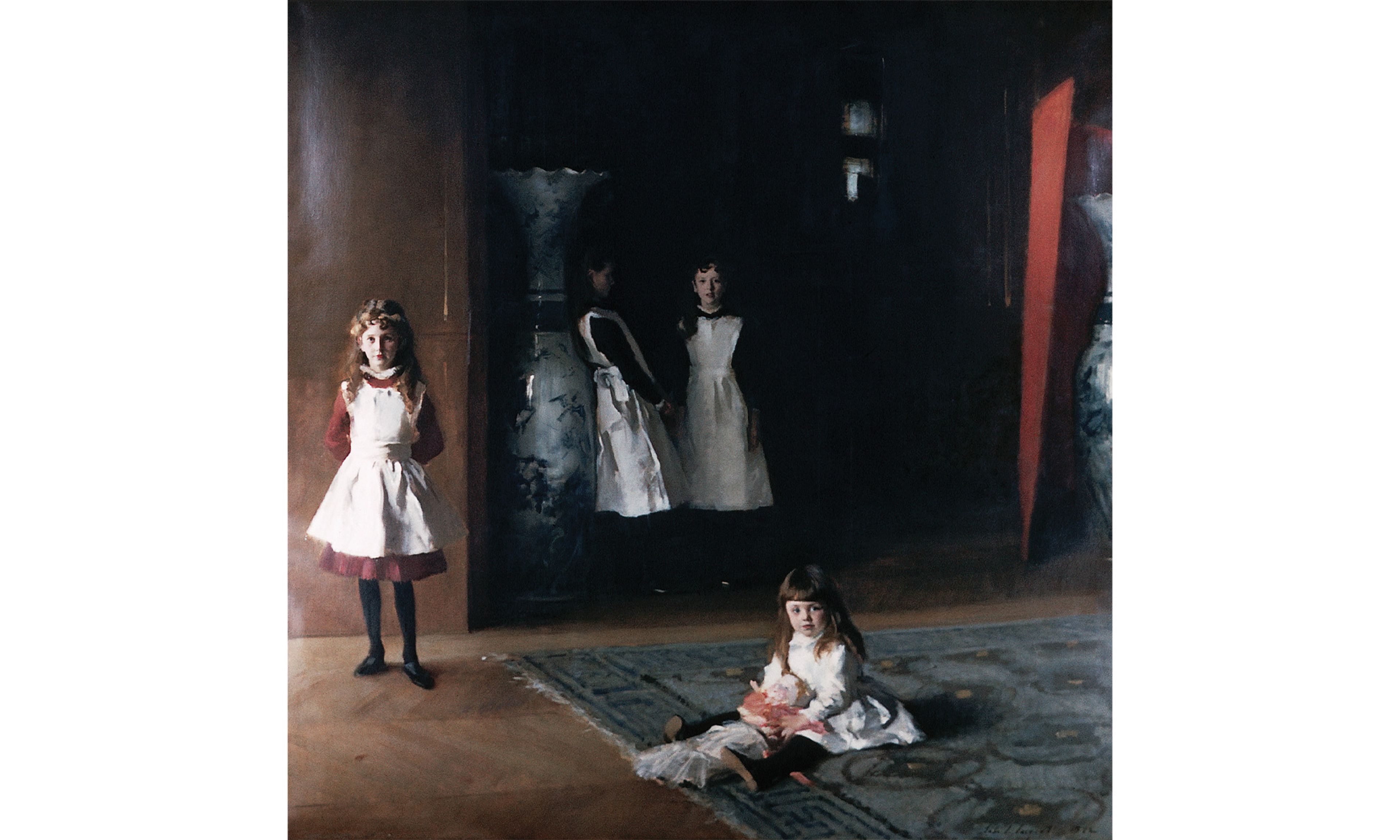
Put plainly, this means that Fisher offers often curious, sometimes bizarre, almost always counterintuitive interpretations of paintings that tend to resist such readings. Take The Daughters of Edward Darley Boit, which shows a quartet of young sisters positioned here and there throughout a beautiful living space: One is plunked down on a rug with a doll, two others stand in the distance beside an enormous vase, and a fourth stands alone with her arms primly behind her back. Somehow, Fisher finds in this portrait “the paradoxes of childhood and young womanhood.” He further notes that, while Sargent “liked the Boits and understood their milieu, his rendition also gave away the secrets of the Boits and their class.” Well, to adopt Fisher’s fondness for the rhetorical question — what paradoxes? What secrets? Not that they didn’t have them, but are they so apparent in Sargent’s painting?
Similarly, it would take a viewer keener-eyed than most to discern the apparent malevolence that is said to emanate from Sargent’s portrait of Theodore Roosevelt; even if the 26th president’s brawn and bluster were unappealing to Sargent, as is claimed here, there’s little indication that the artist’s personal views seeped into his commission. Indeed, a close examination of the portrait shows qualities TR presumably would have wanted to come through — his eyes are narrow and focused, his mien suggests someone champing at the bit for a fight, and his right hand is as large as the staircase finial it rests on.
Even when Fisher accurately describes the controversies that surrounded various Sargent paintings during his lifetime, he tends to overstate their taboo-breaking qualities. For example, the original iteration of Madame X was indeed scandalous for daring to show its subject, Madame Gautreau, with a strap of her gown having slipped from her shoulder. Fisher rightly notes that this detail highlighted her “illicit sexuality,” but it’s a bridge too far to say that the work “forced Parisians to confront the deep-dyed decadence in their midst that many preferred not to see or acknowledge.”
Self-portraits by Sargent are deemed insufficiently revealing of his inner psychology: “In all three of his self-portraits, Sargent suited himself up in his Savile Row coat and styled himself in a rather boring and conventional three-quarters view.” Yet here is a key point that eludes Fisher: In Sargent’s day, one could lead a private life full of contradictions, such as Sargent’s obviously complicated sexuality, while still maintaining a patina of respectability — as did the subjects of countless Sargent portraits. That Sargent gave up painting portraits late in his life — “I abhor and abjure them and hope never to do another especially of the Upper Classes,” he wrote contemptuously — ironically undercuts Fisher’s theme. If the portraits were so imbued with the sort of hidden meanings imagined by Fisher, why did Sargent forsake them so willingly after he made his fortune? Perhaps an upper-class portrait is merely an upper-class portrait?
From time to time, Fisher seems to realize that he is on shaky ground, so he falls into the habit of making big claims followed by endless qualifications. We are told that young Sargent — who, as the son of a globe-trotting physician and his art-besotted, independent-income-sustained wife, benefited from a sophisticated, cultured childhood on the Continent — was taken with sketching statuary of male nudes, but Fisher is quick to point out, correctly, that “the sketching and copying of classical statuary ‘after the antique’ furnished an important part of nineteenth-century art-academy training.” Equally ambiguous are the countless sketches of male nudes rendered by a mature Sargent, especially those of an African-American model named Thomas McKeller. Perhaps these works, kept from the public during Sargent’s lifetime, are reflections of the artist’s personal desire, as is strongly implied throughout the book, but as Fisher notes at one point, “male nudes were a long-running feature of Western art, deemed to embody the dispassionate or idealized beauty of the beau idéal.” When is a male nude just a male nude?
Sargent almost surely would have been baffled by Fisher’s interpretations of his work. After all, even in his own day, Sargent was manifestly a conservative: By Fisher’s account, he was ignorant of the avant-garde, dismissive of Van Gogh and Picasso, and, as he put it in a letter that ran in the Nation, “absolutely skeptical” of the idea that Postimpressionist works had “any claim whatever to being works of art.”
Fisher rightly notes that, among the wealthy class he served, Sargent adopted an admirably egalitarian approach to his portraits. Sargent is to be praised for commemorating on canvas figures who pushed social boundaries, such as Madame Gautreau, and those who might be subject to societal prejudice, such as the many Jewish subjects he painted. “In Sargent’s grand-manner pieces, the retrospective props and references to Old Masters helped him construct grandiose portraits, each executed with a ration of his painterly virtuosity, that helped authenticate and credential rank arrivistes,” Fisher writes.
Sargent conferred dignity and pomp on the well-to-do and aspiring well-to-do — a more admirable legacy, and a simpler one, than is contemplated by this pompous, turgid biography.












Comments