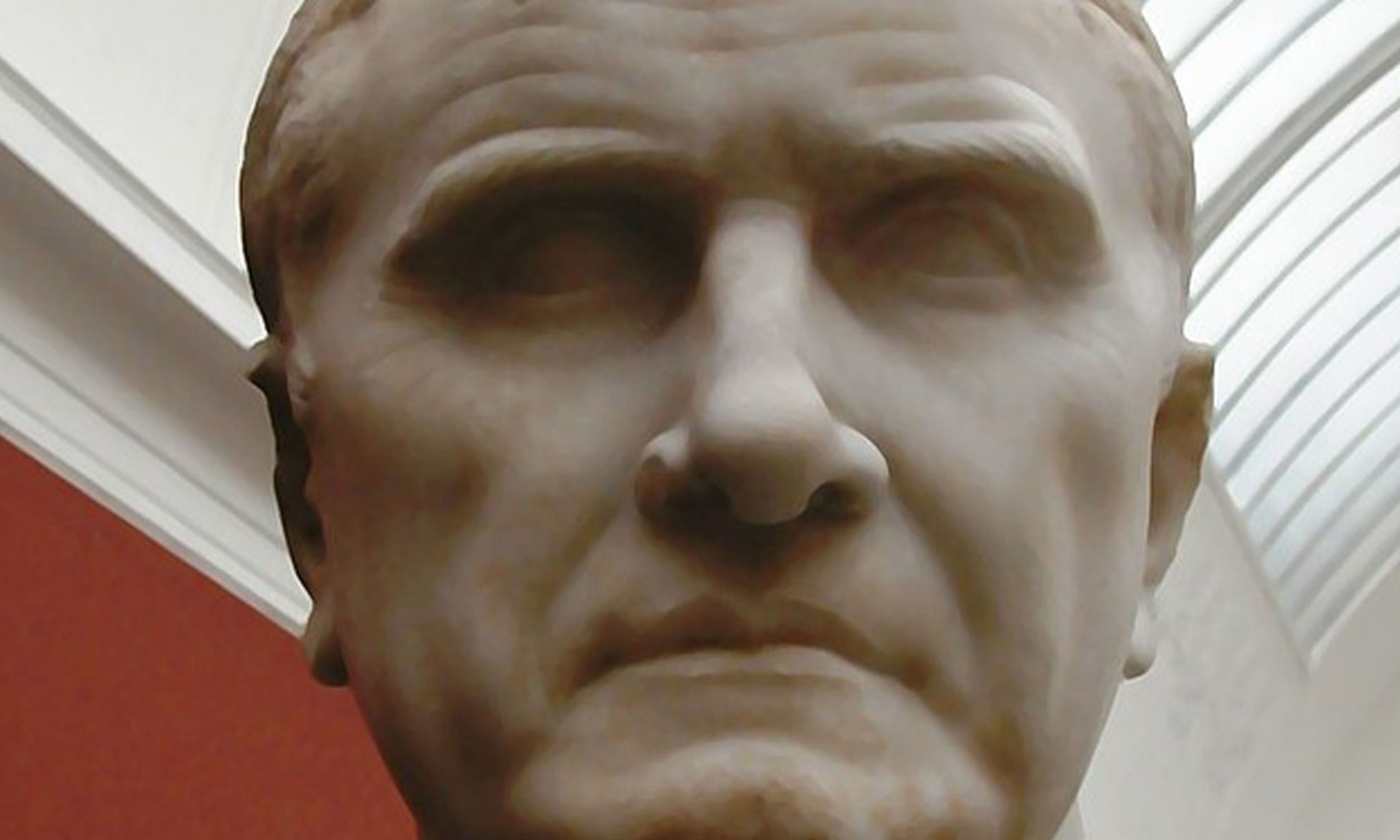
Marcus Licinius Crassus (c. 115–53 b.c.e.), the least famous if not the least significant member of Rome’s first triumvirate, is known chiefly for his avarice. Unlike the other two members, Pompey Magnus and Julius Caesar, Crassus had no great military victories on his résumé. In 73 b.c.e., true enough, he put down the slave revolt led by the Thracian gladiator Spartacus, but this was diminished by Pompey’s furnishing the mopping-up action of the revolt and taking credit for ending it, thus depriving Crassus of a possible triumph through the streets of Rome for his victory.
The war against Spartacus demonstrated that Crassus, like most Romans of the day, had no objection to brutality. When at first the war was not going well, he punished his own men by invoking decimation; that is, he picked out 500 men, divided them into tens, and had one of every ten murdered before his fellow soldiers. When he defeated Spartacus, Crassus set up crucifixes every 30 yards on the Appian Way between Capua and Rome on which he nailed roughly 6,000 of the conquered enemy. Not a man of overly delicate sensibility, Crassus.
Much of what we know about Crassus has come to us through Plutarch (c. 46–119 c.e.), who himself wrote more than a century after Crassus’s death. For Plutarch, Crassus was chiefly interested in acquiring wealth and political influence. Plutarch reports that he was brilliant at flattery yet “no man lay more open to it, or swallowed it more greedily himself.” Nor, according to Plutarch, was Crassus steady in friendship: “Being neither a trusty friend nor an implacable enemy, [he] easily abandoned both his attachments and his animosities, and the same men had him both as their supporter and as their opponent.” Crassus was said to be a gifted orator and well read in both history and philosophy. But it was by his greed that he was best known, and this, according to Plutarch, “tarnished all the luster of his [other] actions.” In short, the old boy was very much in business for himself.
If Crassus felt aggrieved by Pompey, who had been allowed a triumph before he was old enough (35) to be a senator, Pompey worried about Julius Caesar, who was 13 years younger than he and clearly the coming man in Roman public life. Crassus saw an opportunity to smother all this bad feeling, and did so by helping to lay the foundation for the first triumvirate. Shaky enough from within, from without this alliance presaged the end of the Roman Republic, for it turned first into a dictatorship under Caesar, and not long after into an empire under Caesar’s adopted son Octavian, later known as Augustus.
A three-man partnership is likely to be more stable than the traditional partnership of two men. Among Crassus, Pompey, and Caesar, Crassus often played the role of mediator. Only after Crassus’s death did the rivalry between Caesar and Pompey come out into the open, ending with Caesar’s defeat of Pompey at the Battle of Pharsalus in central Greece (48 b.c.e.).
Crassus’s wealth has been estimated to have been around $13 billion in 2021 dollars. “People were wont to say that the many virtues of Crassus were darkened by the one vice of avarice,” wrote Plutarch, “and indeed he seemed to have no other but that; for it being predominant, obscured others to which he was inclined.” Cicero wrote that “if one were able, by the mere snapping of his fingers, to offer Marcus Crassus the power to get himself named as an heir [to a large inheritance], when he was not really an heir, he would, I warrant you, dance in the forum.”
Crassus acquired his money through real estate and the profitable manipulation of slaves. After the civil war between Sulla and Marius, he, Crassus, having fought on the successful side of Sulla, was able to attain many properties of those who had been proscribed by the victor. He also bought up many properties in Rome that were destroyed by fire. He deployed his slaves, some among whom were expert in architecture and construction, to rebuild these properties that he had acquired at bargain prices.
He had a large stock of slaves. Plutarch, again: “And though he had many silver mines, and much valuable land, and laborers to work in it, yet all this was nothing in comparison of his slaves.” He also rented out slaves as copyists, readers, and waiters and to perform other contract services.
Crassus’s death in his attack on Parthia, putting an end to the triumvirate, need not have occurred if he had not felt he required a substantial military victory to bolster his own prestige. Rome had not declared war on Parthia. Crassus, in a freelance effort to enhance his reputation as a military man, had. Avarice being a hard habit to break, he stopped off on his way to Parthia, which was in what is today’s northeast Iran, to strip the Jewish temple in Jerusalem of its treasure. Flavius Josephus reports that Crassus “took away all the rest of the gold belonging to the temple of Jerusalem, in order to furnish himself for his expedition against the Parthians.” He also took more slaves. We shall never know what became of this treasure and of these slaves because Crassus did not come out of that war alive.
He was in his sixties when he went off to conquer Parthia, and had not engaged in combat for some 15 years. He underrated the Parthians’ military prowess. Among other things, the Parthian troops had arrows of a strength that pierced even the strongest of Roman armor. The Parthian cavalry was able effectively to fire their bows and arrows even when riding off in retreat. Surenas, their general, was a brilliant strategist. Crassus took bad advice from his guides and counselors all along on the way to his defeat, a defeat resulting in his head and hands being detached and handed over to Orodes, the Parthian king. Before his death, Crassus had the additional sorrow of having handed to him atop a spear the head of his beloved son Publius. Crassus never lived to have a triumph of his own.
In his new study of Crassus, Peter Stothard recounts that one of Crassus’s soldiers, Paccianus, who resembled him, was dressed in drag, set upon a cart, and made to play Crassus for the triumph in Parthia of Surenas. A legend has it that before Crassus was beheaded, molten gold was poured down his throat. If true, this would be a fine instance of the punishment fitting the crime. Cassius Dio first reported this, but Plutarch, who loved an excellent anecdote, does not mention it, which leads one to believe it never happened. Stothard mentions that after Crassus’s death “some added that his open mouth, shriveled by desert air, had been filled with molten gold as testament to his lifetime of greed” but says no more. Stothard has given his book the subtitle “The First Tycoon.” An earlier book on Crassus by Robert Lerner (2020) carries the title “The Entrepreneurial Thinking of Marcus Crassus” and compares Crassus to J. P. Morgan, John D. Rockefeller, Cornelius Vanderbilt, Jay Gould, and others of the American “robber baron” generation. Lerner makes Crassus out to be a robber baron avant la lettre.
Stothard’s study makes no claims for originality but is instead a concise, smoothly written, often witty account of Crassus’s career, by a serious journalist. (Stothard has been editor of the London Times and, more recently, of the Times Literary Supplement.) He is especially good on the relations among the triumvirate. He also fills one in on Crassus’s education by a Greek follower of Aristotle, the moderation of his personal life, and Cicero’s low view of Crassus, writing: “Cicero remained politely skeptical of Crassus’s plans and wrote to a friend that Crassus had worn his general’s cloak with nothing like the dignity of the last Roman conqueror of so great an age that he could recall.” Stothard refers to Crassus as a “disrupter of old rules, fixer and puller of the puppet strings of power” and notes, rightly, that his career poses “both immediate and lasting questions about the intertwining of money, ambition, and power.”
In the late Roman Republic money was needed to attain high office. “The nature of money,” Stothard writes, “was in the taking more than in the making.” By this I take him to mean that under the late Roman Republic it was all right to inherit money, to acquire it through military spoils or even through corruption while serving in charge of captured provinces, but there was something a bit outré about actually earning it.
As Churchill claimed that “democracy is the worst form of government — except for all the others that have been tried,” so one might say the same for capitalism among all economic arrangements. But capitalists are rarely viewed as heroes. (Consider, in our day, the press’s treatment of Elon Musk.) For all that the robber barons contributed to the founding of universities, libraries, museums, and symphony orchestras, and this at a time when doing so did not provide tax relief, they are still thought robber barons, which is to say, thieves who acquired their fortunes through exploitation.
In Rome, where the notion of capitalism itself was novel, and where only service to the state was admired, capitalism was a touch, perhaps more than a touch, vulgar. So Crassus, whatever his other attainments, has gone down in history as less than a great man. This may well be true, but that doesn’t mean he wasn’t an extraordinary one.












Comments