We think of English spelling — or, rather, British spelling and American spelling — as being firmly fixed. But there’s more instability than you might think. The French loanword restaurateur seems to be gaining an n. (People don’t like irregularities such as spelling restaurant with an n and restaurateur without one.) The word chaperon gained a final e in the mid 20th century. (People think that a long vowel in a final syllable that ends with a consonant sound should have a final e: think of mop vs. mope.) And Americans keep wanting to write cancelled and labelled rather than what American dictionaries specify: canceled and labeled. (In American English, the final consonant on an inflected verb isn’t doubled if the final syllable is unaccented — though there is still controversy with kidnapped vs. kidnaped and worshipped vs. worshiped.)
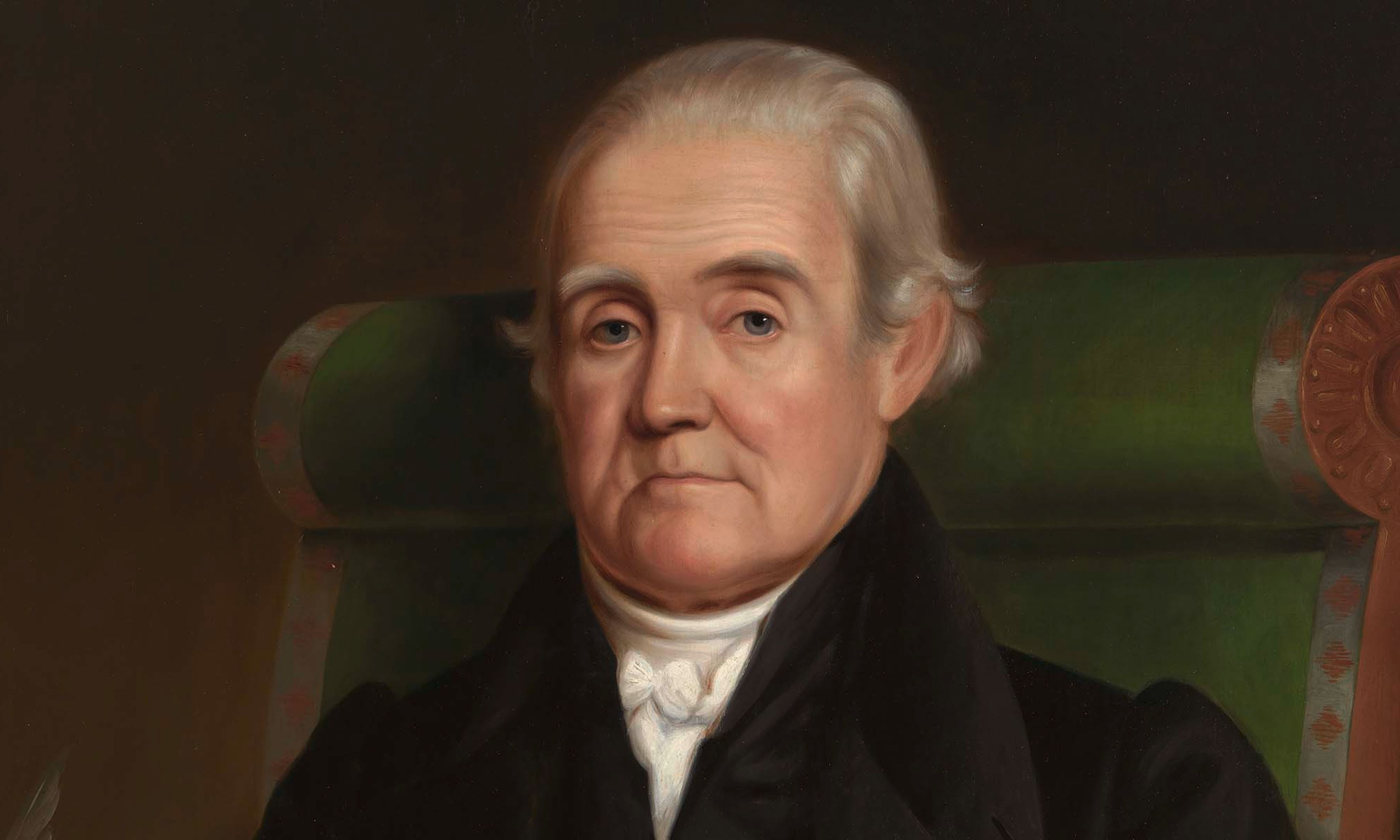
Noah Webster, “Father of the American Dictionary,” is credited with most of the differences between American spelling and British spelling. Sometimes called a “forgotten Founding Father,” Webster decided that Americans should declare linguistic as well as political independence from Britain. And so we write center (not centre), defense (not defence), labor (not labour), and program (not programme). There are hundreds of similar spelling dichotomies.
That basic account greatly oversimplifies historical facts. Webster was beleaguered with spelling difficulties his entire adult life and never did work it all out.
Webster’s first book was a so-called speller, published in 1783 as part I of his Grammatical Institute of the English Language. A word list, not a dictionary, it showed how to spell words and divide them into syllables. At that point, Webster followed the British mode of spelling reflected in the 1755 dictionary of Samuel Johnson. Still, like so many others before and since, Webster was troubled by the vagaries of English spelling: “How would a child or foreigner,” he asked in 1783, “learn the different sounds of o in these words, rove, move, dove?”
In 1787, the year of the Constitutional Convention, Webster reissued his book under the title “The American Spelling Book.” It contained many spelling reforms that we now recognize as distinctly American. So everything changed, but tens of thousands of copies of the 1783 version were still circulating and being reprinted by various printers to whom Webster had given a license.
Webster’s respellings came too late to enter the U.S. Constitution, which uses such spellings as behaviour, chuse, controul, encrease, and labour. By the time of the Twelfth Amendment of 1804, the archaic spelling chuse was altered (in that amendment but not in the main text) to choose.
Even in 1787, Webster hadn’t standardized his methods of spelling. Another big revision of his spelling book appeared in 1804, and in 1829 he revamped his spellings anew. All the while, though, publishers were issuing new printings (not editions) of different iterations of his spellers. Inconsistencies abounded across his works.
Meanwhile, Webster came out with two true dictionaries — an 1806 Compendious Dictionary and a big two-volume unabridged American Dictionary in 1828. In the first, he advocated spellings such as determin, melasses, and tung. By the time of the second, he suggested additional reforms including bronz, chimical, entransing, granit, etc. But by 1828, literally millions of his earlier books were in circulation — and they favored other spellings for those and similar words.
Only the publishers were getting rich from these sales. Webster had signed over publishing rights for paltry sums. Understandably, all the spelling clashes — not to mention the oddities — left the near-destitute Webster open to attack.
Webster’s chief rival here was Lyman Cobb, who in the 1820s put out a competing spelling book. Cobb was relentlessly feisty in promoting his books as superior to Webster’s. Beginning in 1827, he launched 17 attacks on Webster in various newspapers. In 1831, he issued A Critical Review of the Orthography of Dr. Webster’s Series of Books, a 56-page pamphlet that showed Webster’s many discrepancies through the years. For example, in 1806 and 1817, Webster recorded the proper spelling as bridegroom; in 1828, he recorded it as bridegoom, without the second r; and in 1831, two different Webster books collided by listing the word under the competing spellings. What were people to follow?
There were hundreds if not thousands of anomalies. To compound the problem, Webster’s dictionaries often recommended one spelling but then used another in his definitions of other words (for example, recording the headword as wagon but using waggon in various definitions).
Cobb was merciless in pointing out the disparities. Webster’s “mischievous influence of innovation,” Cobb said, had “done more to introduce irregularity in orthography than all of the other works published in this country within fifty years.” Although Cobb wanted to perpetuate such spellings as musick and publick, more often he was on the right side of linguistic history. If we take just Webster’s 1828 spellings, we see that Cobb, not Webster, usually ended up the victor in American English. Consider Webster’s holyday against Cobb’s holiday, Webster’s learnt against Cobb’s learned, and Webster’s turkies against Cobb’s turkeys. And Cobb was consistent throughout his writings.
In the last two decades of Webster’s life — he died in 1843 — the spellings in his books lay in plethoric disarray. He urged people to pay attention only to his latest pronouncements, but his critics urged looking at them all. Meanwhile, publishers to whom he had long before given licenses were continuing to issue what he considered superseded volumes. He called this “a most infamous trespass” on his reputation.
How could that reputation be revived? Stay tuned for part II.











Comments