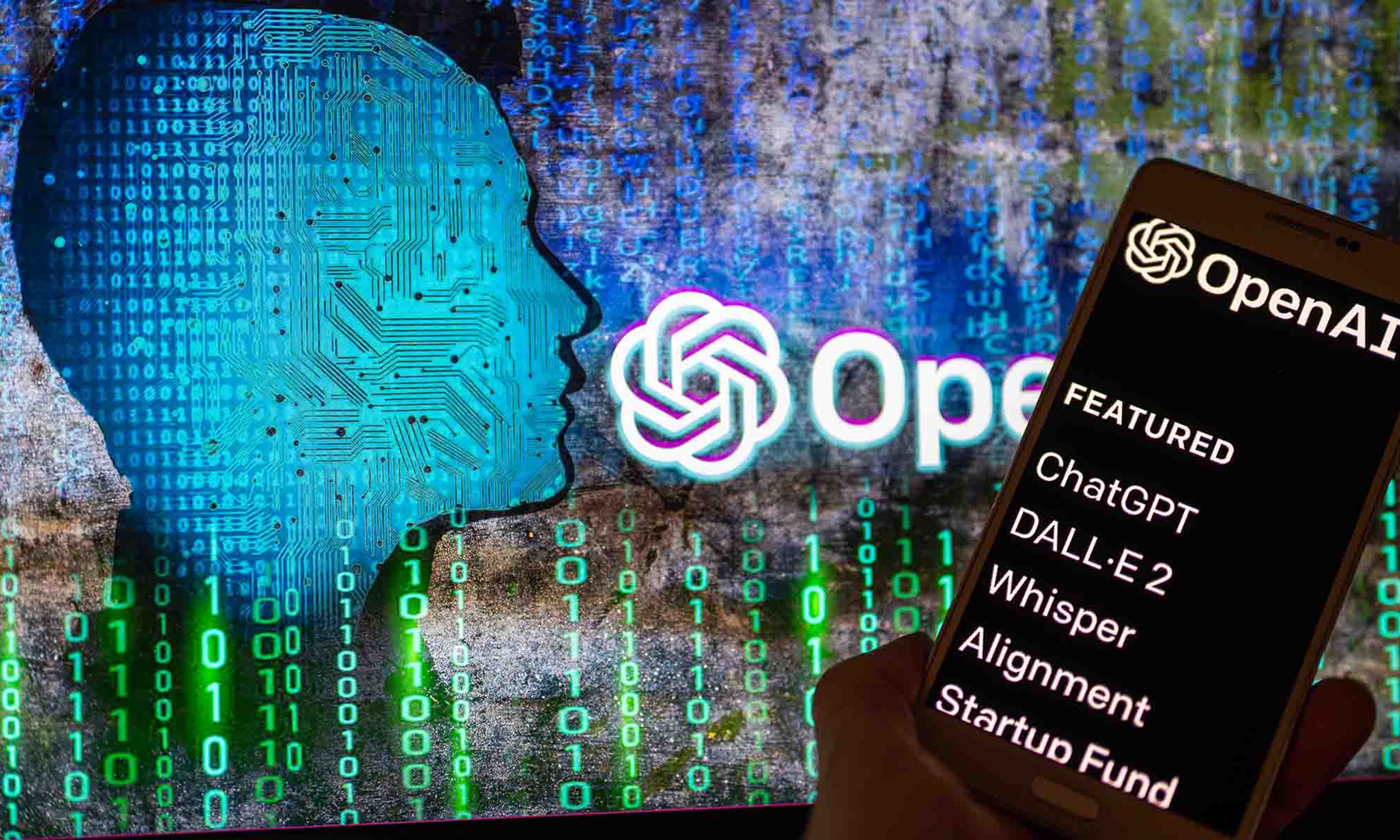
If you, too, are picky of pastime, old of fashion, and furrowed of forehead, then you understand that my spending the morning before Christmas “conversing” with an algorithm wasn’t exactly voluntary.
ChatGPT, the new, artificially intelligent chatbot, can, by all available accounts, answer complex questions with a search engine’s compendiousness, in a sophomore’s style, and at a corporate memo’s length. This is all right, but one can’t confess to the careful reader one’s insecurities and fascinations about this new technology without administering a proper test. After the small offering of personal information required to sign up, I gave the machine the same task I faced: “Write a mellifluous, intellectually and stylistically outstanding essay about creative AI, consistent with the matchless editorial standards of National Review.”
I can’t imagine you’re curious about the result. If you wanted five short paragraphs of trite tosh, you would’ve picked up a different magazine. (My further imploring — “Would you please make it more eloquent?” and “Add some Hazlittian elements” — didn’t yield much. To the second prompt, the language model responded with a paragraph beginning “As William Hazlitt once wrote . . .” No, no. This won’t do.)
OpenAI — an outfit founded by Elon Musk and Sam Altman (who is not, despite my suspicions, Sam Bankman-Fried’s trim alter ego) — birthed this idiot savant in late November, magnetized over a million visitors within a week, and gave instant heartburn to “creatives” who, I assume, gulped with dejection as the computer reduced the turnaround time for a 300-word write-up on any topic to 30 seconds. Perhaps as a result of the intrigue and anxiety evident in the public’s and media’s reactions, the bot, when asked to reflect on itself, now consistently churns out terms such as “ethical considerations,” “concerns about job displacement,” and “the greater good,” which make the whole affair rather more off-putting, and should remind us that the programmers of artificial intelligence are, like you and me, creatures of mammalian social intelligence at best.
But rest back in your deep-buttoned chesterfield, for this radical development will undo a previous one, the professionalization of content-making. The practice of enveloping marketing material in stout pillars of script became common once every product was given a website and regrettable with the advent of social media. AI will prove disruptive, but only of what ought to be disrupted: Advertising, business communications, nonliterary literature — insipid, formulaic prose that vulgarizes our sensibilities — should be played havoc with.
Here’s more: Artificial intelligence is new-fashioned, yes, but not revolutionary. Far more impressive than ChatGPT’s automatically generating acceptable English is the ability of some of its peers (OpenAI’s DALL-E program and Prisma Labs’ faddy app Lensa, for example) to produce beautiful visual art, but without its being artistic in the innately human ways for which we most value the skill. The forthcoming, inexhaustible supply of algorithmically designed texts and images might well urge us to re-elevate our standards — and demand — for the good man-made stuff. Aesthetes and Luddites of the world: This may be your one chance to unite.
A young Edmund Burke distinguished between beautiful things and those that captivate us for reasons more mystifying than sensory appeal. The beautiful is what is pleasing: the visual symmetry in Leonardo’s Last Supper, the tactile smoothness and subtle color gradient of a mahogany desk (or your sweetheart’s unblemished cheek), the construction of Wilfred Owen’s “Dulce et Decorum Est.” These attract, in their various ways. We want to be near them.
Such is not the case with the sublime: the view off the edge of Going-to-the-Sun Road in Glacier National Park in Montana, the bass and bellow of Metallica’s Master of Puppets, the numinous quality of the sea in Ivan Aivazovsky’s Gathering Storm, the imagery in Owen’s “Dulce et Decorum Est.” These inspire awe, which involves an element of terror. We behold from afar what they call forth, appreciating enormity and danger without feeling their threat. This only human art can capture.
More than two and a half centuries after Burke, philosopher Agnes Callard makes a related point in the Point: The purpose of art is to see “evil,” she argues, using the term liberally to include the many degrees and flavors of displeasure that are our lot. Loneliness, regret, fury, disappointment, anguish, ennui, the undying terror of individual extinction — these are the raw materials of a good story. Can you think of a memorable piece of music or writing or a painting that didn’t invoke some darkness, if only to brighten, by contrast, the light, and the lightness of our temporary relief from it?
AI can create something beautiful by identifying and replicating the features that constitute beauty, such as smoothness, rhythm, elegance, roundness, proportion, and symmetry, which are mainly external to the viewer and intrinsic to the object. It cannot, however, obtain the sublime because it cannot feel terror (let alone convey it), which is inherent in the subject and is the natural, exclusive blessing of sentient organic beings: corporeal, impermanent — and aware of it.
Return for a moment to Wilfred Owen’s trench during the Great War. His verse is beautiful in its form (Bent double, like old beggars under sacks, / Knock-kneed, coughing like hags, we cursed through sludge), but not in the images it details. The pity one feels for the unfortunate comrade exposed to phosgene or chlorine gas is what makes the poem sublime:
If in some smothering dreams, you too could pace
Behind the wagon that we flung him in,
And watch the white eyes writhing in his face,
His hanging face, like a devil’s sick of sin;
. . .
My friend, you would not tell with such high zest
To children ardent for some desperate glory,
The old Lie: Dulce et decorum est
Pro patria mori.
Most artists are subtler, to their disadvantage. The doomed youth and poet practically invites us to receive this terror, from a safe chronological and geographic distance — at ease in civilian cotton unwrinkled by combat — that allows for its sober regard. One would barely feel this at all unless Owen himself did. (The boy fell in action precisely a week before the end of the war, aged 25.) Compare this with my meager receipts from ChatGPT this morning, excerpted below, after I suggested that it attempt war poetry:
Still we fight, we soldiers of war
For our nations, our families, our ideals, and more
We march on, through mud and through rain
Towards the enemy, towards death and pain
Yet in the end, what do we gain
But the knowledge that war is a curse, a bane
A plague upon humanity, a sin and a shame
That we must all strive to end, to tame.
Dear me. It would be impressive for anybody to improvise four couplets in five seconds, but, having witnessed it done, I don’t know why anyone should want to read them.
The words are there (“Mud, Pain, and Death” could be at least a working title for a biography of Owen), but there’s no trace of the sublime. If you manage to register any verve in the voice of this Tin-Man Tennyson, it will be accidental. It resembles the writing of many humans who, when they too fail to feel terror or its related passions, try to persuade themselves and their audiences otherwise. Recall how unmoved, how removed you felt the last time you read about the reanimated threat of “fascism” in one of our papers of record; notice the lifelessness such prose shares with the robot Rupert Brooke’s balladry above. Or now that you’ve seen it, try to ignore it if you can.
“It concentrates his mind wonderfully,” says Dr. Johnson, “when a man knows he is to be hanged in a fortnight.” It may be that good artists and writers exist permanently under the weight of this awareness. Trained on enough of their output, artificial intelligence can conceivably learn to ventriloquize them, but the result will instantly stagnate for the same reason that AI cannot reproduce a humanlike psyche or develop one of its own: It lacks the chemical, organic mess that unpredictably — but not randomly — shapes an individual’s manner and character; the way he deals with the good, and especially the evil, throughout the course of finite life.
What should become of entire genres of writing whose sole function is to fill white space and of music whose function is to be white noise? (As I write this, my sister-in-law is waiting to rebook a canceled flight on speakerphone, and we’re both drowsing under the influence of a sedative loop of tinny Muzak — with the usual lyrics about unusual wait times and menu items that have recently changed — that I imagine can be digitally composed by software such as OpenAI’s MuseNet.)
The term “content” has become an autoantonym, referring just as often to substance (as in a “table of contents”) as to immaterial stuff (e.g., bloggy filler). Judging by the performance of products such as ChatGPT, artificial intelligence will quickly become sophisticated enough to satisfy our society’s commercial needs in that latter category. The copywriter and speechwriter, the romance novelist and young-adult-fantasy littérateur, the Netflix-original-Christmas-movie scriptwriter, and the writer of press releases and bloodless op-eds might soon be discreetly shown the door. Editors — I’m relieved to announce — get to stay.
As we delegate these nonartistic (which isn’t to say artless) applications of our aptitudes to the machine, expect to confront your instinctual recognition of the sublimity that distinguishes good art: This impulse, when stirred, will stand out all the more because of its growing relative scarcity. Already, latent AI has induced this discussion on the nature of the beautiful and the lasting. At present, this may still seem the arcane domain of the connoisseur, but the rest of us philistines will no longer be able to afford our ignorance when our social environs are flooded in fluff and piffle. The rare, striking piece of art or writing will strike us doubly; its awe-full, terrific qualities magnified. If we are to have any sense at all, we’ll need to develop taste.









Comments