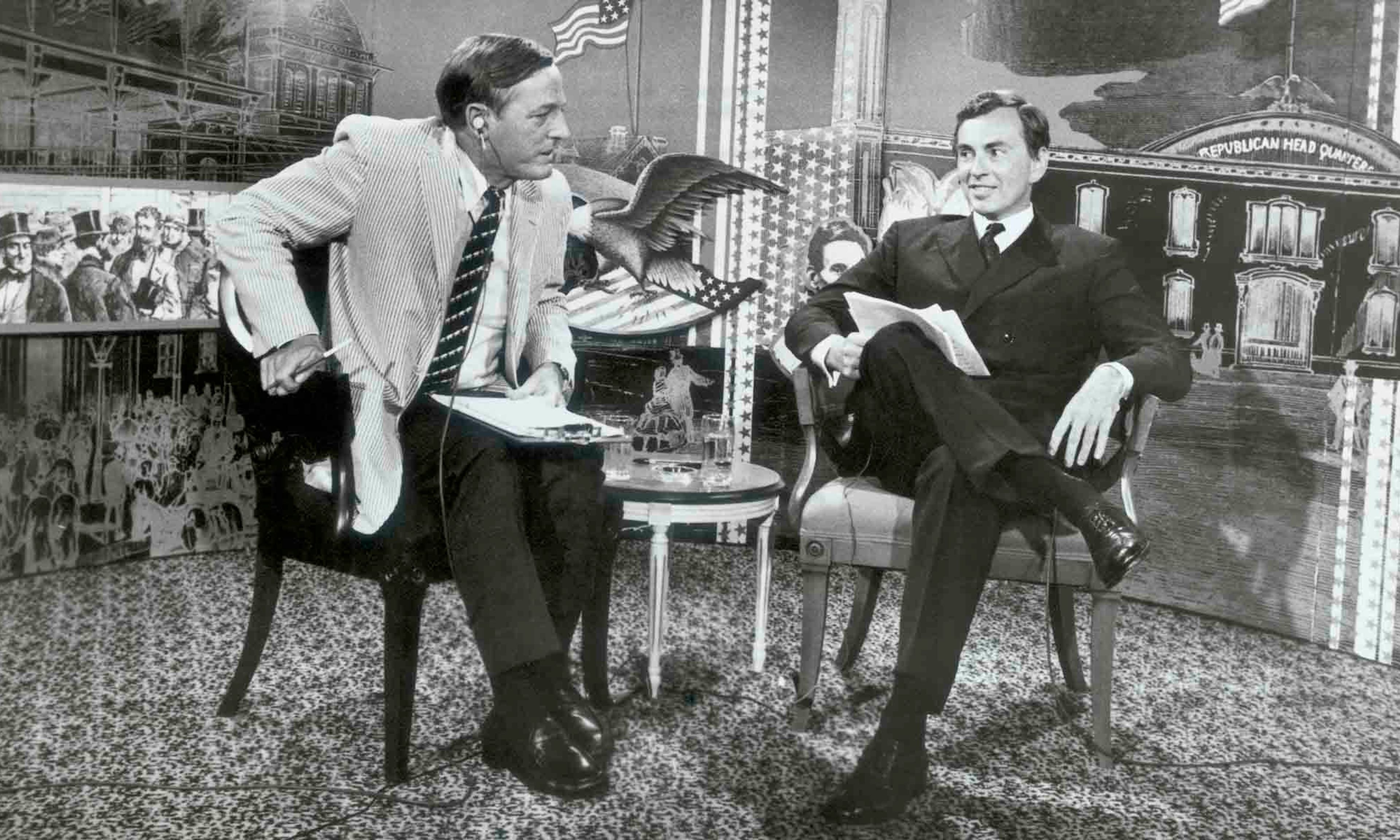
Over the Christmas season, the hottest ticket to the London theater has been a play about the short television debates included in the ABC news coverage of the 1968 Republican and Democratic conventions in Miami and Chicago, respectively, between the left-wing novelist and playwright Gore Vidal and William F. Buckley, who needs no introduction in these pages but was being introduced to most London theatergoers for the first time. Best of Enemies, inspired by the successful 2015 documentary of the same name by Morgan Neville and Robert Gordon, sounds an unlikely hit on a remote topic. But in addition to packed audiences, the play is getting rave critical reviews across the politico-cultural spectrum and some attention on the op-ed pages for its unexpected popularity.
One reason for this is its author, James Graham, English theater’s current wunderkind, who in the last decade has established a record for versatility — he has written plays, films, teleplays, and musicals; for his wide range of subjects, including politics; and above all for his fair-mindedness (given that the stage has been a Tory-free zone for more than a generation). His 2013 play, This House, about the honorable relations between the Labour and Tory whip offices in the dying days of the Callaghan administration, was another runaway hit, performed abroad as well as in Britain. It even included a friendly reference to Margaret Thatcher.
How fair was he in Best of Enemies?
That’s a tough test because his play is a series of debates between two figures, both early practitioners of cultural politics, whose exchanges took place at the very moment when new social forces were emerging in U.S. politics and changed the two political parties culturally as much as politically. That was more evident in Chicago than in Miami because Richard Nixon conciliated the insurgent conservatives in order to preserve party unity, whereas the Democrats were irremediably split and their disputes erupted into violence in the streets. As the play proceeds, the intellectual duel between Vidal and Buckley mirrors the growing tumult outside the studio. It starts if not good-humoredly then at least with formal good manners but gradually becomes testier and eventually erupts into a bitterly hostile exchange ending in the famous exchange of slurs: “crypto-Nazi” and “you queer.” Given that the conflicts that emerged in 1968 still divide us, fair-mindedness is hard for anyone with opinions to maintain throughout.
My judgment is that Graham succeeds pretty well. He is fair in dealing with the two duelists. His real ire, expressed in both satiric and raucous comedy, is reserved for the ABC executives who are shown prostituting their integrity as journalists to stop the fall in their ratings — -more on this below — and for the mayor of Chicago, Richard Daley, who is shown as a foul-mouthed authoritarian thug. It’s impossible to defend Daley’s conduct during the Chicago convention. That’s not the whole truth about Daley’s mayoralty, as a glance at Chicago today will confirm, but in 1968 and in the context of this play, he’s unavoidably collateral damage.
Both Buckley and Vidal, however, are treated as morally and intellectually serious people who detest each other on grounds of principle at the beginning and at the end of their battles. Vidal sees Buckley as the advocate of a fading American empire that at home is racially unjust, sexually bigoted, devoted to greed, and heading for trouble; Buckley treats Vidal as someone whose essentially frivolous taste for cultural and sexual revolutions — he cites Vidal’s gender-bending novel Myra Breckenridge, then a best seller, as “pornographic” to underscore his point — will, unless challenged, undermine a decent, civilized country.
Who wins this debate? Until the final climactic slurs, honors in both the play and the documentary record strike me as even. Vidal had prepared very carefully for it; the documentary filmmaker found that he had conducted major oppo research on Buckley’s journalism and composed a list of ready-to-use witticisms. Buckley took a vacation to rest and relax as debate preparation. As a result, Vidal inflicts some wounds at the cost of sometimes smelling of the midnight oil; Buckley sounds more spontaneous at the cost of being sometimes caught off guard. Vidal approached the debates as a way of destroying Buckley as a cultural leader; Buckley took more seriously his ABC News brief to discuss the conventions. Vidal is incisive, scornful, needling, and waging a culture war; Buckley employs his debating technique of analyzing the flaws in Vidal’s statements to make partisan political points.
In the scenes between the debates — Graham’s major original contribution — we learn a little more of Vidal than of Buckley. Vidal is anxious that the GOP, by selecting Nixon as its presidential nominee, has chosen a “professional” at a time of Democratic disarray. Similarly, having been dismissive of Buckley previously, he sees a line by Buckley — “The liberals always say they want to hear other points of view, and then they’re surprised to find there are other points of view” — and reflects that it’s going to be harder than he thought. And Vidal’s debate with a young aide who wonders whether he shouldn’t be down on the streets fighting for the poor rather than arguing with their enemy in the suites above serves both to undercut Vidal’s revolutionary pose and to hint at the Democratic Party’s future evolution.
Buckley’s debates with his “handlers,” wife Pat and literary editor Frank, are more-straightforward strategy sessions but — or so it seems to me — don’t catch Bill’s extraordinary self-assurance. There’s a little too much stress on his pride in an earlier debating achievement at the Cambridge Union. A friend present at that debate tells me it was a genuine triumph for both Bill and his opponent, James Baldwin. But I don’t recall Bill’s talking about it much. Besides, he didn’t need to pump up his self-confidence. Until the end, both men thought they were winning. And there was enough in both performances to justify their admirers in agreeing with them.
There has been an interesting controversy in the British media about the decision to have Buckley played by a black actor (David Harewood). This decision conforms to the modern theater’s taste for “nontraditional casting.” But it has also been argued that it was done to subvert any prejudices the liberal audience might have against a white American making conservative arguments on racial questions. Given what I’ve written about Graham, that’s plausible.
True or false, however, I think the decision was a mistake. Portraying historical figures should never be merely impersonation, but some element of impersonation is surely inseparable from a convincing performance. Both the principals I saw were strong. Zachary Quinto was Vidal to the life — witty, snobbish, brilliant, self-absorbed. Harewood gave a strong performance and delivered with brio arguments that he probably disliked, but it didn’t have the oddly impish spontaneity of the man he was playing.
Was that because he simply didn’t look like Bill? Or because the part as written didn’t quite catch WFB? I don’t know, but it’s worth making the point that if the purpose of this casting decision was to render Bill’s opinions less offensive, then it really wasn’t necessary. In the key scene in which Vidal and Buckley debate the behavior of the Chicago police, Buckley’s argument is to insist on distinguishing between the violent behavior of individual cops and the general conduct of the police in Chicago and America. Vidal insists equally on blurring that distinction. Graham shows the debate without loading the dice. Nearly 60 years later, the distinction is still fought over — and still worth making as the corpses of murdered cops pile higher.
Nor does Graham disguise the historical winner of the overall debate, who was Vidal. Buckley knew he had lost when, in response to Vidal’s accusation of “crypto-Nazi,” he responded with a threat of violence and “you queer.” We see Buckley distressed by his own loss of control. To the best of my knowledge, he never defended himself, while Vidal rejoiced. Is that the end of the matter? Probably, though when the 2015 documentary came out, Hendrik Hertzberg in the New Yorker delivered a revisionist interpretation: Vidal was gay, but Buckley wasn’t a Nazi, “crypto or otherwise.” Besides, cultural change had altered the meanings of these terms: “To call someone a Nazi is to accuse him of embracing evil. To call someone ‘queer’ is merely to accuse him of embracing a fellow-human being. Vidal won the fight in 1968, but he loses it in 2015.”
Graham’s play, however, embarks on no revisionism but changes topics. It becomes a lament for the degeneration of journalism of which the Buckley–Vidal debates were the fons et origo.
My own view is that this flatters the self-regard of pre-woke journalists, whose bias was just more subtly cloaked, and somewhat exaggerates the influence of these debates. But if we endorse, as we should, the play’s request for media that take time to explore and discuss serious questions with serious people without anger and hostility, shouldn’t we also mention that William F. Buckley ran a television program, Firing Line, that did exactly that and won public-service awards for doing so for 30 years after 1968?










Comments