The responsible teaching of literature and other humanistic studies from kindergarten through college may be said to require balancing two countervailing interests and tendencies — the understandable, but sometimes authoritarian, “centripetal” desire to convey and reproduce what is taken to be good in the inherited cultural legacy, and the opposite, “centrifugal” desire to augment liberty and openness to new perspectives and possibilities. For many centuries, the former practice prevailed — as it still does in much of the “undeveloped” world today — with emphasis on tribal and religious memory. Islamic education is a good example: At its worst it is simply indoctrination and conformity. Today in the modern West and its global counterparts, the latter tendency prevails, with a strong emphasis on novelty, self-expression, utility, and the rejection of any traditional authority. Balancing these two needs and desires often seems more theoretically than actually possible, and in fact the great crisis in the teaching of the so-called humanities in college is the enormous and rapid recent decline in enrollments in literature and history courses.
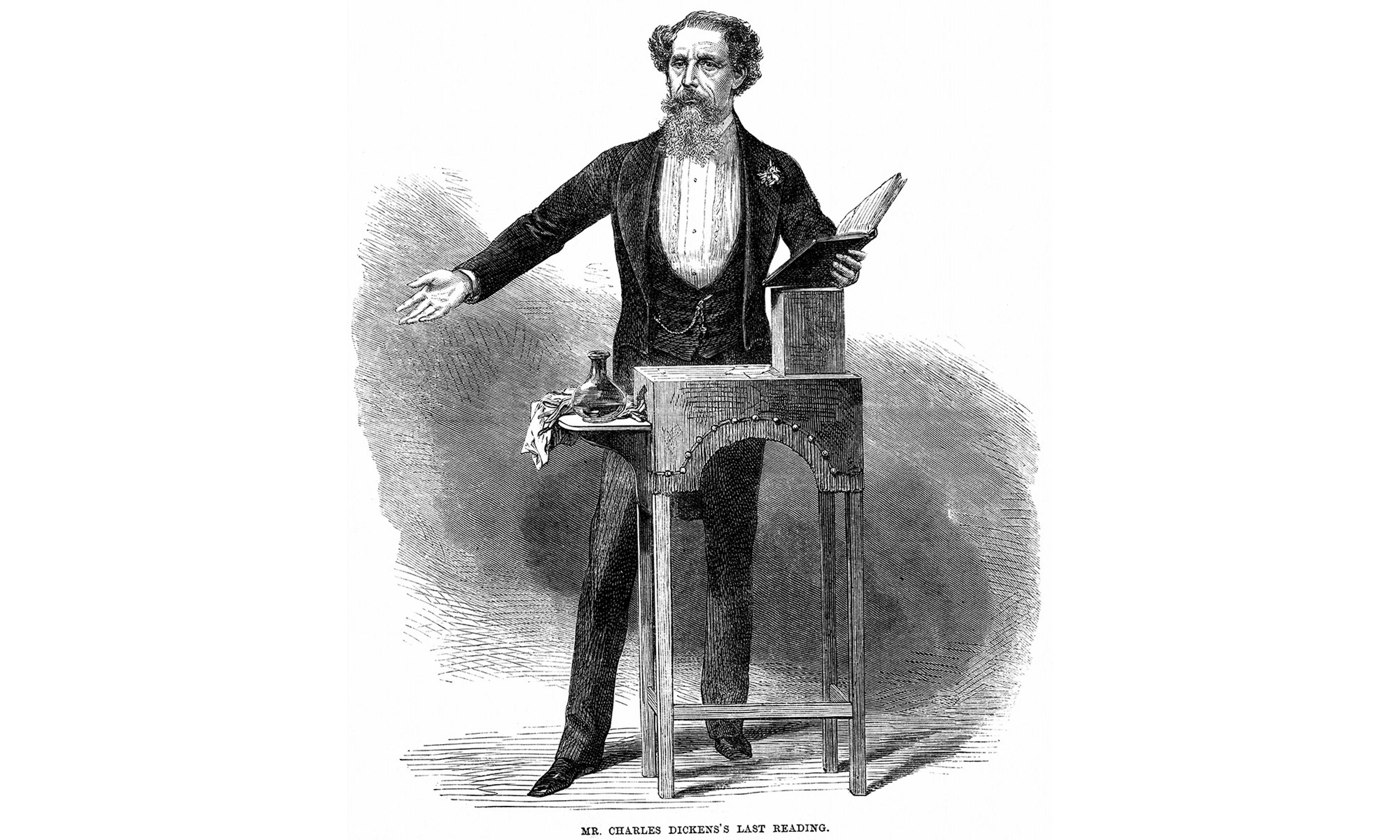
Yet a linguistic community is really a community — a res publica — only inasmuch as it has a shared literary legacy that involves some continuity and overarching criteria of truth, value, and goodness — something beyond self-interest, or competitive group-interest, and utility in its service. The literary-critical meditations on these issues — and on the very nature of language — of the English scholar F. R. Leavis remain of great value. Late in his career, Leavis and his scholarly wife came to the view that Shakespeare and Dickens played this role of providing a shared legacy for English-speaking people: They saw the novelist Dickens as “a great poet,” compared with whom “there is surely no greater master in English than Shakespeare.”
The Australian literary scholar Jennifer Gribble has now published a dense, rich, short (and, alas, very expensive) book on Dickens and the Bible and on his concentration on the theme of Providence and, ultimately, on “the meaning of life.” Many years in preparation (its imminent publication was mentioned to me by a distinguished Oxford scholar-editor a decade ago), and suffused by a profound knowledge of Dickens’s vast body of work (a dozen great novels, most of great length), of the Victorian era, and of subsequent literary-critical and philosophical argument, it is an excellent book, deserving of wide review, readership, and purchase, especially by scholastic and public libraries. But the private reader of Dickens should also read and meditate on its argument and experience its intellectual range, especially in light of current cultural controversy, confusion, and disorientation. Without such books in the “high” culture, the decline of the humanities may indeed become a decline in humanity, only temporarily disguised by the vast, noisy cacophony of postmodernist, radical-pluralist perspectives, whose “name is legion.”
Professor Gribble wisely restricts her analysis to in-depth discussions of only a few of Dickens’s novels, starting with brief treatments of The Pickwick Papers and A Christmas Carol before turning to three major late novels: Dombey and Son, Bleak House, and Little Dorrit (in a 2004 essay in Literature and Theology she also examined Hard Times). As Annette Federico pointed out in the London Times Literary Supplement in February, Gribble’s appreciative discussion of the central heroines of these novels is a courageous countercultural act in a period of heightened feminist awareness and critique of an allegedly patriarchal, chauvinistic, centripetal literary canon supposedly in great need of interruption and rejection.
Like Shakespeare, Dickens has at the heart of his intuitive, religious, ethical, and aesthetic vision an emphasis on the redeeming woman as retaining and renewing a kind of primeval, “unfallen” goodness. In an influential essay on Little Dorrit, Lionel Trilling pointed this out about Amy Dorrit. But the reigning opinion of our contemporary feminist critics and teachers and their allies is that this vision is unrealistic, restrictive, and sentimental. Cordelia in King Lear must have very little resonance for them, though her ravenous virago sisters can even now hardly earn approval for their “unsentimental” Machiavellian realism.
Like the greatest Dickens commentator, G. K. Chesterton, Professor Gribble sees Dickens not as any kind of smug, confident, philistine, masculinist Victorian, nor as a merely superficial, sentimental, dated entertainer, but precisely as the most thorough and wise critic of these self-interested and self-flattering perspectives — and thus, here and now, as an imaginative resource for self-knowledge and the future. Her strenuous engagement with first-order philosophical, theological, and literary-critical writing on narrative, Providence, and the nature of “nature” — especially with the French thinker Paul Ricoeur and the Russian Mikhail Bakhtin — is exemplary and instructive. This is painstaking scholarship at its best, intricate and detailed but large-scale in its subjects, aims, and implications.
High-modernist writers and literary critics in the wake of Dickens often resented and ridiculed his influence, sometimes enviously. Against this resentment, Chesterton’s 1906 and 1911 books (the latter consisting of his introductions to the Everyman editions of Dickens’s novels) were a lonely, salutary challenge, defending the popularity that Dickens had and has never lost with “common readers” throughout the English-speaking world.
Yet the modernist novelists and critics rarely saw how timely, prophetic, and predictive many of Dickens’s themes, insights, and portrayals were. The ultimately heroic martyr Sydney Carton in the 1859 A Tale of Two Cities (still probably the most popular novel in the English language), suffers from precisely the withdrawal of affect, the dissociation of personality, and the “bondage of purposeless freedom” that would become central themes of fiction (and philosophy) from the 1890s down to our own day, when ironic absurdism has become the coin of our realm of entertainment and aesthetic experience in all the arts, from architecture and painting to music and literature.
Dickens’s satire on America in the novel Martin Chuzzlewit (1843–44) is another case in point: Hilariously comic, it is also penetratingly profound in ways that subsequent history has vindicated. Huckstering trumpery, crudely sensationalist journalism, jackass Jacksonian democratism, slave-driving, and chauvinism are mocked, as in the satires of Mark Twain, but so too is vapid, verbose, bogus Emersonian “Transcendentalism,” in ways similar to those of Hawthorne’s contemporary satire The Celestial Railroad and Melville’s The Confidence Man (1857). But, though brief, the most powerful and resonant satire in Martin Chuzzlewit is on the slave-owning “Democrat” Thomas Jefferson — the “noble patriot, with many followers! — who dreamed of Freedom in a slave’s embrace, and waking sold her offspring and his own in public markets.” The editor of the 1968 Penguin edition of the novel felt the need to apologize for this charge in a note. We now know better, not least owing to the work of historian Annette Gordon-Reed on the Jefferson-Hemings family and its fate. Dickens was right.
In the larger perspective, Professor Gribble’s project is based on the civilizing, “logocentric” assumption that, as the American philosopher E. A. Burtt memorably put it, “the only way to avoid metaphysics is to say nothing”: Language, conceptualization, and human purposes and consciousness generally are irreducibly metaphysical. Dickens’s meditations on and depictions of Providence are responses to the inevitable conditions of reality that affect all conscious beings with any degree of free will. We are recurrently confronted with patterns of order and teleology that elicit what Gribble calls “responsible consciousness”: What meanings do we discern and partially create, and into what schemes of signification do we fit them? Dickens clearly believed that good and simple people often saw these realities more clearly than did the clever and privileged: He was an archetypal Christian democrat. (He was the exact contemporary of Abraham Lincoln.) The two final, major authority figures in Martin Chuzzlewit are simple but good men whom we are initially encouraged smilingly to undervalue. We come to know better, as do the more initially impressive protagonists themselves.
A medieval liturgical rubric has it that “not from chance our comfort springs.” Human sanity and well-being consist in purposes and purposiveness, not in chance and necessity. Gribble shows that from early to late in his life and writing career Dickens was suffused with a knowledge of and loyalty to the Bible, “the Judaeo-Christian grand narrative,” and that this very fact made him a frequent and powerful critic of religious hypocrisy, ostentation, and pharisaism. The New Testament was the heart of his moral imagination. Yet she is aware of “post-modernism’s repression of the Bible” in the high culture, and of the secularizing machinery of public culture and institutions. The Bible is today the only book that you certainly cannot teach in a K–12 public school, despite the fact that it and its direct offshoots (inter alia: Dante, Milton, Bunyan’s Pilgrim’s Progress, primers, and hymns) were the chief means by which literacy became universal in the West. In what the French polymath Jacques Ellul calls “the humiliation of the Word,” our ideal seems to be literacy without ethics, functional rationality without morality, knowledge without conscience. The Bible, Shakespeare, and Dickens are our great antidotes and ripostes to this cultural amnesia.












Comments