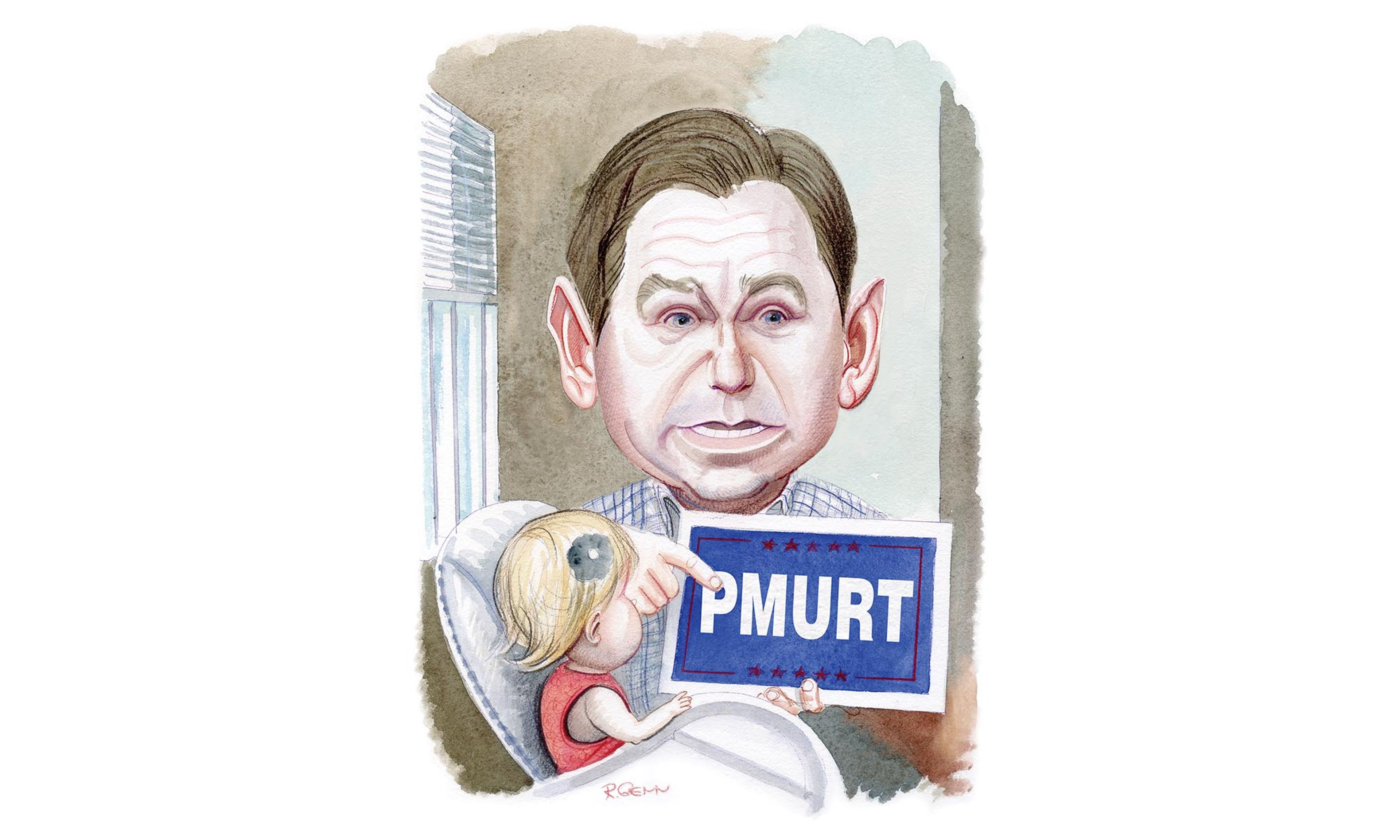
• He backed down.
• House Republicans stood down on plans to hold Hunter Biden in contempt of Congress after the president’s son brazenly defied subpoenas issued by the Judiciary and Oversight Committees. The subpoenas were valid, but Hunter’s lawyer argued that they were illegitimate, having been issued before the House approved the impeachment inquiry. Hunter’s claim had political weight because Republicans had made a similar one in 2019 about subpoenas of Trump-administration officials. The contempt gambit also lost steam when Hunter signaled that he would cooperate if the committees issued a new subpoena. After some squawking, the GOP-led committees agreed to do so — doubtless influenced by the razor-thin Republican majority. It would have been better to issue the subpoena a month ago, but everyone went on vacation instead.
• Scandal mires the prosecution of Trump and 18 others under Georgia’s RICO law. A co-defendant alleges that District Attorney Fani Willis asked Fulton County for funding to address a Covid-era backlog of cases and then diverted nearly $1 million to hire private lawyer Nathan Wade as a special prosecutor on the case. Willis is said to have been romantically involved with the married Wade and benefited from the fees she paid him as he paid for jaunts in Napa Valley, Florida, and the Caribbean. The allegations come from the court file in Wade’s divorce case, which was mysteriously sealed but has now become public. Wade’s wife seeks to call Willis as a witness. The DA responded at a church service, admitting that she is “flawed” but suggesting that racism is behind the allegations — although their source, Mrs. Wade, is black (as are Willis and Wade). The court in the RICO case has given Willis until February 2 to respond to defense claims that she and Wade should be disqualified and the indictment dismissed. As has so often been the case, critics of Trump’s ethical standards are displaying low ones themselves.
• After John Fetterman suffered a life-threatening stroke and turned in a 2022 campaign-trail performance that revealed lingering struggles to communicate, few would have predicted that the Democratic senator from Pennsylvania would be the member of his party making the most sense as 2023 turned into 2024. Fetterman took a forthright stand in support of Israel against Hamas, posting hostage posters outside his office, wearing an Israeli flag on his shoulders to the rally for that country on the National Mall, and declaring, “Israel is really a beacon of the kind of values, the American values and progressive ideals, that you want to see.” Fetterman has also continued to call for the resignation of New Jersey Democratic senator Bob Menendez, objecting to the fact that an official accused in court of being an agent of the Egyptian government is still getting classified intelligence briefings. And while Fetterman isn’t on board with every immigration proposal from Republicans, he has pushed back against left-wing taboos. “It’s just hard to have a conversation or negotiation if you start throwing around the term ‘xenophobic,’” he told Semafor. In the same interview, he lamented antisemitism and campus craziness: “As an alum of Harvard — look, I graduated 25 years ago, and of course it was always a little pinko. But now, I don’t recognize it.” Forget Democrats — when’s the last time you heard a Republican use the term “pinko” to describe Harvard? Fetterman told NBC News he’s “not a progressive.” The Left is horrified to learn this, but polling indicates Pennsylvanians are relieved.
• Late on the afternoon of Friday, January 5, the Pentagon press secretary, Major General Pat Ryder, released a brief statement declaring: “On the evening of January 1, Secretary of Defense Lloyd J. Austin III was admitted to Walter Reed National Military Medical Center for complications following a recent elective medical procedure.” Austin, who is 70 years old, not only was in the hospital but, we later learned, had spent four days in the intensive-care unit. On January 2, some of Austin’s duties were transferred to Deputy Secretary of Defense Kathleen Hicks, who was on vacation in Puerto Rico at the time. According to CNN, Hicks was not told that Austin was in the hospital when she assumed his duties and was not informed about his hospitalization for days. Nor was the president informed about any of this. In short, while the U.S. military was conducting multiple dangerous operations against Houthi militants and a strike that killed a leader of the Iran-backed Harakat al-Nujaba terrorist group, which operates in both Iraq and Syria, no one in the top ranks of the administration knew Austin’s condition. A subsequent statement revealed that Austin is being treated for prostate cancer. We wish him a speedy recovery. But it should be in the private sector.
• With a strong bipartisan vote, the House committee for tax policy approved a deal that extends some tax cuts for business investment that were due to expire and expands the child tax credit in various ways. The most valuable change to the tax credit is protecting it from future inflation. (The deal does not, unfortunately, protect it from past inflation, which has already eliminated most of the increase that Congress legislated as part of the Tax Cuts and Jobs Act of 2017.) Another point in the deal’s favor: It is paid for by reforming a Covid-era tax break that has become notorious for abuse. There are some conservatives who oppose the deal on the ground that one of its provisions — allowing low-income people to use a previous year’s income to qualify for the child credit — would reduce their incentive to work. But some people might respond by working more, since one year’s work would earn a longer-lasting reward. In any case, reasonable debate over that provision should not obstruct passage of a bill that is in the main worthwhile. Congress works well every once in a while, and this is one such case.
• Never mind that manufacturing employment had been growing steadily since the Great Recession and had recovered to trend after Covid, and never mind that the U.S. manufacturing sector is already larger than Italy’s entire economy: Politicians decided manufacturing needed help. So they passed several pieces of legislation, most notably the CHIPS Act and the so-called Inflation Reduction Act, that included subsidies for manufacturing in preferred industries such as semiconductors and green energy. Total construction spending on manufacturing has skyrocketed since those bills became law, and the Biden administration is celebrating, as though spending money were a success in itself. Meanwhile, in the EU, construction spending on manufacturing is flat. Is it really the case that businesses were simply missing profitable investment opportunities for years, when interest rates were near zero, and that these opportunities exist only in the U.S. and not in the peer economy of Europe? Or is it more likely that U.S. politicians are engineering a politically popular bubble?
• Last year was supposed to be a big one for unions. Organized labor received wall-to-wall positive press coverage through the UAW strike, the Kaiser Permanente strike, a threatened Teamsters strike at UPS, and more. Last year did see more labor actions than normal. But the media’s coverage frequently became cheerleading. Headlines talked of a “resurgence” in organized labor, with journalists frequently portraying the strikes as a trend that was sweeping the nation’s workforce. That was all undercut by one inconvenient fact, reported by the Bureau of Labor Statistics in January: The unionization rate for 2023 declined to a record low of 10 percent. The total number of unionized workers hardly changed last year. Americans still don’t want what organized labor is selling, and the media have beclowned themselves with the massive number of stories covering a “resurgence” that is not happening.
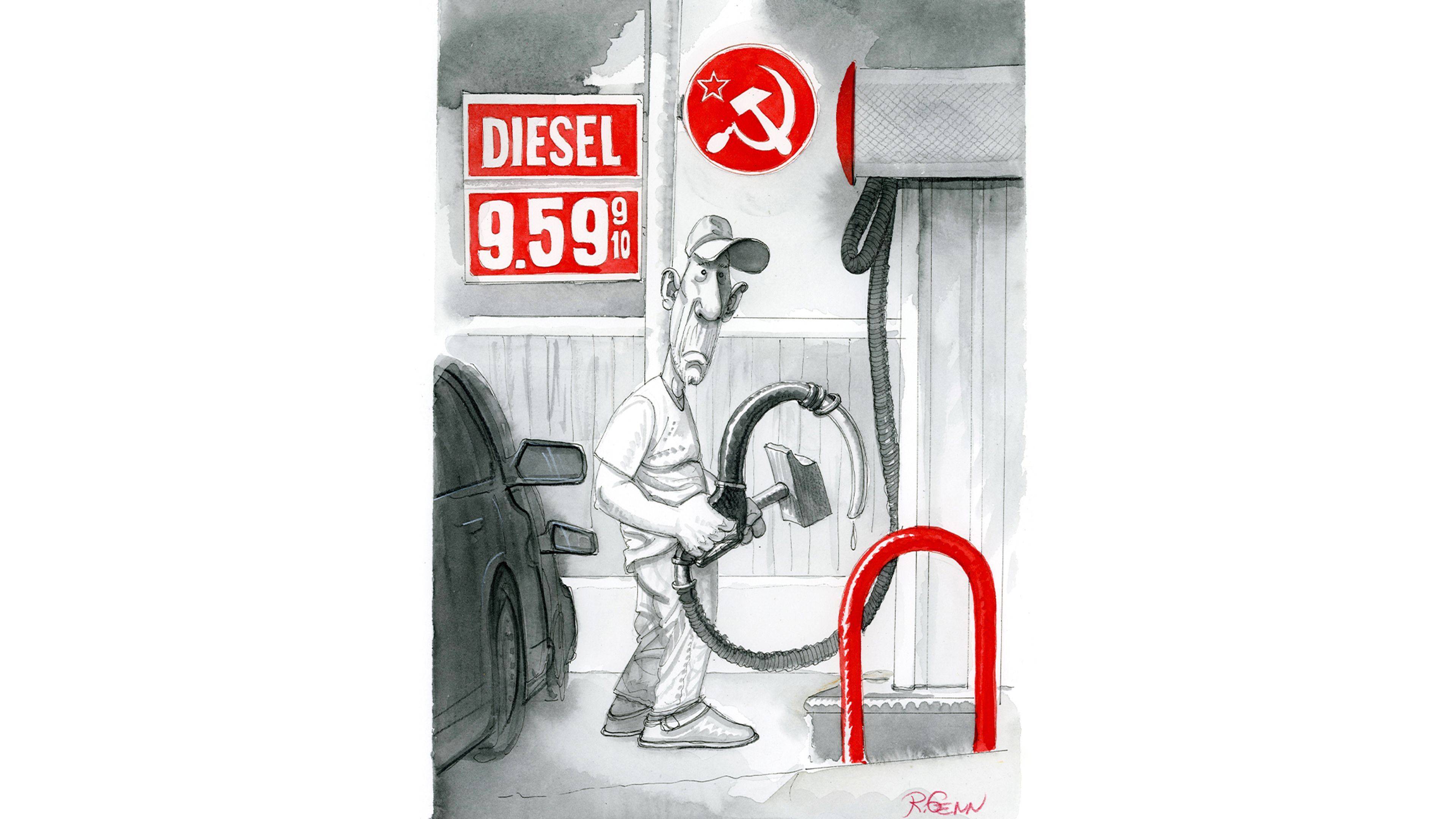
• Cold weather can make the battery of an electric vehicle (EV) take longer to charge and its range to fall substantially, especially if a chilly driver unwisely turns on the heater. Chicago recently received a taste of what this could mean, when a very cold snap left some EV drivers hurrying to charging stations only to find lines so long that their cars were out of power before the rescuing volts could flow. Infuriating, but it was their choice to buy an EV. As climate-related regulations tighten, however, the ability to choose a new car other than an EV will be steadily reduced — and, in some places, eliminated. That’s bad in principle and, as drivers may discover, in practice. It will also lessen the competitive pressure on EV manufacturers to innovate their way out of this and other problems.
• There are four major airlines in the U.S., each of which accounts for 15 to 18 percent of the domestic market: American, Delta, United, and Southwest. There are several smaller airlines that split the roughly 30 percent that remains. Two of those, JetBlue and Spirit, wanted to merge. The merged airline would have accounted for about 10 percent of the market, giving it a chance to compete against the four major airlines in a way each company couldn’t do on its own. But a federal judge, at the urging of the Biden administration, blocked the merger on antitrust grounds. JetBlue and Spirit are appealing the decision. Spirit might go out of business anyway, and if it does, its assets could be purchased by one of the larger airlines, increasing market concentration relative to the status quo. (Spirit had been entertaining a merger offer from Frontier before JetBlue made a better offer.) If the Biden administration really wants to increase competition in domestic air travel, it should urge Congress to open the market to carriers from other countries. As it stands, the four largest airlines are breathing a sigh of relief at not having to face a larger competitor.
• Because of climate concerns, the Biden administration may not grant the necessary permits for a proposed new export terminal for liquefied natural gas. Its priorities are sorely misplaced. One reason Western Europe has remained (unexpectedly) steadfast in its support for Ukraine is that a huge increase in LNG imports from the U.S. has enabled it to weather the loss of almost all its supply of Russian fossil fuels. For the U.S. to do anything that could undermine this lifeline, or indeed Europe’s belief in it (and by extension in America’s reliability as an ally), would be a massive geopolitical blunder for minimal climate return.
• Late last year, Ohio governor Mike DeWine (R.) vetoed a bill that would have banned “gender-affirming care” for minors and required student athletes to compete with their chromosomal equivalents. His veto statement was perplexing, seeming to accept the premises of transgender activists in dubbing these treatments a matter of life or death, yet also professing to agree with the legislature that body-altering surgery should not be performed on minors. In a follow-up executive order, DeWine did indeed ban such surgeries for minors. But the Republicans who passed the bill in the first place were unimpressed: The order did not touch on puberty blockers and hormone injections. The Ohio house of representatives has overridden DeWine’s veto. The senate has now followed, and the bill will become law, as it should. And DeWine will be embarrassed, as he should.
• In Illinois, Democratic governor J. B. Pritzker took to social media to trumpet the success of the state’s legal-marijuana industry, crowing that, “for the third year in a row, Illinois had record-setting growth” in sales. Never let it be said that the Illinois government is uniformly hostile to business.
• On January 2, after weeks of increasingly serious plagiarism allegations in the wake of her headline-grabbing testimony about campus antisemitism, Claudine Gay resigned as president of Harvard University. (She remains a member of the faculty.) Her tenure was justifiably the shortest on record. Gay was transparently guilty of multiple instances of plagiarism — as part of its attempted damage control, Harvard permitted her to “amend” some of her earlier publications, a remedy it does not allow its errant undergraduates — and the light shone upon her academic misconduct also revealed the meagerness of her scholarship, a mere eleven publications over her career. But Gay’s academic record came under scrutiny in the first place owing to her testimony before Congress in early December. Addressing the issue of campus antisemitism, she said that calls to murder Jews and extinguish Israel could well be protected speech on campus, “depending on context.” (Harvard notoriously does not practice this sort of bold free-speech absolutism in other contexts.) Her defenders cry foul, saying that what matters more than her misdeeds are her status as a black woman and that of her critics as right-of-center nonacademics. Her detractors, however, understand that defenses of this kind show the depth of the rot in academia.
• Item: In early 2024, the girls’ varsity basketball team from the Leffell School, a private Jewish school in Hartsdale, N.Y., went to play the Roosevelt High School team in Yonkers. The game had to be cut short, and the Leffell girls escorted out by security, after what has been reported as unusually rough play by the Yonkers team, members of which allegedly shouted “Free Palestine” at Leffell players and “I support Hamas, you f***ing Jew.” Item two: At a “Flood Manhattan for Gaza MLK Day March for Healthcare” — recall that Hamas called its 10/7 attack “Operation Al-Aqsa Flood” — protesters targeted Memorial Sloan Kettering Cancer Center (yes, you read that right), screaming, “MSK, shame on you, you support genocide, too,” as children in a pediatric-care area watched from windows. Item three: Introducing a lecture by Norman Finkelstein, the Israel-hating, Hamas- and Hezbollah-loving former academic whose initial reaction to 10/7 was to compare it to the Warsaw Ghetto Uprising and say it “warms every fiber of my soul,” Representative Jamaal Bowman (D., N.Y.) exulted that he was “starstruck.” It has not stopped being bizarre that the massacre, rape, and abduction of Jews on October 7 in Israel set off an explosion of hatred and bigotry against Jews worldwide.
• Almost from the outset of Israel’s war to destroy Hamas, its left-wing enemies decided to make themselves as obnoxious as possible. The most visible expression of this commitment has been “protests” that shut down transportation arteries. Demonstrators have blocked traffic through New York City’s bridges and tunnels. They have blocked spans across the Charles River in Boston and San Francisco Bay. They have prevented travelers from accessing major airports including in Los Angeles and New York — even going so far as to launch balloons in the path of aircraft to threaten the safety of air travelers and cripple traffic. And they are proud of it. “Our message is clear,” the subversive group Jewish Voice for Peace bragged. “As long as Israel is dropping bombs on Gaza, there can be no business as usual.” This campaign of mass lawlessness won’t end until America’s urban officials summon the courage to do their jobs.
• After 33 years as CEO of the National Rifle Association, Wayne LaPierre is retiring. During his tenure, the organization became one of the most powerful lobbying groups in the United States, helping to usher in a renaissance in the right to keep and bear arms. When LaPierre took over in 1991, the Second Amendment had become an afterthought. Today, it is more robustly protected than it has been at any other time in a century. With that victory, however, came overconfidence and self-indulgence, and in recent years the NRA has been mired in distracting controversy. Some of that controversy has been contrived by the outfit’s political opponents, but some of it — such as the use of members’ dues to fund the lavish lifestyles of LaPierre and his colleagues — has been real. Since 2018, the NRA has lost a million members, and its influence on Capitol Hill has waned. Taken as a whole, LaPierre’s tenure is impossible to regard as anything other than a success — and it is also impossible to avoid the conclusion that, like so many in politics, he stayed far too long.
• In November, in Burlington, Vt., three college students of Palestinian descent were shot while out walking on the street. The man who has been charged with the attack faces life in prison for three counts of attempted murder. Families of the victims have called for him to be charged with a hate crime, but authorities have not found the requisite evidence. What is publicly known about the alleged perp suggests he was mentally unstable — an erratic work history, restraining orders, run-ins with police, an eviction over property damage and unpaid rent, a personal website with some posts in gibberish. In social-media posts reviewed by the Vermont newspaper Seven Days, he had expressed sympathy with the Palestinian cause, and with Hamas. “The notion that Hamas is ‘evil’ for defending their state from occupation is absurd. They are owed a state. Pay up,” he wrote in one comment. A terrible crime, but not, it would appear, one spurred by the anti-Muslim bias initially assumed.
• “Are the airstrikes in Yemen working?” Joe Biden was asked. The straightforward question elicited a response that was as uncomplicated as it was unsatisfying. “Well, when you say ‘working,’ are they stopping the Houthis? No,” Biden replied. And yet the president insisted that his admittedly ineffective response to Houthi aggression would continue. A week later, the Biden administration signaled its intention to craft a sustained military campaign designed to degrade the Houthis’ capacity to project power into the Gulf of Aden and disrupt international commerce. If the duration of that campaign stretches into February, calls from Biden’s critics to seek congressional authorization for these strikes will likely intensify. But that wasn’t the Washington Post’s primary objection. Rather, the outlet fretted that the Biden administration’s lethargic response to Houthi terrorism “could derail the war-ravaged country’s fragile peace and pull Washington into another unpredictable Middle Eastern conflict.” The casual observer might conclude that it was the Houthis’ campaign of brazen piratical raids on commercial ships from the air and sea in concert with its drone and rocket attacks on merchant and naval vessels alike that shattered the “fragile peace” in Yemen.
• Day after day, Russia bombs Ukrainian cities, including the capital, Kyiv. Day after day, Russia kills Ukrainian civilians, including evacuees — women and children trying to flee. Ukrainian forces are losing territory and running out of ammunition. Russia has its allies: China, North Korea, Iran, et al. Ukraine is in great need of its own allies. Congress and the president have so far been unable to agree on terms for further aid to Ukraine. But we should keep in mind that the cost of helping Ukraine now is as nothing compared with the potential cost of dealing with Russia after a conquest of Ukraine. Lithuania’s foreign minister, Gabrielius Landsbergis, put it this way: “Nobody knows the exact timeline of Russia’s madness, but we know Ukraine is buying us time and paying for it with blood. If Ukraine wins, Russia’s expansionism will be halted. If not, we will be wishing we had used the bought time more efficiently.”
• In Taiwan, current vice president William Lai triumphed in a presidential election on January 13. Lai is a member of the Democratic Progressive Party (DPP), the party that holds the most skeptical view of the Chinese Communists and was, until recently, openly supportive of independence. Lai won with just a bit more than 40 percent of the vote, and the DPP failed to win a parliamentary majority. His victory can be explained largely by the failure of the opposition to unify. An election run smoothly, delivering a complex result that will force the parties to share levers of power, is another victory for Taiwan’s democratic self-governance and a setback for Beijing. But the biggest challenge may be yet to come. Beijing detests Lai, viewing him as a proponent of Taiwan’s independence, and will likely retaliate, perhaps around the time of his inauguration in May, with a new trade war and provocative military exercises — or worse.
• China’s birth rate has fallen to a record low for the second year in a row. The number of births per 1,000 people fell from 6.77 in 2022 to 6.39 in 2023; the country’s population shrank by 2.75 million, or 0.02 percent. The precise numbers are questionable — this is China, after all — but the trend is clear. China has been fretting about its fertility rate for a long time. In the early 1980s, under the leadership of Deng Xiaoping, the received wisdom was that there were too many babies; the government’s one-child policy was announced and, over subsequent decades, brutally enforced. In 2015, the government said families were allowed to have two children; in 2021, this was raised to three, and policies to encourage a baby boom were implemented. But to no avail. Penalizing parenthood, it turns out, is far more effective than encouraging it. China will be reckoning with the economic and social costs of its aging population for decades to come.
• The show trial of Jimmy Lai is under way. Lai, 76, is the great entrepreneur and democracy advocate in Hong Kong who has been a political prisoner since 2020. What is his show trial showing? That the authorities are scared of criticism and contemptuous of the truth. In a new development, they have named “co-conspirators” — foreigners who advocate democracy and human rights in China and elsewhere. Two of them live in London: Bill Browder, the founder of the Global Magnitsky Justice Campaign, and Benedict Rogers, the founder of Hong Kong Watch. The Chinese authorities are trying to scare off anyone who would help Jimmy Lai, or any other dissident. “Hang in there!” a supporter called out to Lai in the courtroom. So should we all, until this man is free.
• We do not know whether Javier Milei, the eccentric “anarcho-capitalist” economist who is Argentina’s new president, will end the mismanagement that, over nearly a century, has turned his country from one of the richest in the world to a poster child for decline. It’s an enormous task, but a part of Milei’s good start has been to correctly and loudly diagnose what has brought Argentina down: an overbearing state, constant meddling in the functioning of free markets, and the long sway of the thinking that has allowed both to continue. The implication of the last is, as this didactic president well understands, the importance of winning the battle of ideas. And so he flew (commercial) to Davos, using that unlikely venue as a platform to deliver a powerful speech (albeit with some unusual anarcho-capitalist twists) on the effectiveness and moral superiority of free markets. It was aimed not only at his own country, but also at those others now drifting into collectivism. They should, he argued, learn from Argentina’s experience: “If measures are adopted that hinder the free functioning of markets, competition, price systems, trade, and ownership of private property, the only possible fate is poverty.”
• Ecuador’s Los Choneros cartel may have made the leap from organized crime, which adapts to and operates within a political system, to terrorism, which seeks to overturn it. After the cartel’s leader, known as “Fito,” broke out of prison and set off inmate uprisings in prisons across the country, Ecuadorian president Daniel Noboa declared a state of emergency, quickly revised to an “armed internal conflict.” Gangs associated with the cartel (of which there are 22, now considered terrorist organizations by Noboa) temporarily seized a public TV station during a live broadcast. Armed gangs elsewhere have kidnapped on-duty police officers and attacked and robbed hospitals. A recent series of arrests of judges and prosecutors has proven that Fito’s syndicate has long infiltrated Ecuador’s state institutions. It seems no longer to be content with mere narcopolitics.
• In his Angelus address at St. Peter’s Square on New Year’s Day, Pope Francis spoke of his “deep concern” about “what is happening in Nicaragua, where bishops and priests have been deprived of their freedom.” Two weeks later, Nicaraguan authorities announced their release of 19 political prisoners. Among the two Catholic seminarians and 17 clergymen they sent to Rome were two bishops, including Rolando Álvarez, who was jailed last August after several years of criticizing the regime of Daniel Ortega and aiding efforts by the Catholic Church to bolster Nicaraguan civil society amid government oppression. In praising the competence and sensitivity of the Vatican diplomats who negotiated the prisoners’ release, government officials may have sought to deflect attention from the embarrassment to which the pope exposed the regime on the global stage. The church’s temporal soft power is sometimes underestimated. The good news about the release of Álvarez and the other 18 Catholic churchmen is tempered by the imposition of their exile and by the knowledge that other advocates for freedom in Nicaragua remain behind bars.
• Felled by the last of a series of strokes brought on, quite possibly, by the stress of running revolutionary Russia after a lifetime largely devoted to study, writing, and invective, Vladimir Lenin died 100 years ago, on January 21, 1924. The evil of his ideas and the ruin launched by his deeds paved the way for the horrors that defined so much of the 20th century. Yet there remains a dangerously persistent belief that Lenin’s cause was noble but was turned by Stalin into something monstrous. In reality, Stalin was Lenin’s star pupil, simply expanding the use of Lenin’s methods — single-party rule, censorship, mass murder, mass arrests, mass terror, concentration camps, the dehumanization of “class enemies,” and all the rest — to build a totalitarian socialist state of which Lenin would, for the most part, have approved (more secure in his position than Stalin, he would have killed fewer veteran Bolsheviks). In his very old age, Molotov, who knew both men, reportedly observed that “compared to Lenin, Stalin was a mere lamb.”
• The Saturday Evening Post limps along, in some form. Ladies’ Home Journal is long gone. (It was the first American magazine to reach a million subscribers.) Reader’s Digest limps along. Sports Illustrated may do the same — but, basically, it is kaput. Its editorial staff has been laid off. One may think that SI has been with us forever, but it was founded only in 1954. Frank Deford and Dan Jenkins were two of its most illustrious writers. It also published Faulkner and Steinbeck. At its best, SI was great. At its less-than-best, it was still great, somehow (unless it strained to be political).
• First the Seattle Seahawks announced the end of Pete Carroll’s run as head coach. Hired in 2010, he hit the ground running and rebuilt a team that he led to two consecutive Super Bowls. The Seahawks won in 2013, and lost in 2014 to the New England Patriots, whom he coached for three seasons in the late 1990s. Bill Belichick succeeded him in Foxborough and (with the help of Tom Brady) built a dynasty, leading the Patriots to nine Super Bowls and winning six of them. The day after the news that Carroll had stepped down in Seattle, the Patriots announced that they and Belichick were parting ways after 24 years. Carroll will remain an executive for the Seahawks, and Belichick, reported to be seeking a head-coach position elsewhere, has already interviewed with Atlanta. Between the announcements in Seattle and New England came news from Alabama that Nick Saban was retiring, he of the seven NCAA national championships. Saban and Belichick had coached together in Cleveland and bonded over their Croatian ancestry, which Carroll shares on his mother’s side. Pete, Nick, Bill: Congratulations.
The Cheese Stands Alone
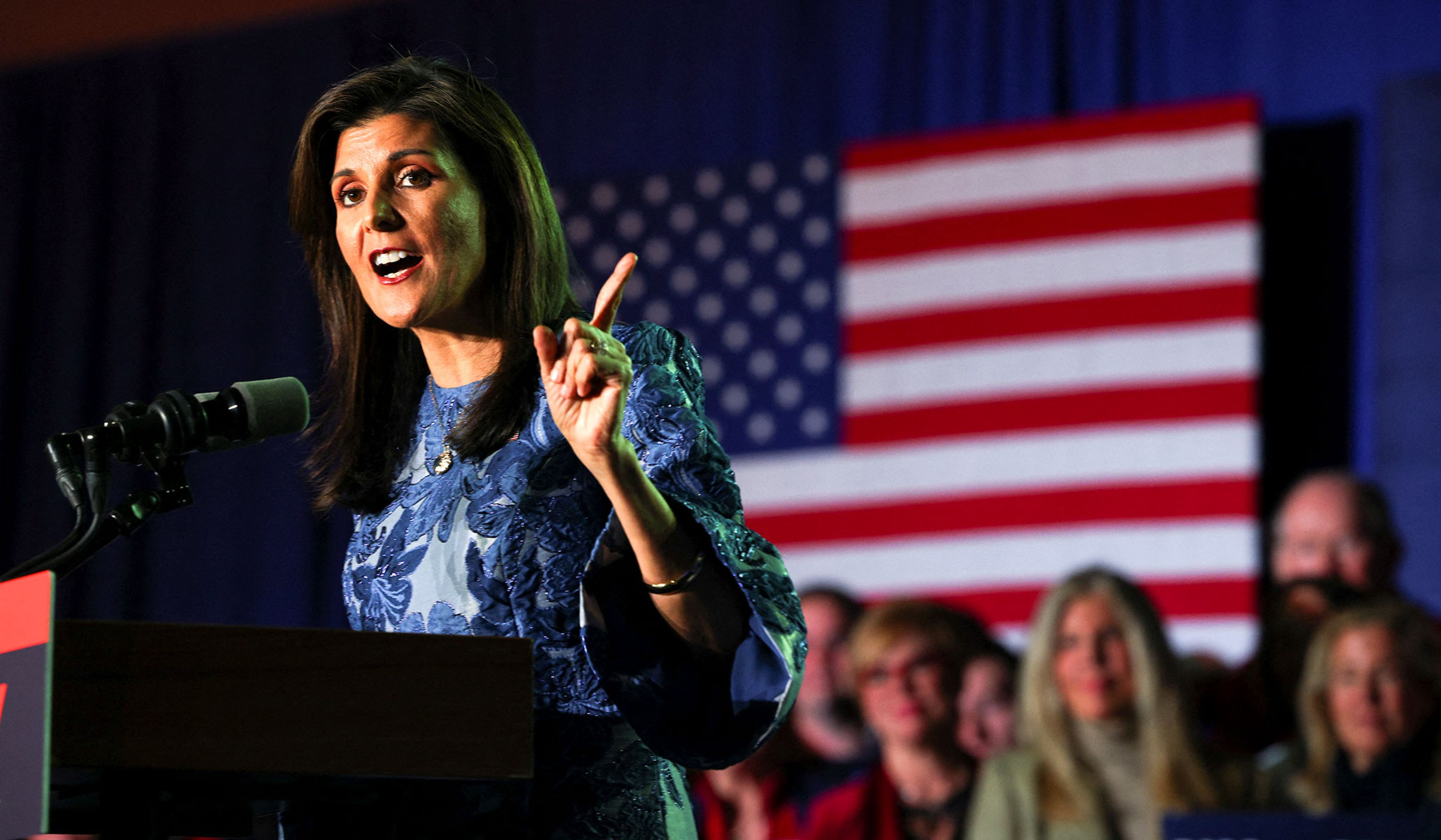
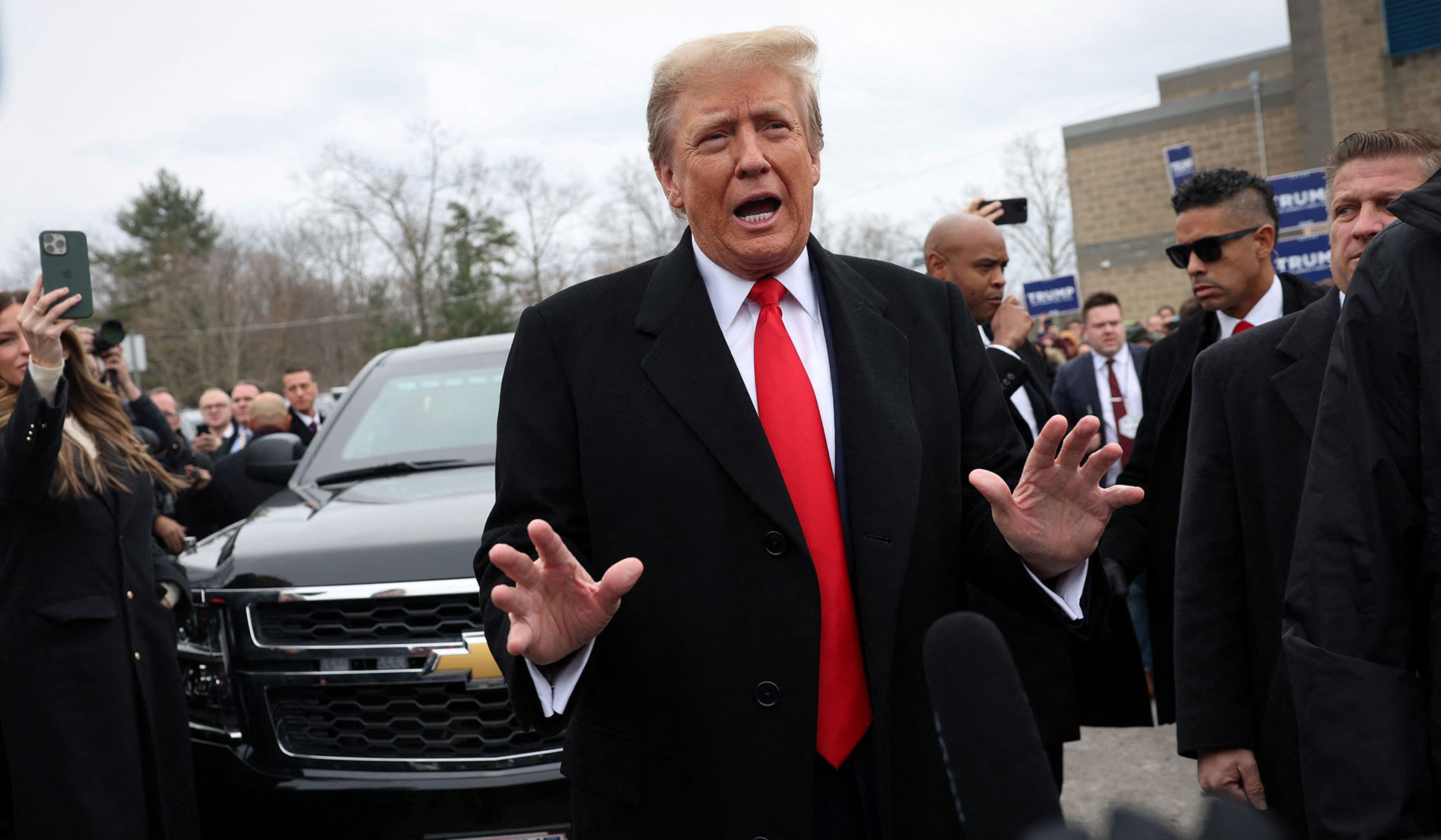
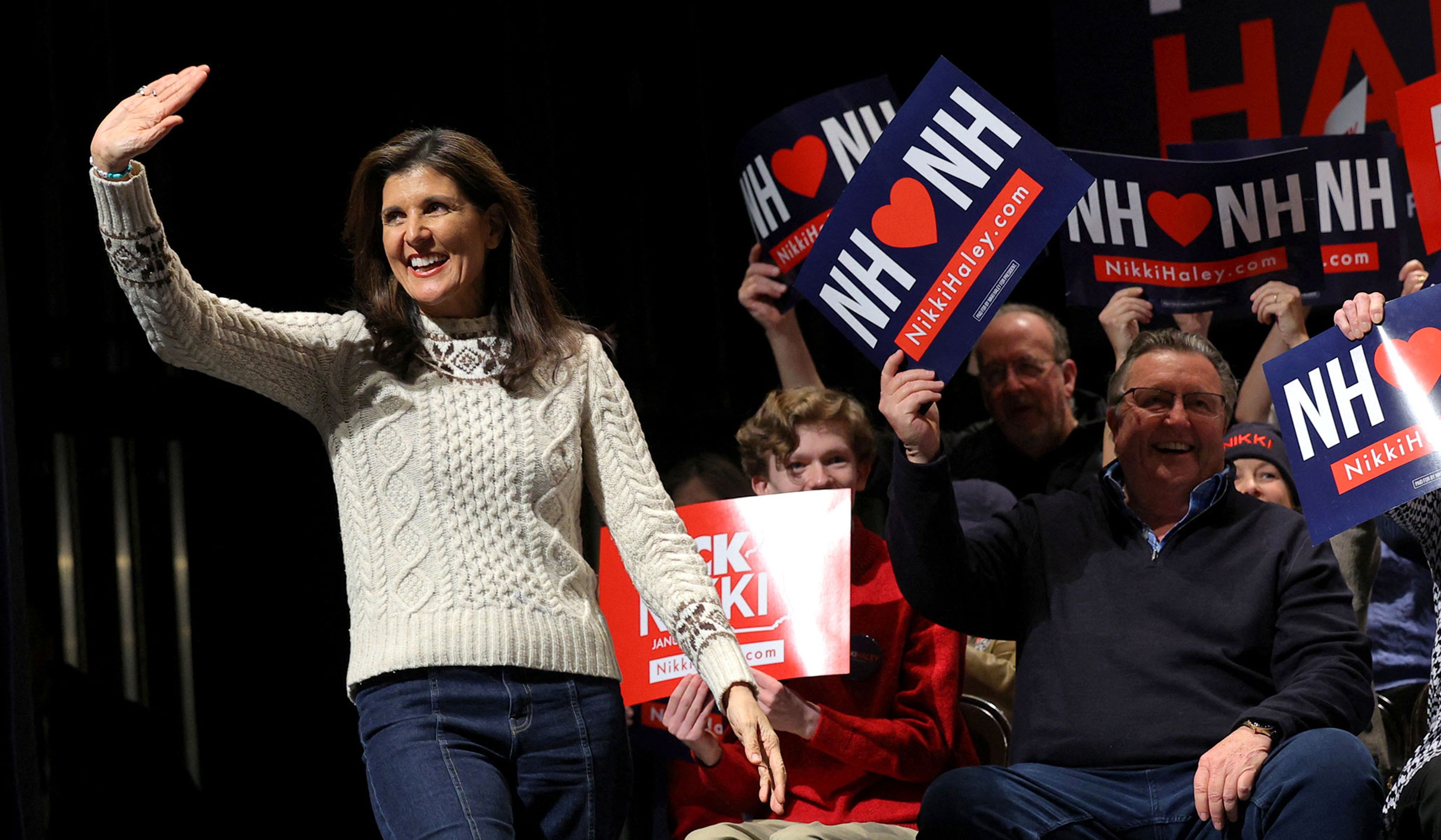
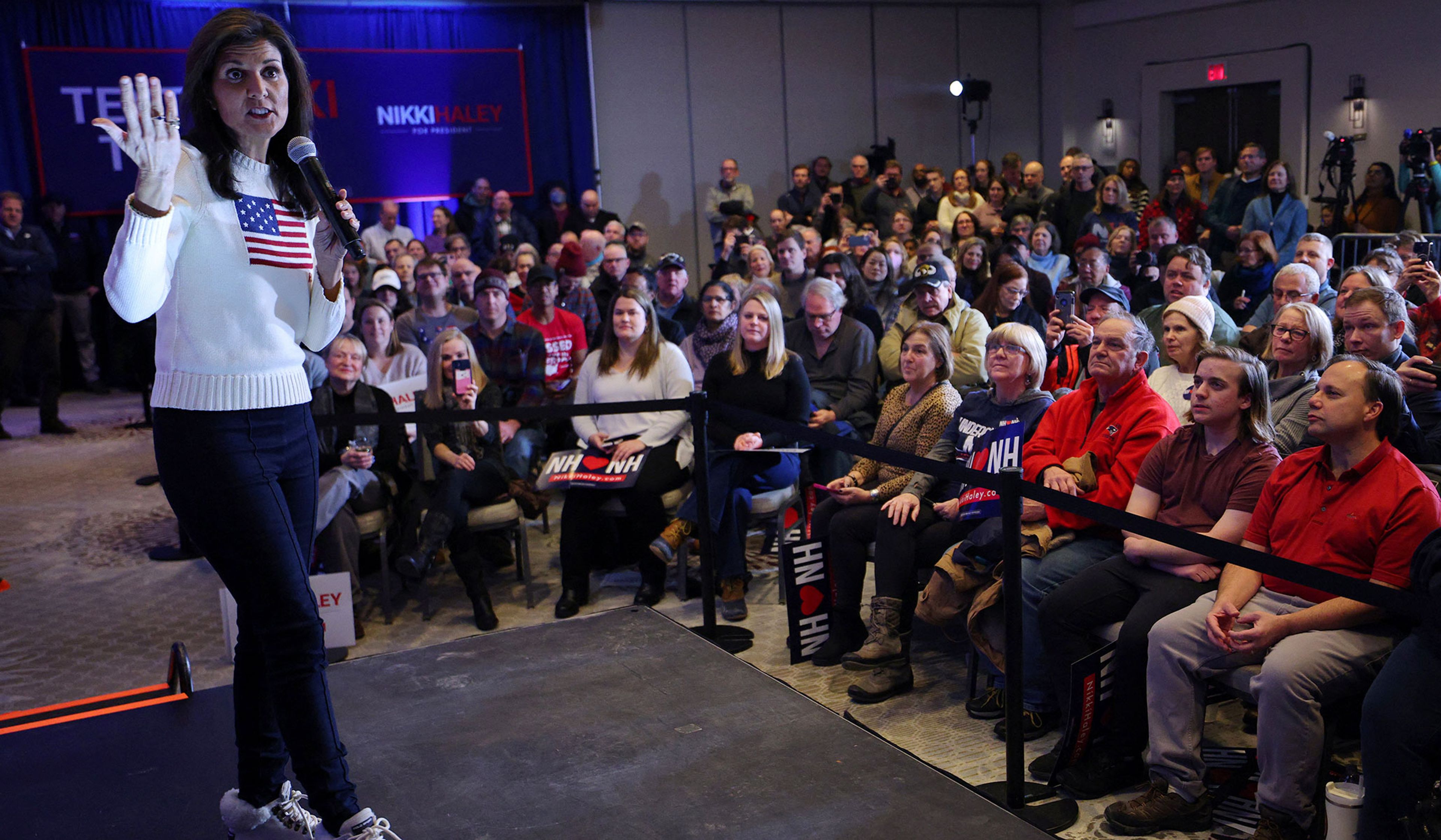
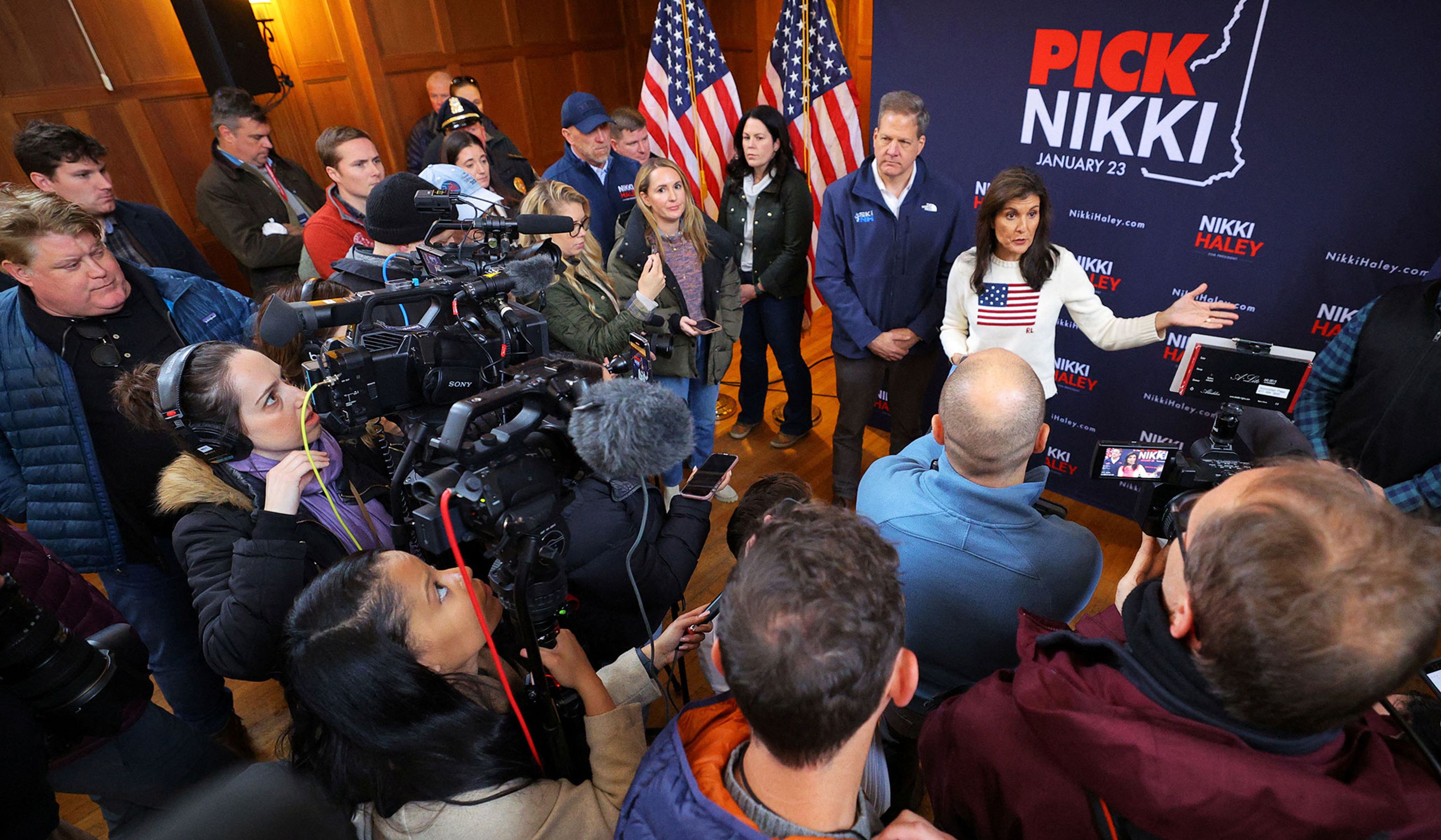
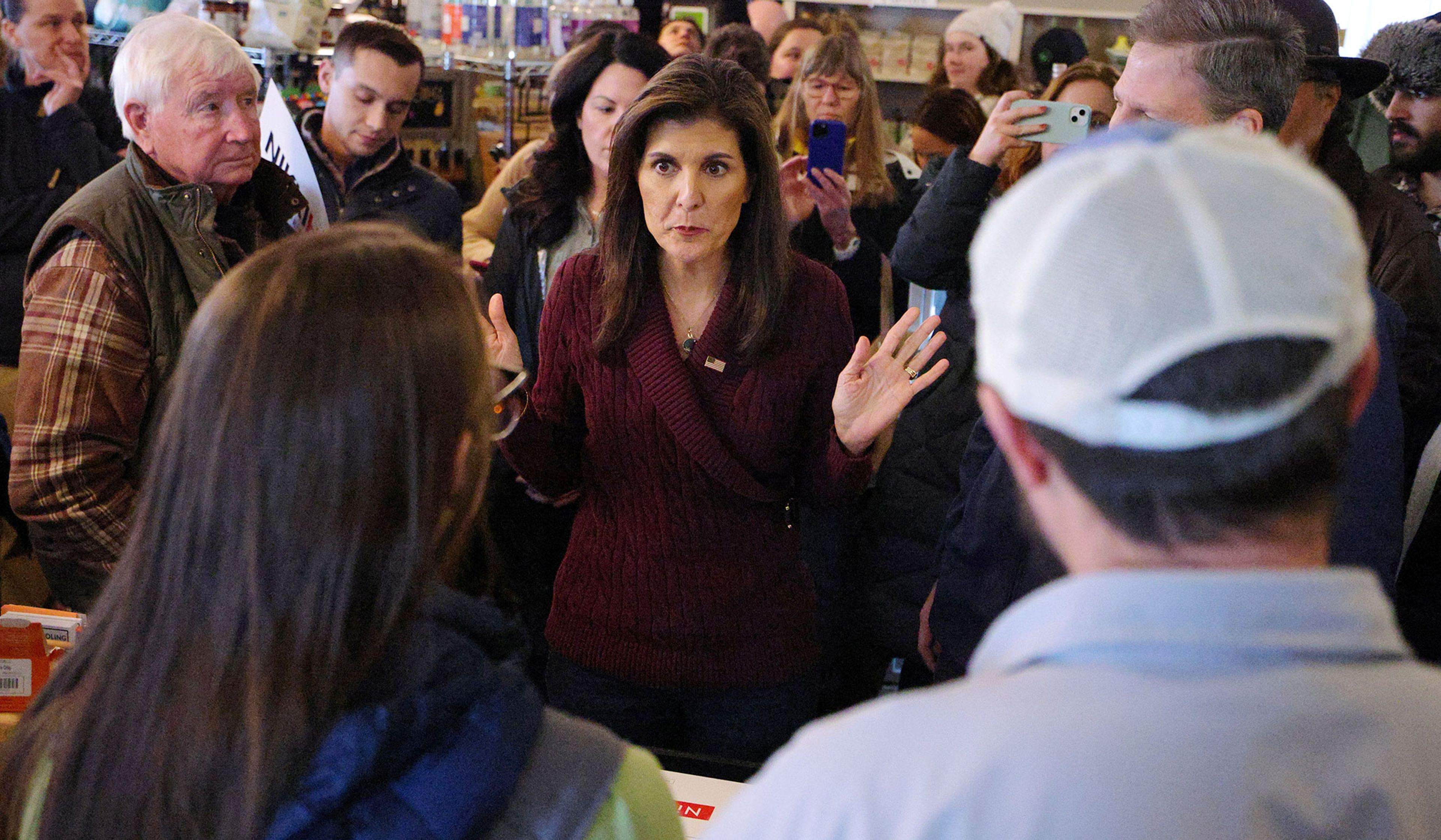
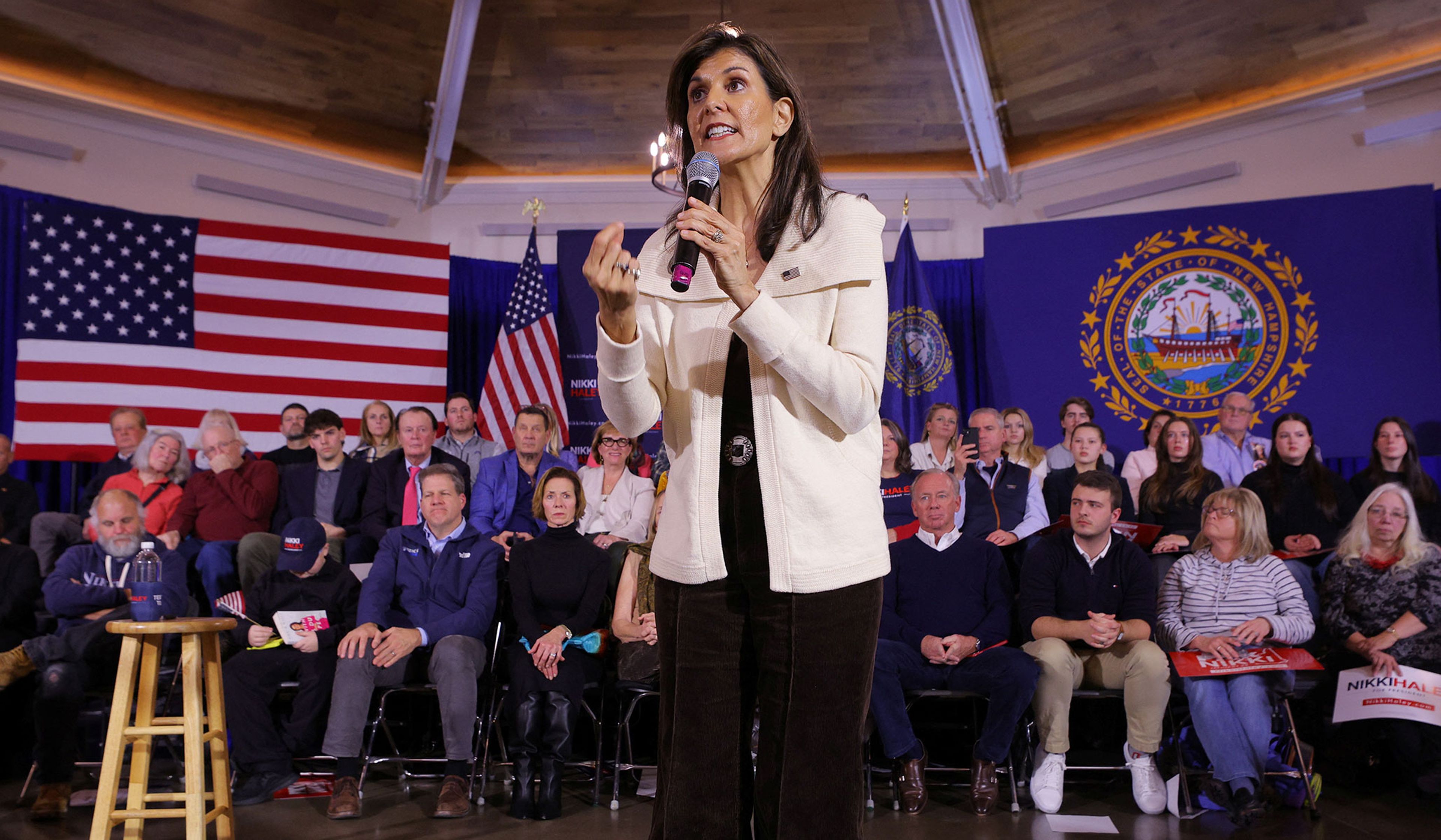
Nikki Haley carried Dixville Notch, the hamlet whose ritual postmidnight vote gives it the first headline on the morning of the New Hampshire primary. It was her last good news of the day, and no doubt of the campaign. Despite an infusion of independents and fence-jumping Democrats, Donald Trump beat her 54 to 43, a solid if not blowout margin. Ron DeSantis had dropped out after an anemic second-place finish in the Iowa caucuses. Vivek Ramaswamy and Chris Christie folded their tents before him. Barring acts of God, the 2024 election will be another Trump–Biden contest.
How did Trump do it? President Biden’s troubles — lingering inflation, wars and rumors of wars, his debility — could have benefited any Republican. But the illegal-immigration crisis targets Trump’s strike zone. No, he didn’t build the big beautiful wall on the border when he was president. But his rhetoric gave aliens pause and his arrangements with Mexico kept many of them there pending vetting. Today’s chaos makes an ongoing campaign ad for his measures. The loyalty of Trump’s longtime supporters is reinforced by the blizzard of prosecutions that engulfs him. His rallies were becoming old hat — how many times can you hear “The Snake”? — but courtrooms became his new stage, turning a former president into an underdog. Finally, he still enjoys the game. Pleasure in performers, politicians included, is infectious.
The GOP, voters and leaders alike, is a Trump party. What have they gained by the bargain? However motivating Trump’s legal troubles are for his base, they turn off the ambivalent (Haley’s New Hampshire showing reflected this). Some prosecutions — Alvin Bragg’s bid to nail him on business fraud — are rickety. Not all. Trump has already lost sexual-abuse and defamation civil judgments to E. Jean Carroll; the court is now reckoning further defamation damages. His mishandling of classified documents seems brazen.
Trump’s rhetoric concerning these and other matters is grossly irresponsible. He claims “complete & total” immunity for presidential behavior, “even for events that ‘cross the line.’” Not content to invoke the privileges of royalty, he reminds audiences how fond he is of dictators — Putin, Xi, and Kim Jong-un are “very fine people,” “brilliant,” “top of the line.” Leaders of republics should have more respect for their systems, their fellow citizens, and themselves.
Not that respect has ever been a Trump strong suit. The pleasure he takes in campaigning is too often that of a primary-school bully — mocking John McCain’s injured arms, Biden’s stutter, and Haley’s ethnicity. (Vivek, call your office.)
Age is not only Biden’s problem. Trump is showing his — in the slather of bronzer that has become his maquillage, and in the increasingly frequent misspeaks — e.g., Nikki Haley being responsible for Capitol security on January 6, 2021 — that are all the more noteworthy in such a practiced talker.
All this is to say nothing of Trump’s political positions. To flag only one new concern: Many Republicans, as the party is now constituted, would abandon Ukraine. Trump, the supposed China hawk, remarked that Taiwan “took all of our chip business.”
Republicans will have ten months, at least, to watch the consequences of their choice play out.
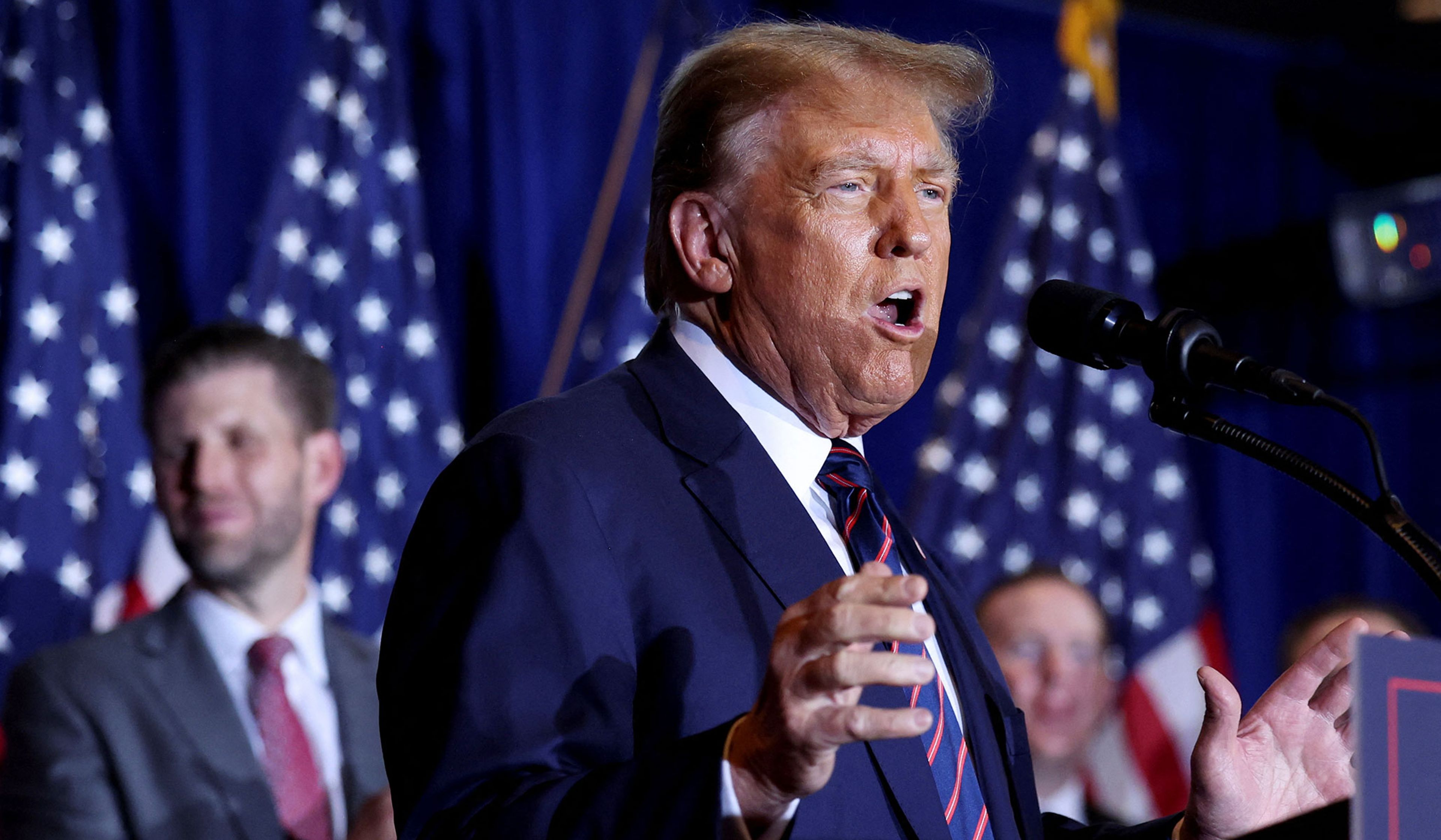
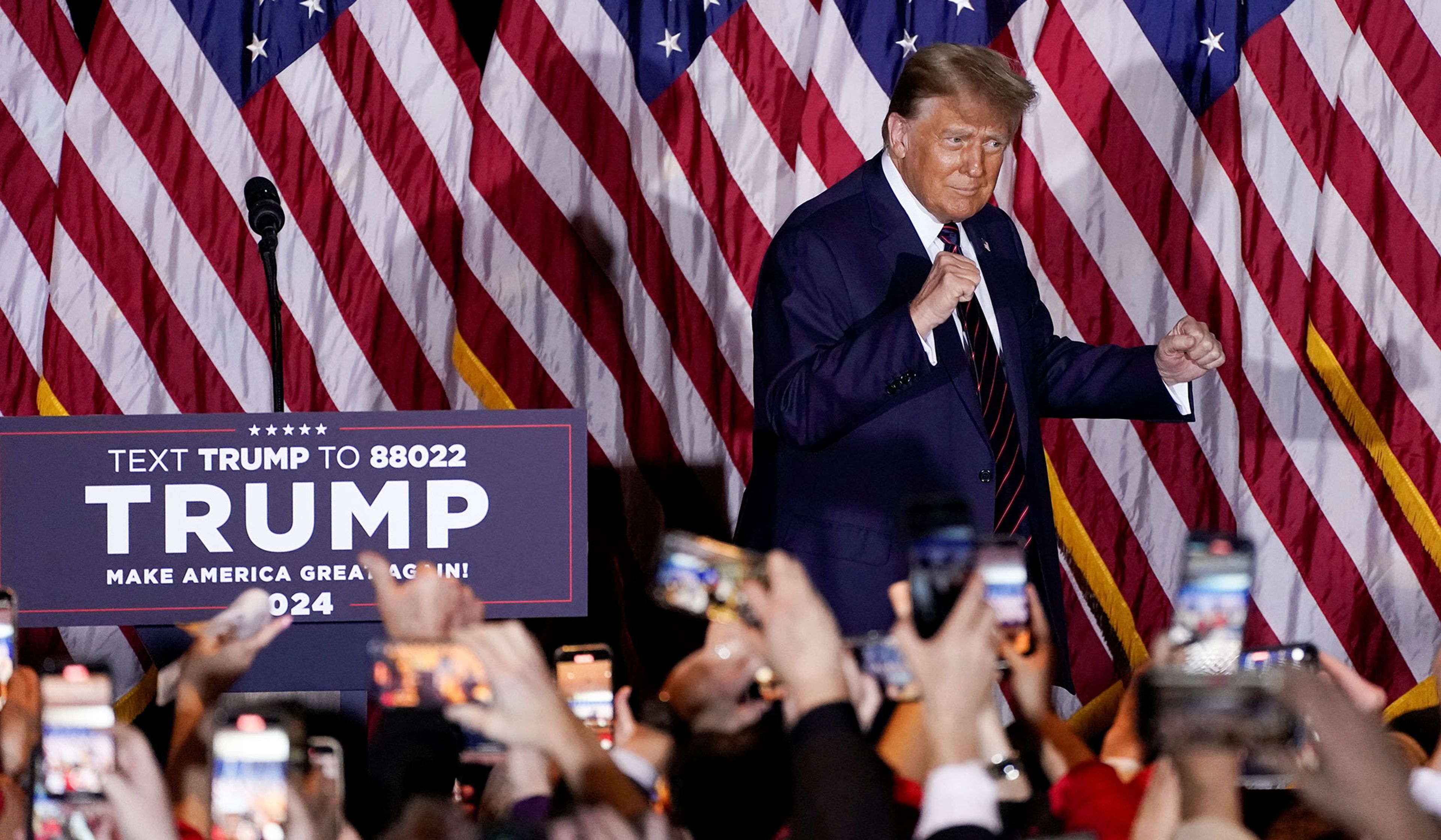
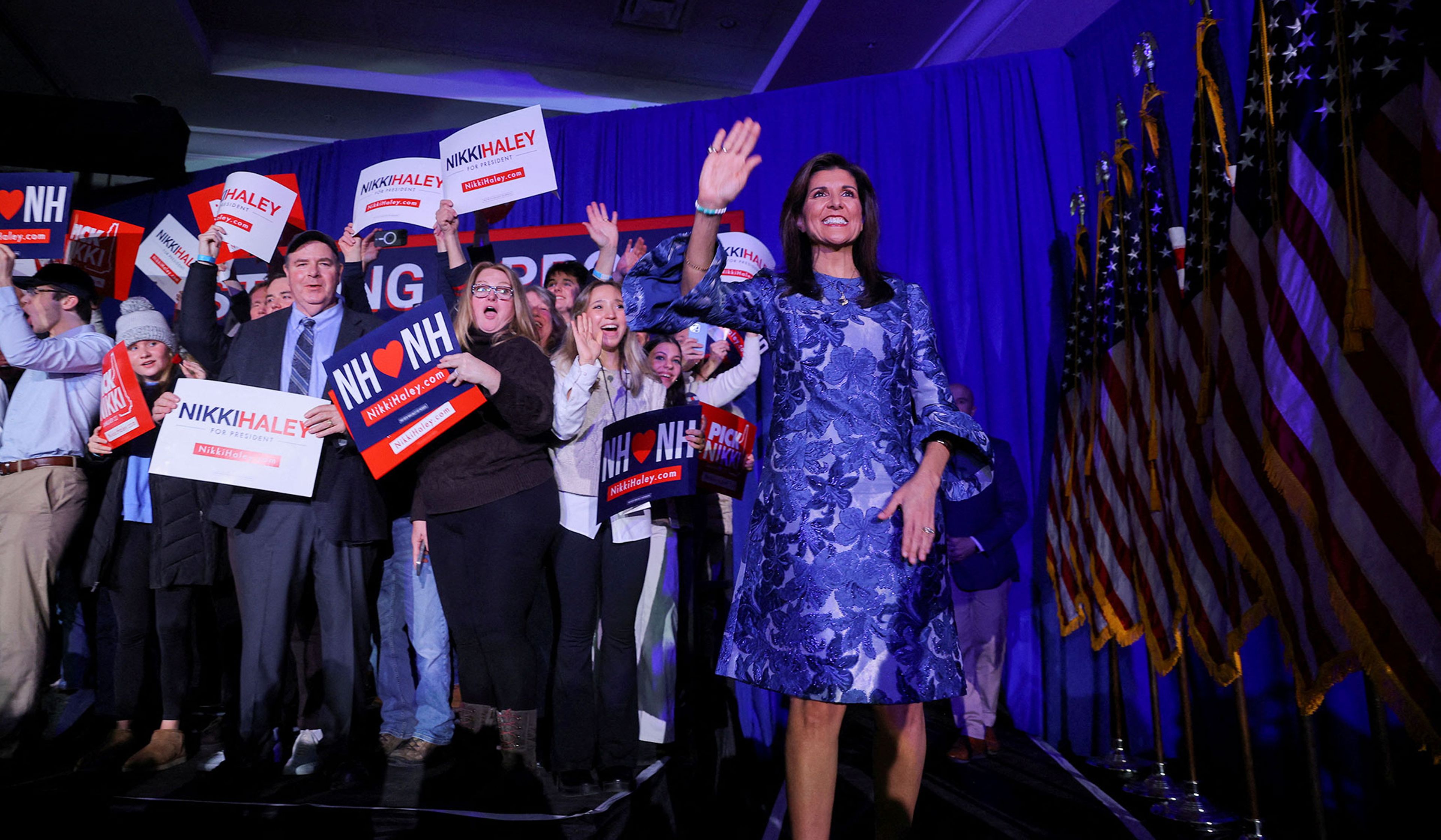
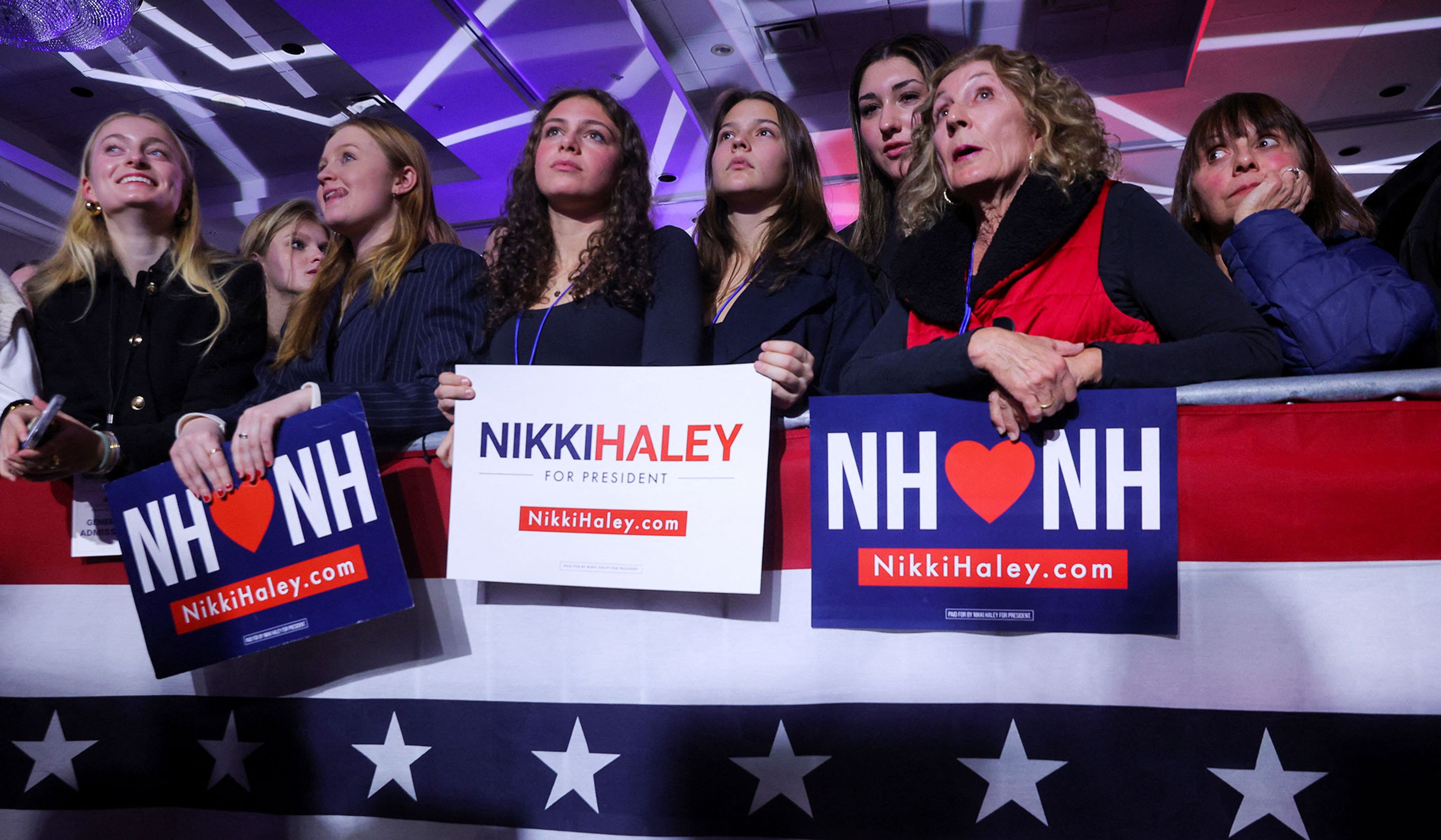
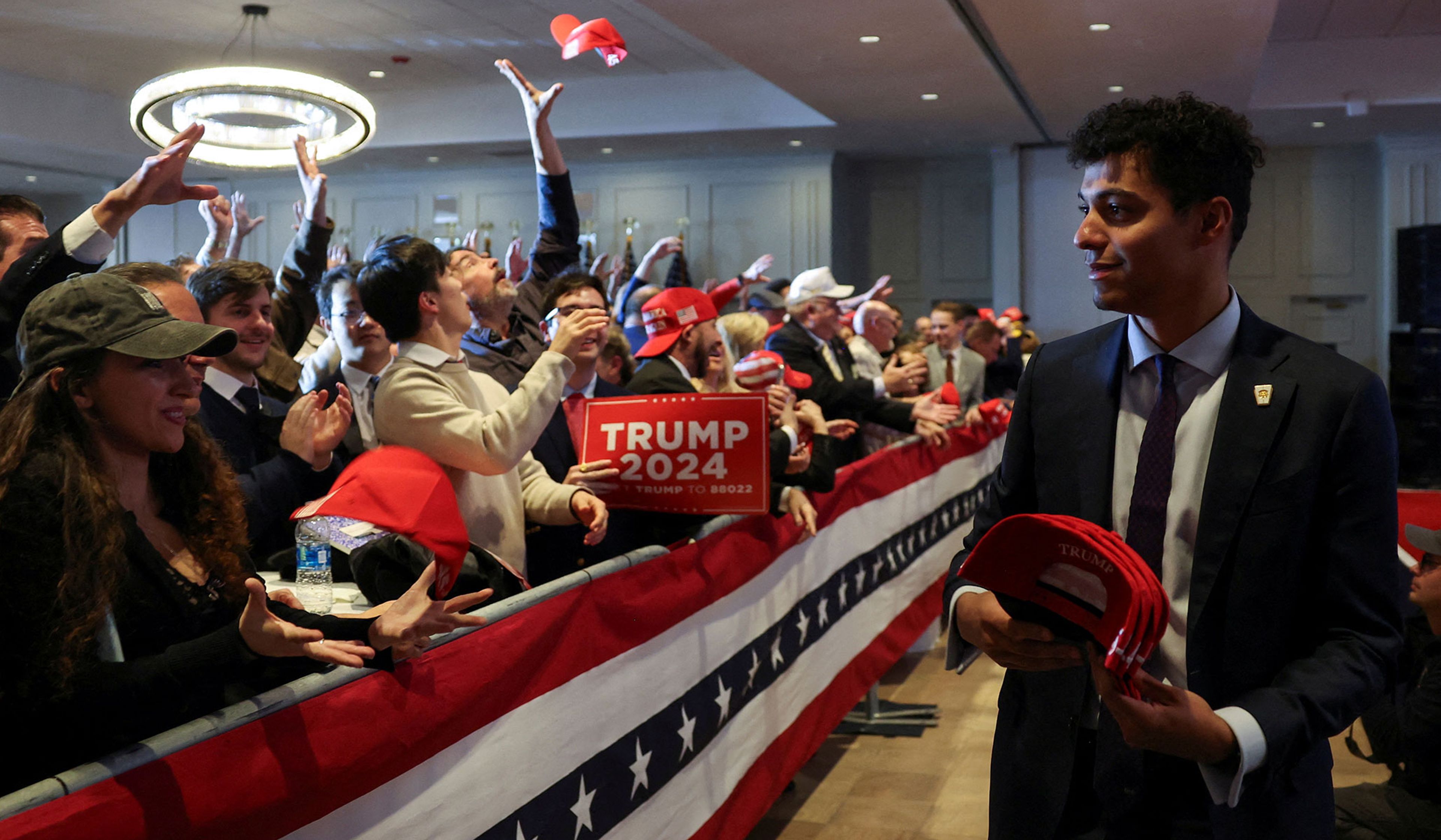
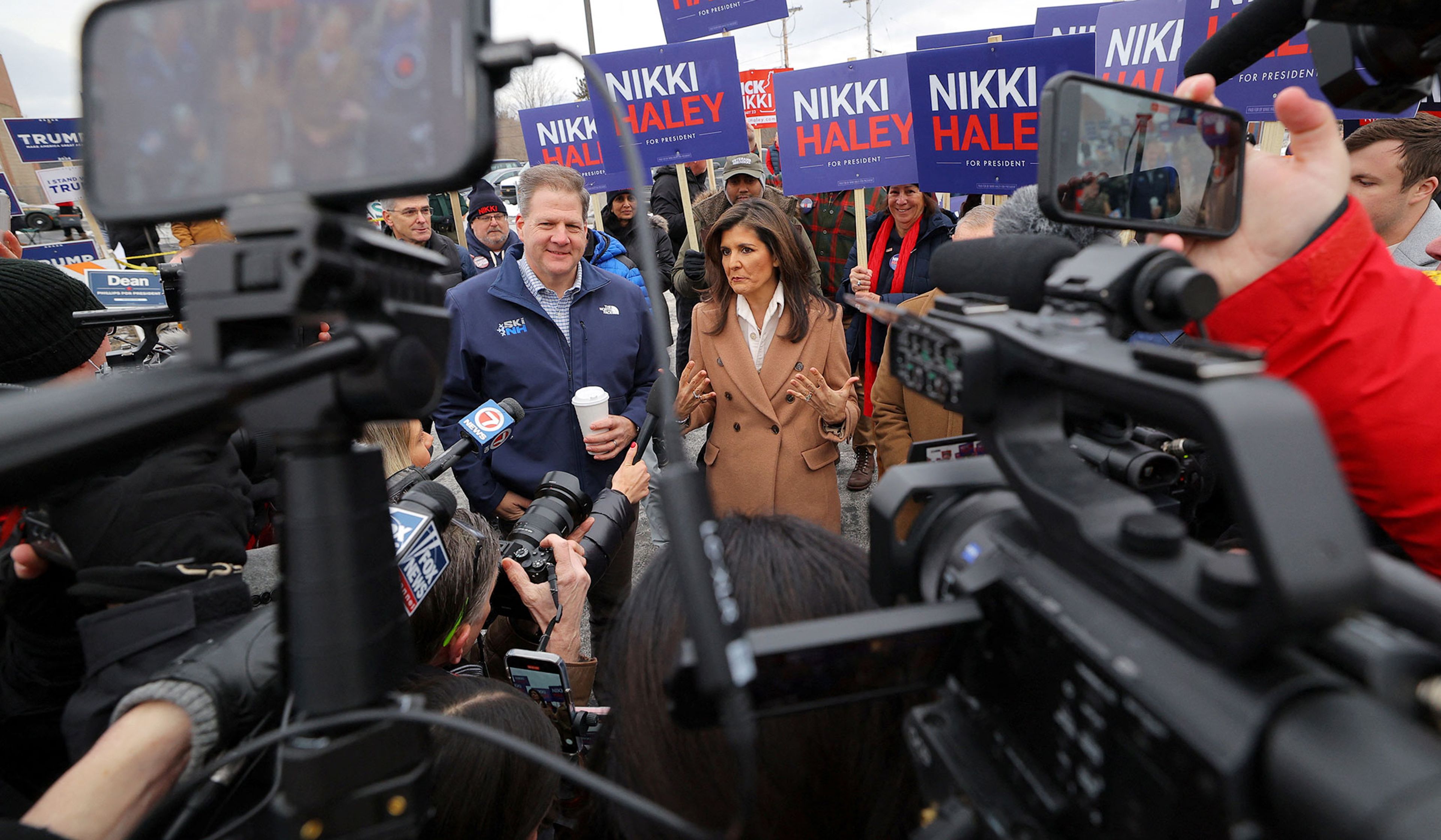
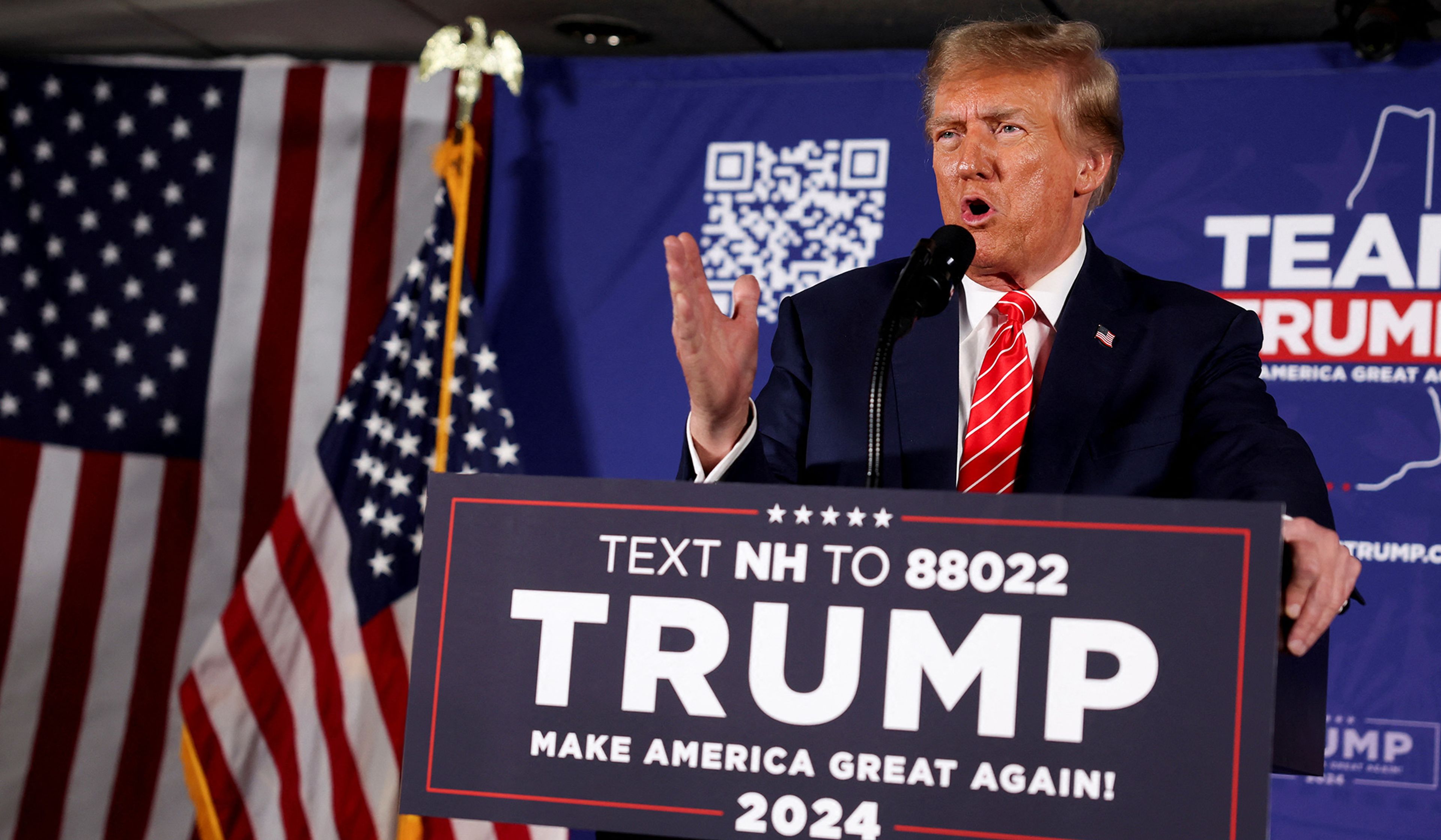
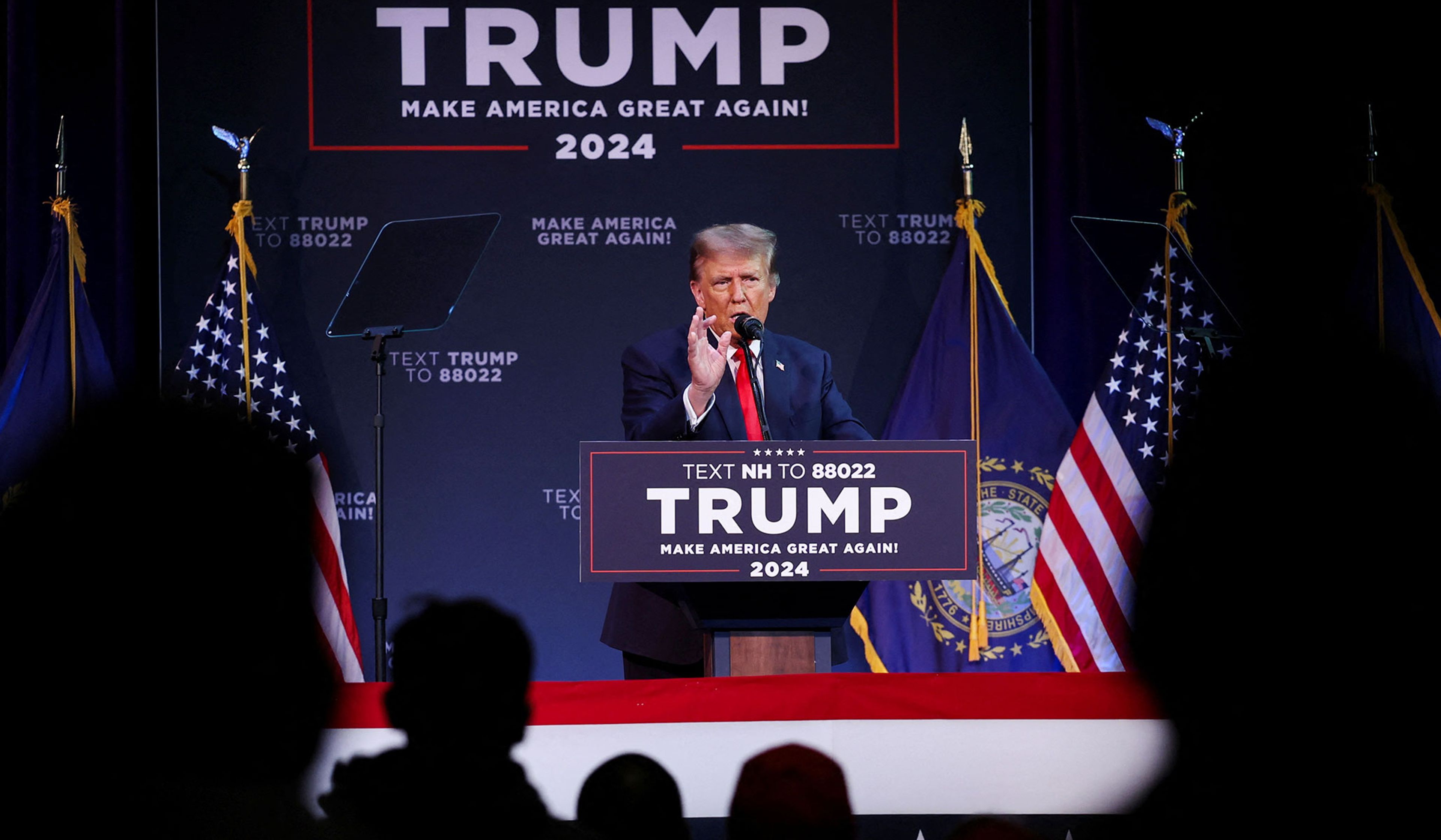
Former president Donald Trump speaks during his New Hampshire presidential primary election night watch party in Nashua, N.H., January 23, 2024.
Mike Segar/Reuters
CORRECTIONS
In the Week (December 2023), the editors referred to a false accusation that Israel had bombed Al-Shifa Hospital. In fact, the accusation concerned Al-Ahli Baptist Hospital.
In “Big Law Gets Smaller” (Stuart Taylor Jr., December 2023), Paul D. Clement was described as having litigated more than a thousand cases before the Supreme Court. In fact, he has litigated more than a hundred.
The Stat
111 days — the amount of time it took to accumulate the most recent trillion dollars in national debt, according to the “Debt to the Penny” report from the Department of the Treasury.
U.S. total public debt outstanding broke $34 trillion for the first time on January 4. It broke $33 trillion for the first time on September 15, 2023. But the 111 days between those two dates are not the fastest the U.S. has ever accumulated $1 trillion in debt. Here are the intervals for other recent trillions:
- 93 days to go from $32 trillion to $33 trillion
- 256 days to go from $31 trillion to $32 trillion
- 246 days to go from $30 trillion to $31 trillion
- 47 days to go from $29 trillion to $30 trillion
- 291 days to go from $28 trillion to $29 trillion
- 152 days to go from $27 trillion to $28 trillion
- 115 days to go from $26 trillion to $27 trillion
- 36 days to go from $25 trillion to $26 trillion
- 29 days to go from $24 trillion to $25 trillion
The 29 days during the Covid pandemic, from April 7, 2020, to May 5, 2020, are the record for fastest trillion accumulated. All told, the most recent $10 trillion in national debt took 1,265 days to accumulate. It took 219 years, from 1789 to 2008, to accumulate the first $10 trillion in debt. by Dominic Pino











Comments