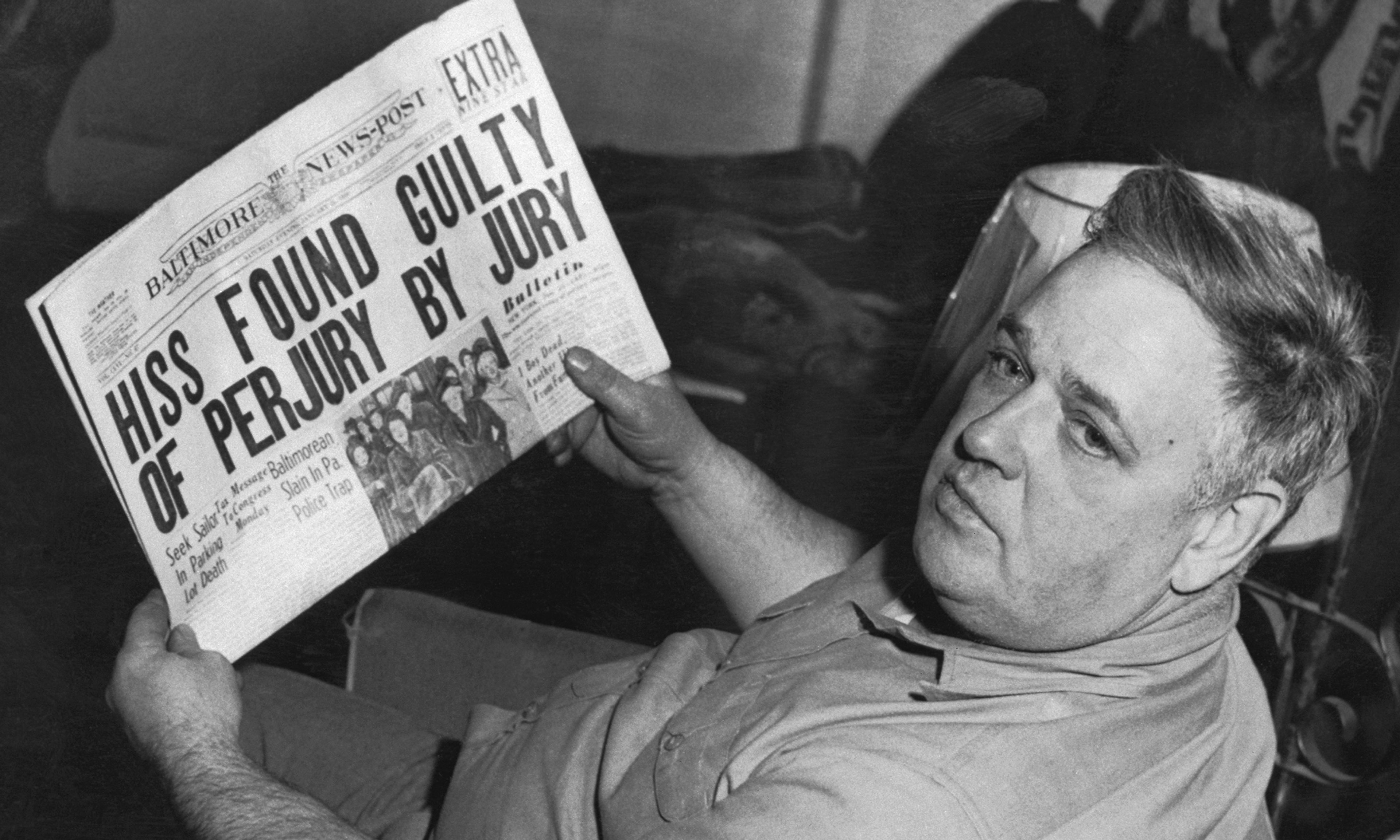
‘At the heart of man there is an innate silence,” says Robert Cardinal Sarah, “for God abides in the innermost part of every person.” Silence may not be the first quality that comes to mind when taking up Witness, an 800-page memoir that covers, among many other events, the author’s voluminous testimony in one of the most infamous trials of the 20th century. But in rereading Whittaker Chambers’s literary masterpiece on the 70th anniversary of its publication, with the Cold War over and the principal characters in the Alger Hiss case long dead, what stands out is the author’s spiritual odyssey, one culminating in the grace granted him through the power of silence.
Chambers’s importance in shaping the post-war American conservative movement, particularly through his influence on the founder of this magazine, is well known. And except for the occasional ex–Nation editor and a handful of other assorted cranks, no holdout believers in Alger Hiss’s innocence remain, thanks to definitive research by Allen Weinstein, Sam Tanenhaus, and others. But as the minutiae of the Hiss case fade into obscurity — the typewriter, the rolls of film, the Ford Model A sale, the gift rug, and all the other pieces of evidence that collectively exposed Hiss as a liar and Soviet spy — what comes to the foreground in Witness is the spiritual agony that drove Chambers to embrace communism in the first place and the respite he would eventually find in Christianity, specifically in the tranquility of Quakerism.
To read about Chambers’s early life is to understand why he came to the conclusion that, as he famously said before the House Un-American Activities Committee, “we are caught in a tragedy of history.” Early in the chapter focused on his upbringing on Long Island, Chambers shares a childhood memory of his younger brother Richard standing on the porch of their Lynbrook house, calling him to come out and join him as it drizzles lightly.
In a voice whose only reproach is a plaintiveness so gentle that it has sounded in the cells of my mind through all these years, he calls: “Bro (for brother), it’s mainin (raining), Bro.” He calls it over and over without ever raising his voice. He needs me because he knows what no child should know: that soft rain is sad. I will not understand this knowledge in him until it is too late, when it has ended his life. And so I do not go out onto the porch.
As the chapter continues and the brothers struggle through their youth, their parents in a broken marriage and their father emotionally (and often physically) distant, the reader sees Richard’s childhood sadness slowly blossom into full-blown despair. After a brief stint at college, he returns home ranting and raving to his brother about the books he’s discovered and the lesson he’s come away from them with. “All his reading . . . added up to one certainty: the folly of life, the need to end it,” Chambers says. A descent into drunkenness and multiple suicide attempts follow. “We’re hopeless people,” Richard tells his brother shortly before he succeeds at taking his own life. “We can’t cope with the world. We’re too gentle. We’re too gentle to face the world.”
Reflecting on his brother’s bleak outlook, Chambers finds that he agrees with it — up to a point. “That the world was dying both brothers knew. We differed as to how to face the fact,” he writes. Rather than join his brother in death, Chambers decides to fight against the brokenness of the world through embracing communism. Next come many years advancing the cause, first in word on the staff of the Daily Worker and the New Masses, and later in deed as an underground agent working for Soviet military intelligence.
Chambers would fully break with communism and go into hiding in early 1938 after years of growing doubts. In the decade between that break and being called to testify before the HUAC, he found in the quiet of Quakerism what he thought he would find in communism: hope for a broken world. Ironically, the same childhood that set the stage for his journey into Marxism-Leninism sowed the seeds for his return to God. One Sunday as a boy, Chambers asks his grandmother why she isn’t sewing. She tells him it’s because it’s the Sabbath and her mother was a Quaker. As she nostalgically describes the exterior of a Quaker meeting house, Chambers asks her what was inside. “She paused for a moment,” he writes. “Then she said: ‘Peace.’”
Decades later, as a friend tries to persuade Chambers to convert to Episcopalianism, he recalls the conversation with his grandmother and finds himself drawn anew to Quakerism. What follows in Witness, detailing Chambers’s encounter with the Christian faith, are some of the most moving spiritual-conversion passages in American literature, worthy of Thomas Merton. As he picks up the journal of George Fox, the founder of Quakerism, his soul awakens:
It was a voice that spoke peculiarly, as Quakers say, “to my condition.” It summoned me to a direct daily experience of God and told me that His revelation is continuous to those who seek to hear His voice in the silence of all distractions of this world. It summoned me to know the Inward Light, that of God within myself, as within all other men without exception. . . . In short, it summoned me to the most difficult of vocations — to be a Christian as in the first century.
In the still, soft silence of Quakerism, Chambers finds what he never could in the words he wrote and actions he took for communism: “a human completion such as I had never felt before.” This is not to say he rested in emotional and spiritual peace from then on — many a dark night of the soul lay ahead of him, including his botched suicide attempt, described so memorably toward Witness’s end.
What silent contemplation before God did do, however, was to sharpen Chambers’s moral focus. “I came to feel that the problem of evil was the central problem of human life, and that it took as many forms as there were men and women,” he writes.
Seventy years on, Witness still stands as a testament to the power of one such form that evil took in the 20th century — and to the faith, hope, and love that could vanquish it in the hearts of men.












Comments