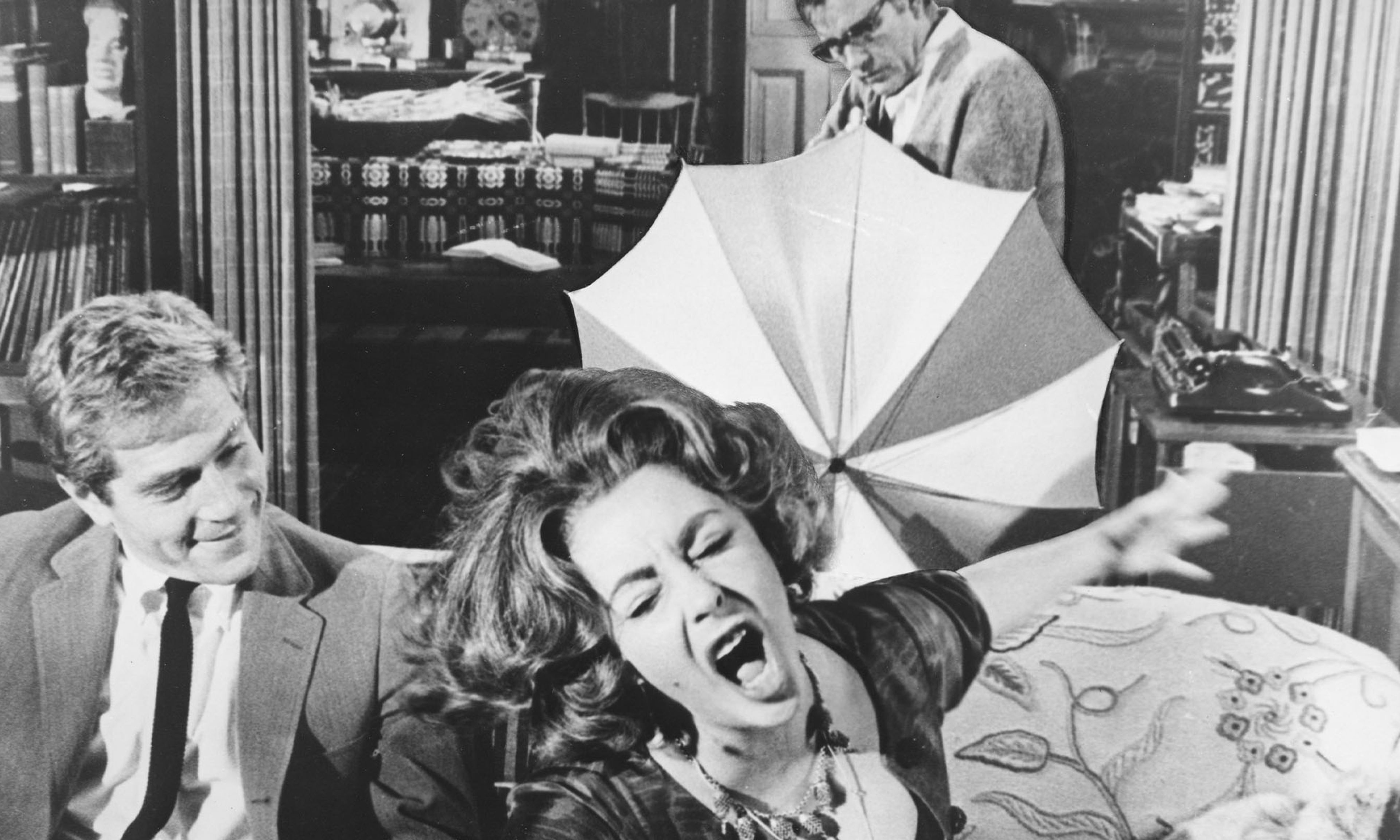
The 1962 play Who’s Afraid of Virginia Woolf? by Edward Albee is a great work about a supremely sad subject: childlessness.
Anticipating our country’s ever-falling birth rate, the American playwright understood that for a married man and woman to proceed through life without children is often, at best, a sadness and, at worst, an invitation to boredom, emptiness, and resentment. In the absence of children into whom they could channel their time, care, and hopes, husband and wife are left with no one but themselves — and, in the fullness of time, many will realize that that is not enough.
Such is the state of history professor George and his wife, Martha, the central couple in Albee’s classic play. Having reached middle age without children, George and Martha have no outlet for their energy other than intermittent marital brawls. They take up arms over their perceived inadequacies: Martha pounces on George for his failures as an academic, George assails Martha for her licentiousness. Each has the other’s number on their mutual drunkenness.
Theoretically, their cancerous anger might have its source in any manner of thing, but Albee, in the course of the play, makes plain its origins: For an unknown number of years, the couple, unable to have children, have been perpetuating between themselves the fiction that they are parents to a son — a phantom figure about whom they speak, for whom they celebrate birthdays, and in whom they find a measure of contentment. The “little bugger,” as George calls him, functions as a stand-in for an alternative life, one that might have held less rancor and more hope, less self-centeredness and more giving. In the final act of the play, George brings the fantasy to a climax by announcing that the illusory boy has had an illusory death — an attempted exorcism that may bring them momentary peace but is likely to do little to help their fractured union. Is a fake dead son really better than a fake living one?
Today, most audiences are familiar with Who’s Afraid of Virginia Woolf? through the 1966 film version directed by Mike Nichols, produced and adapted by Ernest Lehman, and starring Richard Burton as George and Elizabeth Taylor, his real-life wife (for two periods), as Martha. George Segal and Sandy Dennis co-starred as Nick and Honey, the younger, sprightlier, but similarly (and notably) childless couple who are induced to spend an evening with George and Martha and thereby bear witness to their fisticuffs, shenanigans, and revelations. A major box-office success, winner of several Oscars, and all-around boundary-breaker, the film deserves credit for its relative fidelity to the play and its undeniable comprehension of the meanings behind the text. Through the volcanically committed performances of Burton and Taylor, the film communicates the madness of George and Martha, and through the expressive, sometimes baroque direction of Nichols, it also gets across the wellspring of that madness.
The movie is the subject of a laudatory, engagingly written new book. Philip Gefter ably recounts the backstory of the play, the movie, and the assorted personalities involved in the creation of each, but he gets tripped up on the point of the movie: For Gefter, George and Martha’s troubled marriage has no specific explanation but is instead merely an extreme example of the trials and stresses experienced in most marriages. “Albee is peering beneath the surface of one marriage to reveal a set of fundamental truths about marriage itself,” he writes, and, to prove his point, he indulges in a tiresome recent trend, of nonfiction writers’ inserting bits of autobiography into books in which they otherwise play no part: “My parents bickered, too, of course. And sometimes, bitter arguments would erupt between them, with Who’s Afraid of Virginia Woolf? intensity. . . . I lived with the persistent fear of their divorce, but it never happened.”
As long as Gefter limits himself to discussions of the creation of Who’s Afraid of Virginia Woolf?, his book is a readable piece of pop-culture history. We are reminded of the famous story of Albee encountering the title phrase scribbled in soap on a mirror in the men’s room in a Greenwich Village bar, and we learn of other, less known details. Gefter tells us that a bohemian couple named Willard Maas and Marie Menken were dead ringers for George and Martha (Albee “used to come here every time to eat and just sit and listen while Willard and I argued,” Marie said, adding that the characters’ childlessness reflected something in her own life: “That’s supposed to be me and Willard arguing about my miscarriage”). Other interesting tidbits are that the tune “Who’s Afraid of the Big Bad Wolf?” was too costly to use so the title phrase was sung to the public-domain tune “Here We Go Round the Mulberry Bush” and that Albee wrote to the husband of the late Virginia Woolf seeking permission for the title (“The play is not a frivolous work, and the use of your wife’s name in the title will not, it seems to me, do dishonor to her name or position”). Upon its premiere on Broadway, the play received admiring, if occasionally skeptical, reviews and was undeniably a sensation: It sold out each of its 644 performances and prompted Warner Bros. to pay half a million dollars for the film rights.
The book is equally good when it shifts to Hollywood, where a seemingly ill-matched cast of characters conspired to make the movie: studio boss Jack Warner, whose chief preoccupation seems to have been to force the movie to be shot in color (it was ultimately filmed in black and white); producer-adapter Lehman, presented as a square with, as Taylor put it, a “Brooks Brothers mind and intelligence”; and director Nichols, whose time was spent managing his social life, working with (and sometimes against) Lehman to preserve Albee’s vision, and supervising his tempestuous, much-talked-about stars, Taylor and Burton. Wonderful anecdotes abound, including Nichols’s screening New Wave classics The 400 Blows and Jules and Jim and Fellini’s 8 ½ as directorial inspiration, Lehman observing Nichols act out the script for his performers (“He is particularly great as Honey”), and Taylor and Burton, having been offended by a bit of direction, stalking off only to return, hours later, in the company of their pals, the duke and duchess of Windsor. A bold and brilliant film emerged.
Yet, for all his strengths in cultural reportage, Gefter does not persuade with his thematic analysis. He juxtaposes the happy marriages shown in fluff such as Ozzie and Harriet with the toxic marriage in the play, but he errs in assuming the former to be counterfeit and the latter authentic. As we all know, in real life there are both contented unions and discontented ones, and for a work of art about marriage to be great and true, it need not portray only unions that end in rancor or separation: In cinema, the great “comedies of remarriage” feature spouses who have drifted from each other but nonetheless find their way to reconciliation: The Awful Truth, The Philadelphia Story, The Palm Beach Story. Gefter makes much of changing cultural mores about marriage and divorce — he even quotes from Betty Friedan’s The Feminine Mystique — but the fact remains that the play assigns specific blame for the bleakness and barrenness of George and Martha’s particular marriage: the missing child.
Albee, who himself was an adopted child saddled with apparently cold, uncaring parents, was vague in explaining the dramatic purpose behind George and Martha’s made-up youngster. At one point, the playwright said the child was “a ‘beanbag’ for them to throw at each other, a way of getting at each other indirectly.” It is always better, however, to trust the tale, not the teller: Because the absence of a child is given such prominence in the play, we can conclude that had one existed, George and Martha’s lives would have been different; because Martha is so deeply stung by George’s “killing” of their son, we can surmise that she harbored dreams of actual motherhood. This is why Uta Hagen (who played Martha on Broadway) held back in her performances: She herself had had miscarriages and, as director Alan Schneider recalled, “could not suffer the pain of revealing herself that openly night after night.”
Yet that conclusion eludes Gefter, who adopts the contemporary view that marriage is inevitably messy and always governed by emotions, not duty, honor, or obligation. In being so attuned to the mores of the age, he is unable to see what is right in front of him: If George and Martha had been blessed with offspring, their lives likely would have been a whole lot happier. The painful truth is acknowledged, indeed foregrounded, near the end: “You couldn’t have any?” Nick asks, to which George and Martha each say in turn, quietly, “We couldn’t.”












Comments