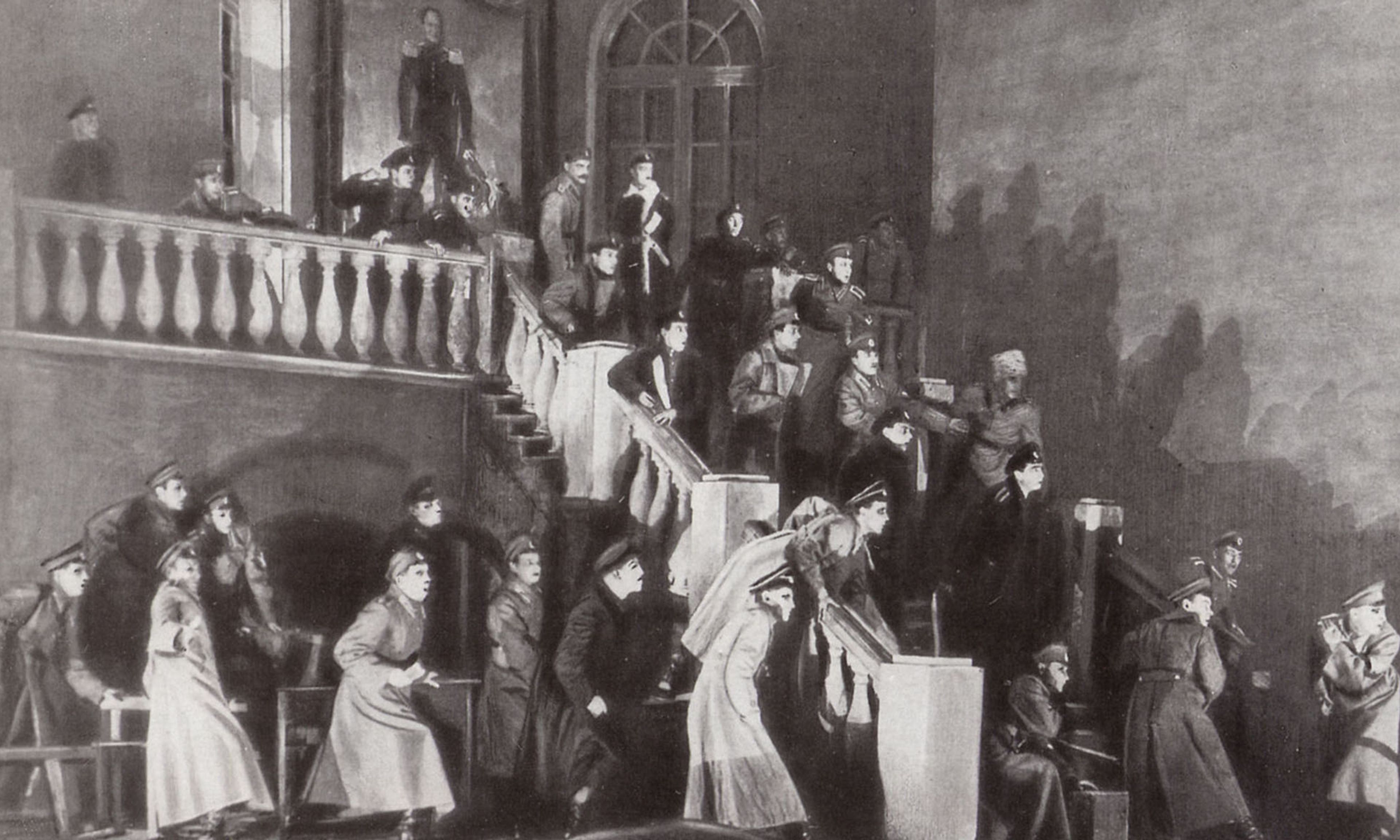
I was brought up on lore of the Moscow Art Theatre. Konstantin Alexeyev (stage name: “Stanislavsky”) and friends started an amateur chamber theater in Moscow in the 1890s. He reports, in My Life in Art, that he’d been moved by witnessing the Saxe-Meiningen Players in 1885. He found their playing revolutionary, as it discarded the old Delsarte technique of standard poses for standard emotions. He’d “seen the new thing.”
He met an entrepreneur-amateur, Vladimir Nemirovic-Danchenko, and the Alexeyev Players became the Moscow Art Theatre. They were supported, first, by the czar, and later by the state; and, most important, by the genius of Chekhov. Stanislavsky started a school of acting and wrote several books on the subject.
When Everything Russian was in vogue, in the ’30s, when the Concerned Left had “seen the future, and it works,” Stanislavsky was taken up by the theatrical intelligentsia of New York. Schools claiming to teach his “system” sprang up like mushrooms. I put “system” in quotes as one who suffered under it. I tried to understand its tenets as taught by Moscow Art disciples. I failed, and decided, the hell with it, I’d just go out and produce plays.
My teacher was Sanford Meisner, at the Neighborhood Playhouse. Other New York Muscovites included Lee Strasberg, Harold Clurman, Stella Adler, and so on.
Harold and Stella made the Hadj to Paris and met with Stanislavsky in 1937. I knew Harold as a friend, and one who’d once run his hand up my wife’s skirt, while at the Theatre, as, he explained, “he came to the theater to enjoy himself.”
I knew Stella as she’d hit on me, in her eighties, me a fresh young thing of 35.
The New York Muscovites were a randy bunch indeed. They were Eastern European Jewish Americans, brought up on socialism and free love, and some notable teacher actually came to grief from taking young students into the broom closets to overcome their repressions.
Stella, charmingly, for one rebuffed, sent me a gift. It was a photo of Yevgeny Vakhtangov’s study in Moscow, given to her by Vakhtangov’s wife. He and Vsevolod Meyerhold were the protégés of Stanislavsky. They founded the First and Second Studios of the Art Theatre.
Meyerhold was all about constructivism, which I believe means sharp-angled sets and boxy movements; and Vakhtangov (my preferred avatar) seems to’ve been concerned with fantasy. I prized The Vakhtangov School of Stage Art (Nikolai Gorchakov, 1959) and the descriptions and photos of his Turandot. And the photo came in handy.
My cousin Sam was a theater student, or something of that sort, at Brown. But he’d forgotten, for several semesters, to show up. When graduation time came around, he squeaked through his tests but still owed the school one semester of a course on dramatic structure or somesuch.
I was living in Cambridge and friendly with a professor at Harvard, who agreed to tutor Sam. My task was, then, to convince Brown to accept the transfer credit from, as Sam said, “one of the lesser schools.”
In my best Chicago fashion, I went to Brown to schmeikel Sam’s advisers. I threw into the pot my willingness to come down to Providence and teach a class or two to the students of such an obviously generous man. No dice. But, I said, perhaps we can just say, “You’ll think it over,” and brought forth my gift. I thanked him for his time and gave him the beautifully wrapped photo that came from Stella, which came from Madame Vakhtangova in Moscow. That turned the trick.
Sam did-or-did-not meet with the Harvard professor the stipulated number of times, but my Cambridge friend had no skin in that game. He wrote Sam a note, and Sam got a degree from Brown. I later told the story to my sister, Lynn, who howled.
“What’s the joke?” I said; and she told me she’d written the essay that got Sam into the place.
My cousin, then, like me, is indebted to the Moscow Art Theatre, and, indeed, to the tenets of Marx: “From each according to his ability, to each according to his need.”
But that’s not all.
I had one of the great theatrical experiences of my life watching one of the Art Theatre’s actresses onstage, in Chicago’s Goodman Theatre in 1964. Eugenie Leontovich had been a member of Meyerhold’s troupe, and of the Art Theatre itself. Her family had been murdered by the Bolsheviks, and she came to New York, and taught herself English. She had a long career on Broadway, as a teacher and producer, and appeared in talkies and early TV.
She came to Chicago’s Goodman in 1964 in Brecht’s Mother Courage. We didn’t know her age, as she kept postdating it, but she was probably in her eighties. Her voice was weak, but the Goodman had an early example of the new Technology: body microphones for actors onstage. It worked passably well until the receiver started picking up taxi calls and broadcasting them to the audience. That, I believe, was as close as I ever got to an actual member of the Art Theatre.
I’ve long cherished (you can, too) their performances in film.
Leontovich’s husband, for a time, was Gregory Ratoff (né Ratner). He went to Hollywood and directed 30 (rather good) films. He can be seen as Max Fabian in All about Eve and as the painter in O. Henry’s Full House; as Lakavitch in Exodus, and in 50 other films. Also, we can adore Vladimir Sokolov. He left Russia for Germany and France, and got out a half step ahead of the Nazis, and came to Hollywood, where he played every Foreign Type (see Back to Bataan, Mr. Lucky, For Whom the Bell Tolls, The Magnificent Seven, and countless television episodes).
Akim Tamiroff, another Moscow alum, played in over 60 films, usually a light- or comic-heavy. He was a favorite of Orson Welles and can be seen in Touch of Evil and Mr. Arkadin, see also Ocean’s Eleven, and in every television show made in the ’50s and ’60s. He is immortalized as Boris Badenov, the cartoon Russian spy, in Rocky and Bullwinkle, his signature accent voiced by Paul Frees.
And who had a more charming accent than Maria Ouspenskaya? She was nominated for an Oscar for her performance in Dodsworth (1936). (Do watch it.) She is remembered for the magnificent kitsch of her performance as “a villager” in The Wolf Man (1941) (“You must not go in dee Voods, dee Volffman leefs in dee Voods”). She was a great actress.
I revere her for her portrayal of the Indian Maharani in The Rains Came (1939). I don’t know how an actual queen behaves, but I would be proud to be a subject of one like that created by Madame Ouspenskaya. Bidding adieu to the new pretender to the throne (Tyrone Power), she says, “Geef my wespects to the wiceroy,” which has become the standard leave-taking in my family.
At one degree of separation, one’s ex-mother-in-law studied acting with her in Hollywood in the 1930s and reported that Ouspenskaya was, day after day, more drunk than any human could be and breathe.
And, again from Hollywood, we have the Moscow protégée, Marem-Ides Leventon. She took the name “Alla Nazimova” and played the European classics on Broadway. She, of course, came to Hollywood (don’t we all?) and played in many silents and a few talkies. See Blood and Sand (1941) and The Bridge of San Luis Rey (1944). She is also remembered as the proprietress of that Mecca of debauchery, her mansion on Sunset, known as “the Garden of Alla.”
There were great actors who came out of Moscow. They left Russia because of the Bolsheviks, and then Germany, as most of them were Jews. I can’t give them much credit as teachers in the States. Neither do I criticize them, for I’ve done the same. Actual theater people (writers, directors, actors) start a school to gain student tuition and free help carrying both spears and coffee. This is not to dismiss the urge to communicate the ideals one holds dear. These, unfortunately, can’t be learned in the classroom, or the studio, but only onstage.
Here is the true legacy of Stanislavsky: He attracted the greatest talents, as he recognized and respected them. It was not his teachings but his theater that communicated his vision to the world. It was an organic vision, of performances created not in front of the mirror, but onstage, in concert with and in response to the performances of one’s fellow actors.
As I did not understand my teachers, I was inspired to figure it out for myself. The question, the answer ever receding, is how to achieve actual spontaneity when speaking a memorized text and moving in a predetermined pattern. The books and the classes can, at best, serve to drive one, in confusion or boredom, to try it out oneself.
Frances Farmer did. (My last example.) She is one of the great actresses of American film. There’s no one like her. Most, when they walk on stage, or before the camera, add an element of “performance” — that is, of artificiality — to the performance.
The great actors are not those who do that well, or with originality, but who don’t do it at all. She was one.
She went to Moscow in 1935, having won a drama contest, and studied at the Art Theatre. But I suspect she may have taught more than she learned.









Comments