Writing in the July/August 2007 issue of Foreign Affairs, then-candidate Barack Obama outlined his foreign-policy views. He wrote that after the financial and human cost of the Iraq War, “many Americans may be tempted to turn inward and cede our leadership in world affairs. But this is a mistake we must not make. America cannot meet the threats of this century alone, and the world cannot meet them without America.”
He then harkened back to three Democratic presidents:
Such leadership demands that we retrieve a fundamental insight of Roosevelt, Truman, and Kennedy — one that is truer now than ever before: the security and well-being of each and every American depend on the security and well-being of those who live beyond our borders.
This statement may seem somewhat surprising given that Democrats spent much of the Bush presidency questioning President Bush’s interventions abroad, and that even as Senator Obama wrote these words he and many in his party were advocating the abandonment of the Iraqi people to sectarian bloodshed.
Democratic foreign policy since the end of the Cold War has been characterized by this dichotomy between U.S. international engagement and a more restrictive view of America’s international obligations. A majority of Democratic senators voted against the 1991 Persian Gulf War. The Clinton administration intervened in Bosnia, Haiti, and Kosovo, repeatedly bombed Iraq, and went after Osama bin Laden with cruise missiles. In the wake of the September 11 attacks, a majority of Democratic senators supported the Iraq War, but the Left turned against the war and today is lobbying President Obama to pull out of Afghanistan.
This Democratic uncertainty about America’s role in the world and its ability to effect change overseas is apparent once again as President Obama’s national-security team discusses the way ahead in Afghanistan. Gen. Stanley McChrystal has submitted an assessment stating that, without additional forces, the U.S. effort in Afghanistan “will likely result in failure.”
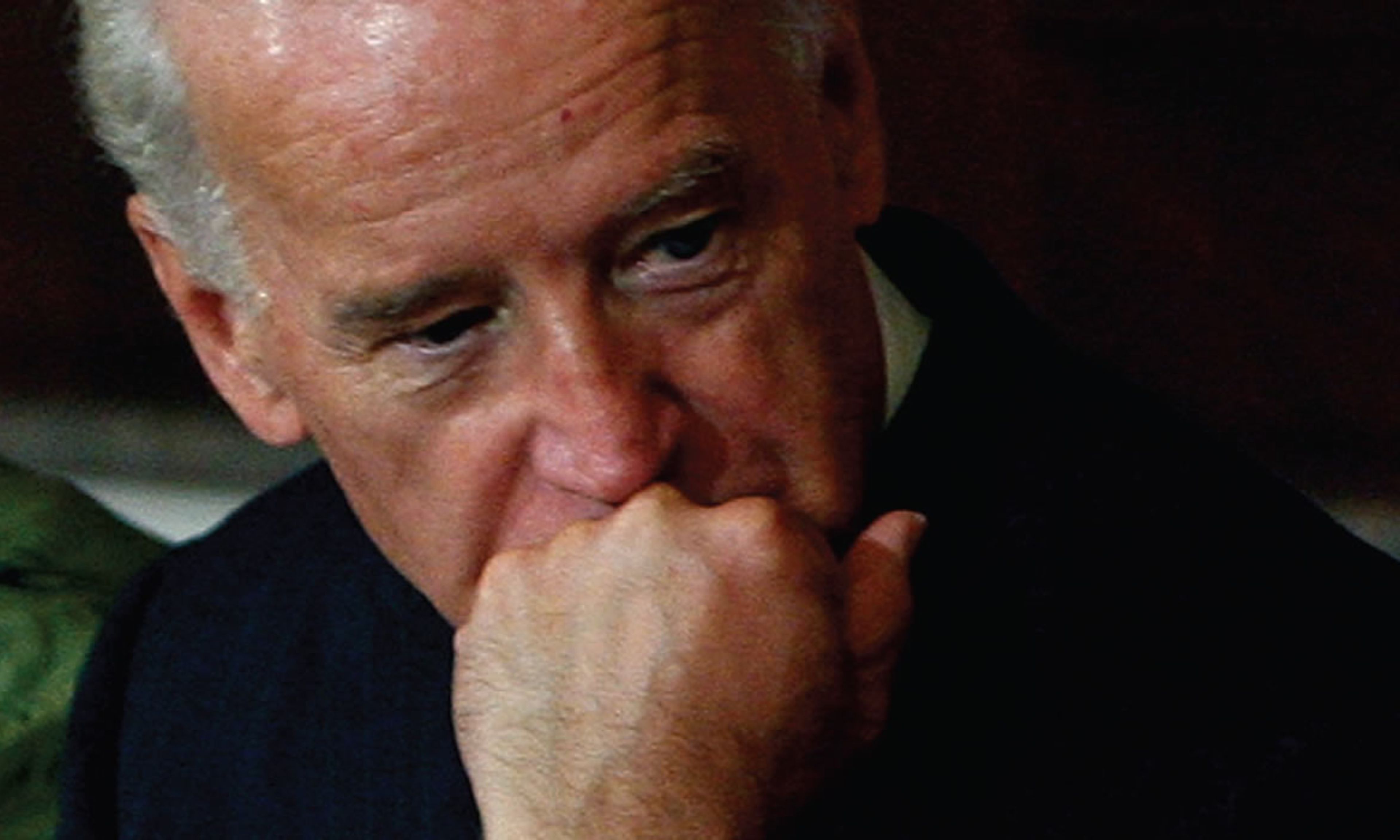
The chief opponent of General McChrystal and the military brass is an unlikely one: Vice President Joe Biden. Unlikely because for much of the last eight years, Biden criticized Vice President Cheney for his supposedly oversized role in policymaking, especially on national-security issues.
Earlier this year, Biden lost the first round when President Obama rejected his advice and decided to send 4,000 troops to Afghanistan beyond the 17,000 he had already authorized, but the vice president has now resumed his advocacy for a “counterterrorism” approach. This approach would narrow U.S. goals and rely primarily on Special Forces, drones, and an increased effort to build up the Afghan National Army to reduce the U.S. footprint in the country over time. By contrast, the counterinsurgency approach, favored by General McChrystal, Gen. David Petraeus, and the Joint Chiefs of Staff, would focus on increasing the Afghan people’s sense of security and thus their support for the government in Kabul.
Given the rest of the administration’s reluctance to address the issue — a recent Washington Post article described Secretary Clinton as “muted” in her comments at a meeting of senior advisers, and noted that Secretary Gates had kept his views “private” — Biden may be the most engaged senior civilian official in this debate.
As Biden so frequently pointed out on the campaign trail, a powerful vice president can be “very dangerous.” This is especially the case when a vice president has a track record like Joe Biden’s.
The vice president’s position on Afghanistan today is a drastic departure from his previous views. In February 2002, Biden said of our effort in that country: “Whatever it takes, we should do it.”
The “evolution” of Biden’s views since that statement is not out of character. A review of his record on foreign policy in recent decades reveals more discontinuity than coherence.
During the 1980s, Biden opposed funding for the Contras, referring to it as “bankrupt — bankrupt morally, bankrupt politically, and bankrupt militarily.” He became a regular opponent of new weapons systems and campaigned against President Reagan’s proposed missile defense. An ardent arms-control advocate, in July 1986 Biden chastised President Reagan as “the first president since Dwight D. Eisenhower to not have any success in the arms-control arena.” As a presidential candidate in 1987, two years before the fall of the Berlin Wall, Biden praised Soviet premier Mikhail Gorbachev for his “pragmatic leadership” and said that President Reagan was “reacting without a strategy.”
Despite that run for the presidency and his position as a senior member of the Senate Foreign Relations Committee, Biden didn’t emerge as a key Democratic voice on foreign policy until the 1990s, when he became what Jeffrey Goldberg described in a 2005 article in The New Yorker as “a missionary in the cause of armed humanitarian intervention.” Biden proudly recounted to Goldberg how he had been on the right side of the debates over Bosnia and Kosovo and how Republicans had opposed efforts to intervene there:
“I came back to the Republicans and laid out the death camps in Kosovo, the rape camps in Bosnia — I laid it out in stark relief,” he told me. “These guys” — the Republicans — “said, ‘It’s not our business.’ What is so transformational in the last four years is that these a**holes who wouldn’t give President Clinton the authority to use force” have now become, he said, moral interventionists. “Give me a f**king break.”
Biden also advocated the use of U.S. ground forces in Darfur. At a Senate Foreign Relations Committee meeting, Biden said he would “use American force now” and cited the views of senior U.S. military officials that as few as 2,500 U.S. troops could “radically change the situation on the ground.” Biden held this belief as late as August of last year.
It’s unclear how he has used his powerful West Wing office to promote this policy. Some left-leaning groups recently ran ads in major U.S. newspapers advocating action in Sudan. One cited a Biden remark from July 2008, scolding, “Vice President Biden, it is just a nice quote unless it inspires equally strong action in Sudan.”
Also, Biden’s views about humanitarian intervention are inconsistent with his views about U.S. strategy in the War on Terror. He has consistently opted for approaches that have later proven wrong, and has shown disregard for the fates of innocent people living under repressive regimes.
He voted with the majority of his Democratic colleagues in the Senate against the first Gulf War. Eleven years later, with many of his fellow Democrats, he supported the Iraq War before turning against it. As late as 2005, he was telling Goldberg that “the decision to go to war was the right one.”
In 2006, with violence in Iraq on the rise and some in his party calling for a full-scale withdrawal, Senator Biden began a collaboration with Leslie Gelb, a former president of the Council on Foreign Relations, to promote a truly harebrained scheme to break up Iraq into three autonomous regions. Biden continued to promote the idea until, several years later, the success of the Bush administration’s surge (which he had called “absolutely the wrong strategy”) exposed his plan for what it was: a ridiculous notion that would likely have destroyed the country and had drastic implications for Iraq’s neighbors and U.S. interests in the region.
But that didn’t stop Biden. As late as September of last year, he was trying to argue that it was his strategy, not the surge, that had led to success in places such as Anbar Province. He told Tom Brokaw on Meet the Press that “they did what I’d suggested two and a half years ago: gave local control.”
Biden’s attraction to “unique” solutions to complex problems may be behind his fascination with the counterterrorism option in Afghanistan. But his current position on that issue is also starkly different from the one he outlined in statements just a year ago.
Much has been written about Barack Obama’s rhetoric on Afghanistan during last year’s presidential campaign. He described it as the “central front in the War on Terror.” What is often overlooked is that Joe Biden also spoke about the war’s importance, often in very personal terms, and attacked John McCain for supposedly taking his eye off of Afghanistan. In September 2008, Biden said:
John McCain continues to insist, against all the evidence and all the facts, that Iraq is the central front in the war on terrorism. . . . John is more than wrong — he is dangerously wrong.
Biden is now pushing a strategy for that same “central front in the war on terrorism” that is not supported by the commanders on the ground, the combatant commander, or any member of the Joint Chiefs of Staff. It is a strategy that would allow al-Qaeda to return to Afghanistan and would very likely mean the deterioration of Afghanistan to its pre-9/11 condition of Taliban rule.
Oddly, Joe Biden the humanitarian interventionist is nowhere to be found. Commenting in April of this year about a new Afghan law that some felt would allow men to rape their wives, the vice president condemned the law but said, “I am not prepared to send American troops to die for that.” Perhaps he should explain why the peoples of Bosnia, Kosovo, and Sudan are more valuable or more vital to U.S. interests.
Like Biden, the Democratic party seems confused about its foreign-policy bearings. Few commentators are comparing the Obama administration to those of the wartime presidents Roosevelt and Truman, or that of Cold Warrior Kennedy. References to LBJ and Carter are far more common. Sweeping statements about America’s obligations to those beyond its shores have been set aside as the Obama administration debates the impact of an Afghan surge on the 2010 midterm elections and whether losing Afghanistan to the Taliban would reestablish a haven for al-Qaeda and endanger American security.
With the overwhelming majority of his party’s supporters opposing the war in Afghanistan, President Obama’s choice in the coming weeks will define his and his party’s foreign policy for some time to come. The strategy Vice President Biden now offers, like many others he has advocated over the last three decades, is unsound. To borrow his own words, it would be dangerously wrong. It is divorced from reality and America’s most basic national interests. May the president and his party consider these words and ask whether they — like Joe Biden — wish to end up on the wrong side of history once again.











Comments