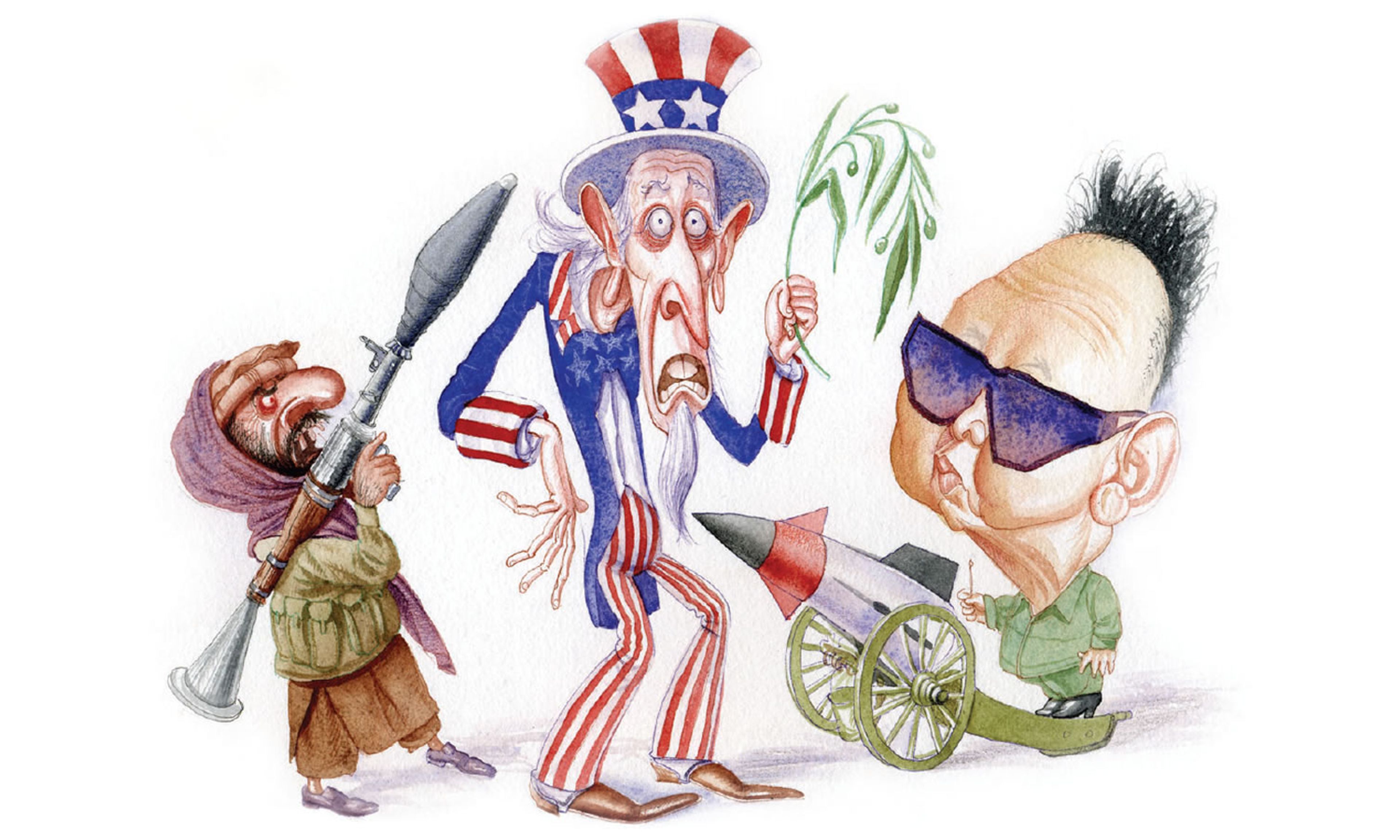
In 1983, Barack Obama, then a student at Columbia University, wrote of his vision of a “nuclear free world.” Twenty-six years later, on Sept. 23, 2009, Pres. Barack Obama delivered a major speech to the United Nations General Assembly in which he outlined, in his own words, “a comprehensive agenda to seek the goal of a world without nuclear weapons.” That agenda combines nuclear nonproliferation and nuclear disarmament into a single pillar of U.S. foreign policy. On the following day, at a meeting of the United Nations Security Council, President Obama endorsed a Security Council resolution (1887) that similarly wraps the goal of nuclear disarmament in the language of and enthusiasm for nuclear nonproliferation.
The merger of nuclear disarmament and nuclear nonproliferation, and their adoption as a unified priority of U.S. security policy, is based on a narrative and an underlying logic that have emerged over the past decade. It may seem complex, but its basic points are simple: The greatest threat to the United States is nuclear terrorism; the best way of countering nuclear terrorism is to prevent the spread of nuclear weapons and thereby reduce their availability to terrorists; consequently, we must maximize nonproliferation efforts; and doing so requires that we lead the world by example toward nuclear disarmament.
The usual saying that goes along with this narrative is that the United States cannot credibly ask others to reject nuclear weapons if it continues to hold on to its own. The underlying presumption is that if the United States takes the lead in nuclear disarmament, other nations will follow, and nuclear nonproliferation efforts will succeed. As a result, terrorists will be denied the nuclear weapons they seek, and U.S. security will be safeguarded. In contrast, if we continue to pursue nuclear capabilities, proliferation will soar, and our worst fears will be realized.
The bottom line of this narrative and logic is that the U.S. nuclear arsenal increases U.S. insecurity because its continued existence leads others to see value in nuclear weapons and to seek their own. Only by offering to give up our own nuclear weapons, it is said, can we have the moral authority and credibility necessary to unite the world in the necessary pursuit of nonproliferation. A complementary line of reasoning is that our nuclear weapons are no longer of much use because they cannot deter the terrorist enemy, who aspires to a violent death. Since terrorists are the main threat the U.S. faces today, giving up nuclear weapons holds little potential downside.
The logic of this narrative is elegant. Once nonproliferation is accepted as the best solution to our greatest threat, and the U.S. nuclear arsenal is cursed as the roadblock to successful nonproliferation, this bottom line becomes the inevitable conclusion.
Wrapping nuclear disarmament together with nonproliferation and counterterrorism in this fashion also has several rhetorical advantages. First, it adds a national-security rationale to the case for nuclear disarmament. Advocates no longer appear disdainful of U.S. security interests; instead, they seem to be addressing our greatest contemporary security threat, unburdened by Cold War notions of nuclear deterrence. It also allows endless public moralizing about the supposed hypocrisy of preserving nuclear weapons while asking others to forgo them. Finally, the argument is so simple that it can be repeated concisely and absorbed easily enough to become the unquestioned truth for many.
The problem, however, in elevating this disarmament narrative to be the lodestar for U.S. policy is that most of its main points are half-truths or complete fallacies. To begin with, even if death-loving terrorists are not themselves directly susceptible to nuclear deterrence, the state sponsors who enable them may be. The Soviet Union, for example, appears to have been successful in applying high-level military threats against Iran in 1985 to bring pressure on the PLO and Hezbollah in Lebanon.
In addition, terrorists are not the only security threat confronting the United States and its allies. While fears of a nuclear attack are no longer centered on a single opponent, as they were in the days of the Soviet Union, states that are hostile and armed with nuclear weapons have not disappeared since the end of the Cold War; in fact, their numbers have grown. Despite what the nuclear-disarmament narrative suggests, the terrorist challenge has not replaced these more traditional threats. The U.S. nuclear arsenal is as important as it ever was in deterring state-launched nuclear attacks, as the daily revelations about North Korean and Iranian nuclear and missile programs demonstrate. It is more than imprudent to base the direction of U.S. strategic policies on the speculative hope that nuclear weapons no longer serve an essential deterrent purpose.
In fact, even if all enemies and potential enemies of the United States miraculously gave up their nuclear weapons, the United States would still need to maintain a nuclear deterrent arsenal. Why? Because some enemies reportedly retain other types of weapons of mass destruction (WMD), such as chemical and biological weapons, that could inflict enormous civilian casualties. The United States and its allies have already given up these other forms of WMD. If we also take nuclear deterrence off the table, we may, as Gen. Paul Fouilland, commander of the French Strategic Air Forces, has observed, “give a green light” to chemical and biological threats. (During the Clinton administration, U.S. officials insisted that the United States could afford to give up chemical weapons precisely because we would retain nuclear weapons for deterrence.) The continuing threat posed by chemical and biological weapons is a fatal flaw in the logic of the nuclear-disarmament narrative, one that is all but ignored by its proponents.
Second, the presumption that U.S. movement toward nuclear disarmament will deliver nonproliferation success is a fantasy. On the contrary, the U.S. nuclear arsenal has itself been the single most important tool for nonproliferation in history, and dismantling it would be a huge setback. America’s nuclear arms, in combination with treaty commitments that connect them to the security of our allies, are what permits many of those allies to remain non-nuclear. The United States offers this “extended deterrent” (or “nuclear umbrella”) coverage to over 30 countries, and if that coverage did not exist, some of them would seek nuclear deterrents of their own.
This positive linkage of the U.S. “nuclear umbrella” to nonproliferation is not speculative. Key allies with dangerous neighbors remind us of it regularly, including countries such as Japan that could easily go nuclear if they felt the need. A 2009 report by an impressive list of Japanese academics and former senior military officials observes that as long as “the U.S. extended deterrence remains credible, Japan would have no intention to build an independent nuclear force, even though it may be assumed to possess the necessary economic and technological wherewithal.” For anyone who truly cares about nuclear nonproliferation, such statements should be a bright yellow flag of caution regarding the U.S. push for nuclear zero. French president Nicolas Sarkozy recently chided the U.S. in this regard in typically Gallic terms, reminding us that “we live in a real world, not a virtual one.”
Third, there is a stunning lack of evidence supporting the fundamental assumption of the disarmament narrative: that the world will unite with us in support of nonproliferation only if we become a model of enthusiasm for disarmament. This, again, is a hope masquerading as a reasoned expectation. In fact, most of the available evidence suggests just the opposite. Some countries, including Russia, appear to see the U.S. push for nuclear disarmament as a trick to rid them of the weapons they deem necessary for their security. In their view, a world without nuclear weapons would be a world dominated by the great and enduring U.S. superiority in conventional military capabilities.
The irony here is that our superiority in conventional forces makes our nuclear weapons seem less important, but it motivates other nations to seek or retain nuclear weapons and other WMD. This is precisely the reason that former Soviet president Mikhail Gorbachev said recently that talk of nuclear disarmament is “just rhetorical” if it not accompanied by restrictions on U.S. conventional capabilities. Here again, reality presents a gaping hole in the popular nuclear-disarmament narrative. Even if it were true that nuclear weapons no longer have critical value for America, it would not follow that they have none for other countries.
The Obama administration’s push for nuclear disarmament has a seductive intellectual and political appeal, but its main points are in contradiction with reality. And when a security policy is built on fantasy, someone usually gets hurt.












Comments