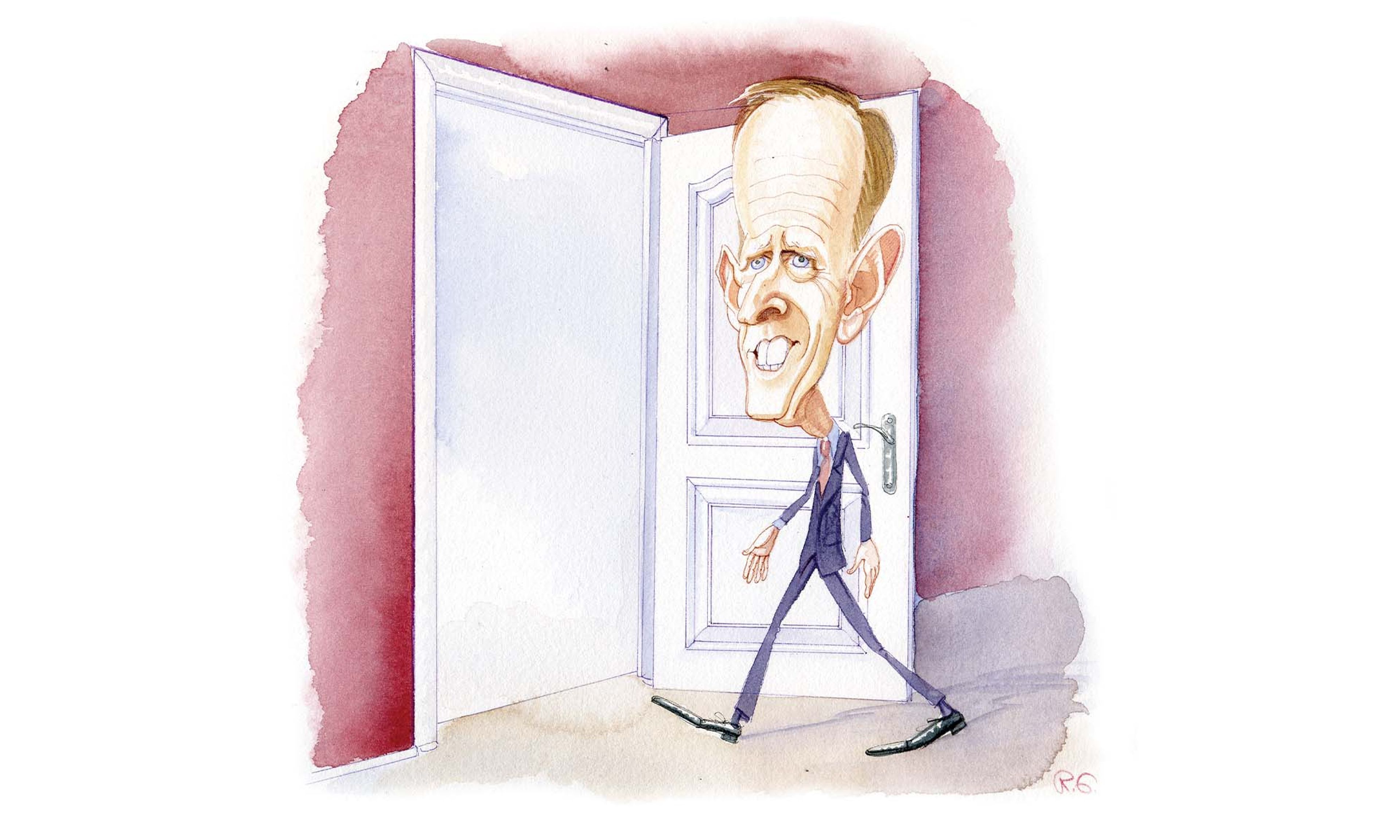
‘After 18 years, I’m just ready to move on,” says Pat Toomey, the retiring Republican senator from Pennsylvania. Who can blame him? Toomey has supported term limits throughout his political career. With six years in the House and a dozen in the Senate, he has campaigned as a candidate or served as an officeholder for much of his adult life. Toomey’s time really should be up.
He’s also ready to talk — and he asks a question of his fellow conservatives as they prepare to move on without him: “Do we still believe in the fundamental principles that have guided this big coalition for decades?” He offers a tentative answer: “I hope we will.” He tries to sound cheerful, but his uncertainty is evident.
When he leaves the Senate in January, Toomey will be 61. He entered the chamber as a conservative folk hero who had the nerve to launch a pair of primary challenges against a Republican who often behaved as a Democrat. In 2004, Toomey’s underdog bid against Senator Arlen Specter came up short. In 2010, Toomey tried again, chased Specter out of the GOP, and won the general election as part of the libertarian-leaning Tea Party movement. “I’ve always been and I remain a Tea Party guy,” he says. “The main focus of my time in both the House and the Senate was to try to create an environment to maximize economic opportunity.”
Toomey ticks off what he regards as his major accomplishments. He starts with the 2017 tax legislation, which lowered rates for businesses and individuals: “That was the most dramatic tax reform in at least 30 years.” Next, he touts a law from 2012 that made it easier for companies both to raise private capital and to go public. He’s also pleased to have pushed for the repeal of Obamacare’s tax on medical devices, which finally happened in a 2019 budget bill.
“Economic freedom has been a hallmark of Republican philosophy for quite a long time,” says Toomey. But he warns that this could change: “Now we see Republicans becoming big advocates for the government playing a much more active role, whether it’s expanding the child tax credit because of what they perceive to be the social consequences from that, or even economic interventions like subsidizing chip-makers because in their minds the free market doesn’t know how to allocate capital.”
He has a related concern. “Part of economic freedom is free trade,” he says, adding that among Republicans “there’s a greater division now.” Blue-collar voters have driven these trade divisions, as their political allegiances have tilted to the GOP. What does the senator say to Pittsburgh steelworkers and others who worry about foreign competition? “This is a false notion, that expanding trade costs those jobs,” he says. “Before the pandemic hit, we had a 50-year low in unemployment. The standard of living in Pennsylvania improved year in and year out and we did it in the freest-trading environment in a hundred years.”
Toomey recognizes that some U.S. companies can’t compete with foreign exporters, which leads to job losses in America. “We want to help those workers find employment elsewhere, but it does not make sense to say that we’ll just force Americans to pay more for their consumption and have a lower standard of living so that we can subsidize these particular jobs.” He also encourages conservatives to embrace the disruptions of technology: “When word processors made typewriters obsolete, should we have stopped that? It certainly put people in the typewriter-manufacturing business out of work. Dislocation is difficult and painful, but it’s not the right solution to stifle innovation and growth.”
China poses a “unique challenge,” says Toomey. “This country with whom we have extensive trade is increasingly looking like an adversary, clearly demonstrating the hostility and the ambition to overturn the order of the post-war era. I think we have to reexamine our economic relationship with China in light of the national-security concern.” In 2016, Toomey’s support for free trade appeared to waver when he came out against the Trans-Pacific Partnership, a trade pact that would have improved economic ties between the United States and a group of Pacific Rim nations, in what was widely seen as an effort to thwart Chinese objectives in the region. “It would have endangered intellectual property, especially in the pharmaceutical space, and that’s a big deal to Pennsylvania,” he says. Yet he endorses the concept: “Having a multilateral trade agreement with the countries of East Asia, except China, is a very good idea.”
He recommends a series of bilateral trade deals, too. “We should have a trade agreement with Taiwan,” he says, citing economic and strategic benefits. “We should have a free-trade agreement with the U.K., and that is very much available to us.” He mentions potential accords with Kenya and South Korea. Moreover, he would wipe out cases of unilateral protectionism: “We could also get rid of the 232 tariffs,” he says, referring to special levies imposed on steel and aluminum imports in the name of national security. “They were an egregious abuse of power by President Trump and continued by President Biden, who’s really been an extension of the Trump administration when it comes to trade. Aluminum and steel imported from Canada is not a threat to the national security of the United States.”
When Toomey was a member of the House of Representatives, he made a name for himself as a champion of entitlement reform. On Social Security, for example, he called for allowing younger workers to put portions of their payroll taxes into private investment accounts. He also sought changes to Medicare and Medicaid. But his proposals went nowhere.
“The big missed opportunity came during the Obama administration,” he says. It arrived after the 2010 elections, which put Republicans in control of Congress. Divided government often means partisan gridlock, but Toomey suggests that it also presents a paradoxical opportunity: “Entitlement reform by its nature is not something that is likely to get done when one party has complete control of the elected government. The political dynamics are seen as too risky. The time to do it is when government is divided. Neither side gets a great political advantage. It’s much more likely to be enduring.”
That doesn’t make it easy, though. “The political class exaggerates the price that will be paid for any kind of entitlement reform.” Obama refused even to try: “He wasn’t interested in entitlement reform at all.” Neither was Trump. If these reforms ever happen, “it’s going to take presidential leadership.” Toomey adds that “it may also take some kind of exogenous pressure.” Will it require a fiscal crisis? “It might. We just want to keep whistling past the graveyard, and that’s not a great strategy.”
Toomey has plenty of strategic advice for the GOP: “It’s important that the Republican Party maintain its traditional understanding of conservatism.” This includes a commitment to economic freedom as well as “the concept of subsidiarity, the idea that government is best when it governs closest to the people.” This approach worked well in the 1980s: “Ronald Reagan was enormously successful because he implemented policies consistent with these enduring principles.” It contributed to Toomey’s own victory in 2010: “The Tea Party was a movement to restore limited government and lower taxes and less spending. It was a reaction against the excesses of the Obama administration as it sought to expand government in every direction.”
It might have kept working, but a funny thing happened on the way to the 2020s: “Donald Trump came along and created a different kind of narrative.”
Toomey concedes that some kind of adjustment was necessary. “We probably need different policies when we have different circumstances,” he says. “But the principles remain and they’re still correct.”
If Toomey had sought reelection this year, he probably would have faced a primary challenge — not for violating his Tea Party principles but for crossing Trump. When the senator ran for reelection in 2016, he withheld his support from his party’s presidential candidate until the fall, long after many other Republican skeptics had gotten over their doubts. He says he voted for Trump that year and again in 2020, but he did it both times grudgingly: Before the election in 2020, in fact, the president branded him on Twitter as a “RINO,” or a “Republican in Name Only,” a label once attached to Specter, Toomey’s old GOP rival. Trump’s epithet came after Toomey criticized the commuting of the prison sentence of Trump’s political adviser Roger Stone, who had been convicted of lying to Congress and other offenses. The dispute grew more acrimonious when Toomey became one of seven Republican senators to vote to convict Trump in the impeachment trial of 2021. “He knew he had lost the election,” says Toomey. “He didn’t care. It’s hard to imagine too many more-egregious offenses to the Constitution.”
By then, Toomey already had announced his retirement from the Senate — and so his decision not to run in 2022 had nothing to do with the backlash that has ended the careers of several pro-impeachment Republicans. Yet he thinks the experience of Trump’s presidency and post-presidency holds an important lesson for conservatives: “We should not be a party that’s about allegiance to one man.” Instead, he urges conservatives to reflect on their beliefs: “We ought to have a debate among ourselves.”
Toomey says the GOP enjoys “a strong bench.” He mentions “several of my colleagues” in the Senate, as well as governors and “people who held high office in the past,” as possible presidential candidates. Although he has said nothing to prompt my curiosity, his Reaganite idealism and swing-state success compel me to ask whether he’d be a candidate. His reply is quick and sharp: “No, I’m not going to run.” He’s not sure what he’ll do next. “I have nothing lined up,” he says. “I do intend to have another career.”
As for the county, Toomey is optimistic: “There’s plenty to worry about, but we have overcome more-difficult and -polarizing times. We still have the most enviable position in the world. I’ve got to believe that Americans won’t want to discard the system and the institutions that have allowed us to have so much success.”











Comments