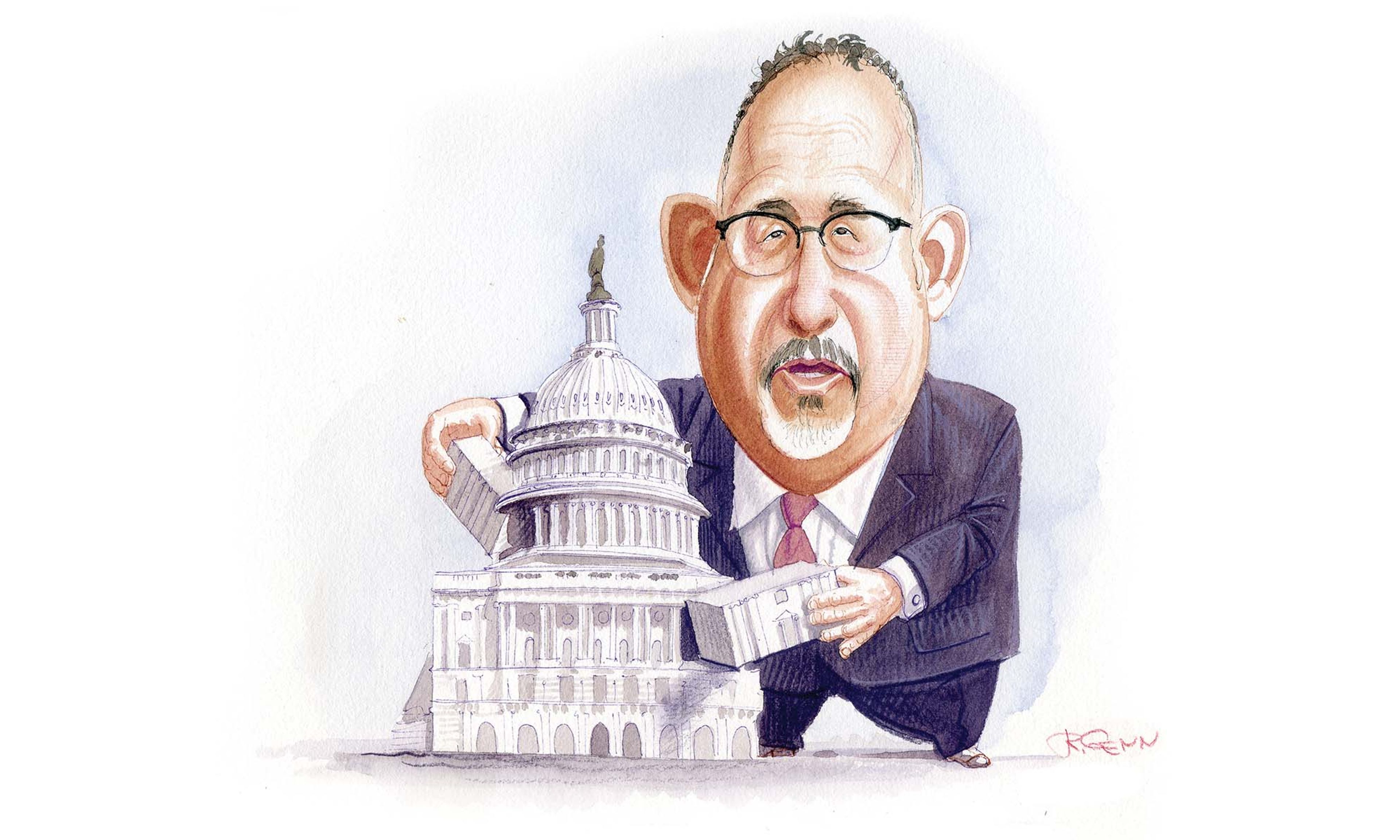
After the 118th Congress is sworn in in January, the new Republican majority in the House of Representatives should begin impeachment proceedings against Secretary of Education Miguel Cardona.
The House should pursue three lines of inquiry during its impeachment investigation. The first would be the student-loan-“forgiveness” program implemented by the Department of Education. Cardona’s general counsel produced a specious opinion according to which Cardona had authority under a 2003 law, designed for first responders and members of the armed services, to authorize nearly unlimited federal spending. The department then changed the program on the fly to dodge court challenges, through methods as informal as website updates and press releases.
Under the Constitution, spending taxpayer money is a power of Congress, not cabinet secretaries. That’s especially important when the amount in question could be as much as 4 percent of U.S. GDP. Searching for holes in standing doctrine through which to push an unconstitutional policy is conduct that should not go unpunished.
The second line of inquiry would be Cardona’s attempts to rewrite Title IX. The Department of Education has attempted to redefine “sex,” the word used in the statute, to mean gender identity, which is something else entirely and was not intended by Congress. It has also attempted to gut due-process protections for people accused of sexual harassment in educational contexts. The effects of its actions would eradicate female-only spaces and activities in schools and prevent parents from supervising or, in some cases, even knowing about their children’s education and school activities. Federal rules would also be in conflict with state laws concerning parental rights and public-school transparency.
If Title IX needs updating, it is up to Congress to amend it. Congress has not done so, and the Constitution does not permit cabinet secretaries to replace duly enacted legislation with politically motivated bad-faith interpretations, or interpretations of any other kind.
The third line of inquiry would concern Cardona’s alleged role in soliciting a letter from the National School Boards Association asking the Department of Justice to investigate education activists as potential “domestic terrorists.” The NSBA sent the letter when many parents and activists were protesting Covid policies and leftist curricula at school-board meetings across the country. Attorney General Merrick Garland responded by directing the FBI and U.S. attorneys nationwide to look into criminally investigating school-board protesters even though threats and dangers of violence had been almost nonexistent.
Emails obtained by the activist group Parents Defending Education found that the NSBA had coordinated with the Biden administration in writing the letter. Specifically, the NSBA CEO had “told the [other] officers [of the NSBA] he was writing a letter to provide information to the White House,” in accordance with “a request by Secretary Cardona.” The Department of Education said that Cardona “did not solicit” the letter but that the department works with groups such as the NSBA to “understand the views and concerns of stakeholders.” If Cardona was working with the NSBA not only to understand its views but to create a pretext to treat education activists as potential domestic terrorists, this would constitute an effort by a powerful federal official to chill free speech and deter protest.
Each of these three actions would be an impeachable offense on its own. The first two would be violations of Cardona’s oath of office to support and defend the Constitution. The third would be abuse of office and violation of the public trust.
Cardona is not suspected of criminal misconduct, and an impeachment inquiry would not be expected to find any. Impeachment, as Alexander Hamilton wrote in Federalist No. 65, is for offenses that are “POLITICAL, as they relate chiefly to injuries done immediately to the society itself.” They “proceed from the misconduct of public men, or, in other words, from the abuse or violation of some public trust.”
A 2019 Congressional Research Service report said the Framers were intentionally vague about what constitutes an impeachable offense, largely because they knew public officials would come up with innumerable schemes and plots to advance their agendas. The language the Framers settled on, “high crimes and misdemeanors,” was a term borrowed from English law that “applied to behavior found damaging to the state, including significant abuses of a government office or power, misapplication of funds, neglect of duty, corruption, abridgment of parliamentary rights, and betrayals of public trust,” the CRS said.
Cardona’s actions certainly fit that definition of high crimes and misdemeanors. But so do actions of President Biden — for example, abusing the Defense Production Act or decreeing a national eviction moratorium. And Biden, as the one with whom the buck stops, is ultimately responsible for the student-loan program and the Title IX rewrite as well. Why not impeach him instead?
An impeachment of Biden would become too wide-ranging and unfocused. There are any number of reasons Republicans are upset with Biden, and an impeachment would turn into an all-purpose airing of grievances. Republicans would be much better off making that case to voters on the campaign trail in 2024 that they should not return Biden to office.
Focusing on Cardona, on the other hand, would allow Republicans to unite on an issue on which they have a considerable advantage, something that will be important for House Republicans in particular. In the aftermath of school closures and as parents have become more aware of the nature of progressive curricula, impeaching Cardona would be a way to prosecute the entire progressive education establishment.
The Senate can do any number of things to thwart the administration since it has the filibuster and the ability to vote down presidential appointments. The House, when its majority opposes the president, is largely useless for ordinary legislative business. Impeachment, however, is a power that resides solely with the House. It’s a process Republicans would be able to carry out all on their own — with a simple-majority vote, and with no interference from the courts since, by constitutional design, impeachment is not justiciable.
The impeachment inquiry would allow Republicans to teach the American public how federal education policy works. How closely has Cardona been working with teachers’ unions and other progressive activist groups in creating national education policy? Did Cardona know the student-loan program was unconstitutional and nonetheless order his general counsel to contrive a justification? What sorts of things is Cardona saying about school-board protesters and conservative activists in private emails and text messages? Impeachment inquiries can be set up pretty much however the House wants. Republicans could use standing committees to pursue the investigation or create a select committee. They should be thorough and take their time. Assemble a record.
The House should conduct its inquiry with the aim of voting to impeach Cardona, who deserves it, but the Senate will not convict him. The only way Cardona will leave office is if he resigns. But making his job a pain and grilling his department in the House would at least be some recompense for his acts over the past two years.
Impeachment is not only about prosecuting political misconduct. It is also about maintaining the balance between the branches of government. Impeaching Cardona would serve as a chance for Congress to remind itself that legislating is a job for it — and for no one else.
Republicans say they believe that the administrative state is a problem, that it has grown out of control, and that it poses threats to Americans’ basic liberties. The Department of Education is one of the primary examples of administrative bloat, regulatory capture, and federalization of power that rightly belongs to state and local governments. Republicans have a clear-cut case of the secretary of that department acting lawlessly and indeed unconstitutionally. They should make use of the opportunity.












Comments