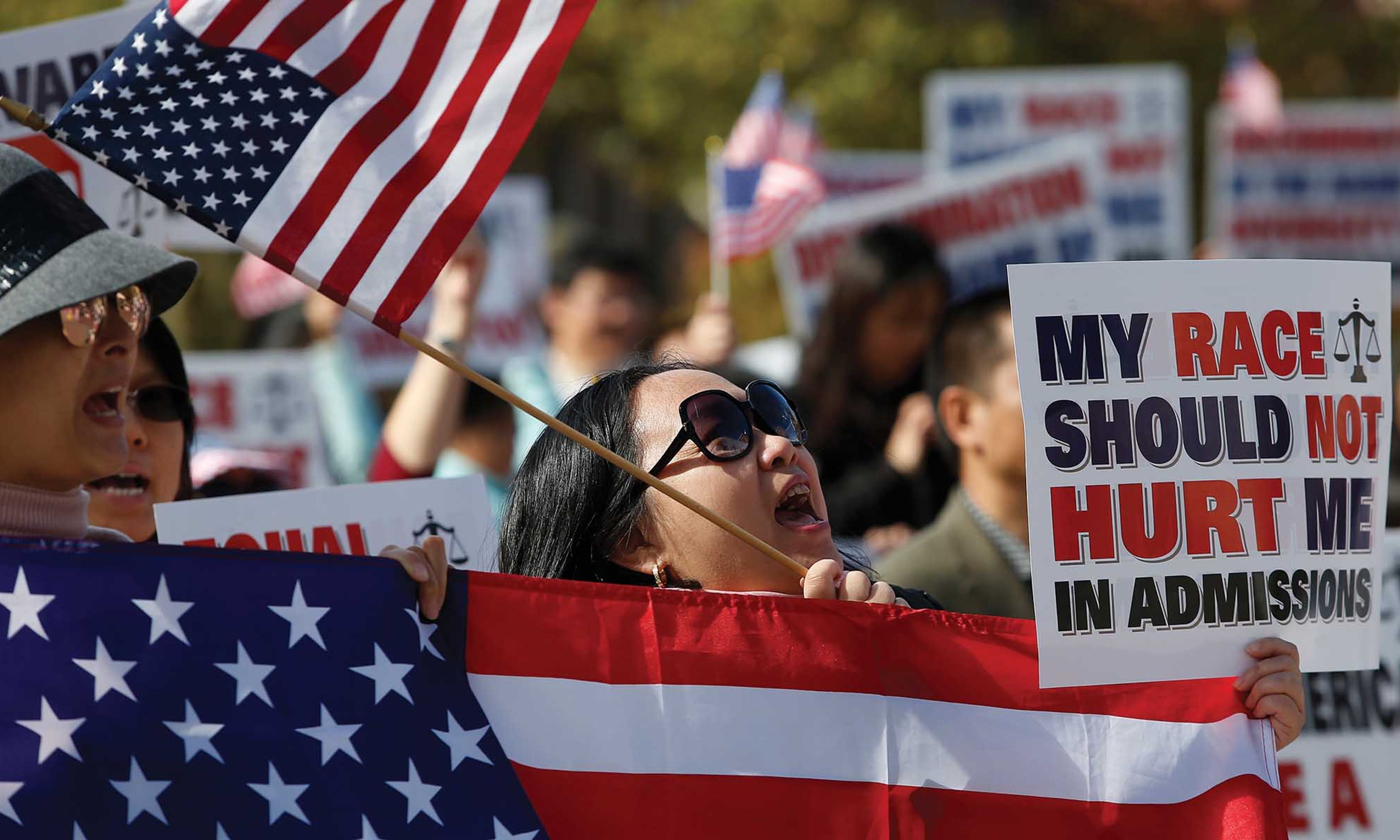
As we assess the dynamics of the midterm elections, the data reveal the continuation of a trend that should both please and challenge the Republican Party: Asian-American voters are coming back.
In several elections throughout this cycle, we have seen Asian Americans’ willingness to break with Democrats, based on their hostility to affirmative action and their desire for tougher laws against crime. With a stunning 40 percent turnout, Asian voters recalled three members of the San Francisco school board in February 2022. That turnout was higher than the rest of the city’s 36 percent turnout overall, even though previous elections saw Asians consistently turning out at a rate 5 to 15 percent lower than the citywide rate.
The month after the recall, Asian voters were also instrumental in voting out uber-progressive San Francisco district attorney Chesa Boudin, who had pledged to strip funds from the police and hand more-lenient sentences to criminals. These voters rallied under the banner of preventing anti-Asian violence and other inner-city crime.
When Asian Americans are properly informed about issues, they can be a significant conservative and moderate force in politics. It’s why Republicans should start courting them now, rather than later.
Perhaps the correct term is re-courting. According to City Journal contributing editor Charles Fain Lehman, a significant percentage of Asians voted for Republicans between the Reagan era and the first term of the younger George Bush. Vietnamese and other Americans of Southeast Asian descent led the way, voting for Reagan in massive numbers, thankful for the 40th president’s strong anti-communist stance. Then, during the early 2000s, Asian support shifted heavily toward Democrats, first Al Gore, then John Kerry, and at the peak in 2012, with nearly 70 percent support, Barack Obama.
Why this shift? There is no one answer, but much has to do with Asian Americans’ perceptions of the doltishness of Bush II. In contrast to historical leaders in Asia, such as Singapore’s Lee Kuan Yew and the Meiji Emperor of Japan, who radiated competence in their professional stature and meritocratic attitudes, Bush 43 did not appear to Asian Americans to be the leader who could shepherd their adopted home — certainly not compared with the well-spoken, Harvard-trained, handsome Obama.
Over the past two presidential-election cycles, Asians have signaled that they will vote based on material concerns rather than perceptions alone.
One issue that has precipitated this trend is affirmative action. The Students for Fair Admissions v. Harvard case, which alleges discrimination against Asian students by Harvard in the name of diversity, has drawn Asian voters toward conservative causes more than ever. Across the United States, Asians have shown they’ll fight any progressive who threatens merit-based opportunity. After all, Asian immigrants don’t have anything in this country but their skills and their willingness to work hard. If even that is discounted by progressive universities such as Harvard and other woke institutions that would rather judge by skin color, then they truly have nothing.
Analysts shouldn’t underestimate this issue’s potential for driving a rightward swing in Asian voting patterns. In 2020, Asian Americans in California banded together to defeat a Democratic proposition that would have reinstituted racial preferences in admissions to the state schools. They led a campaign (which I helped organize as media director) that mobilized not only Asians but people of all races to reject the measure, 57 percent to 43 percent.
Another factor behind Asians’ rightward turn is crime, specifically anti-Asian violence. Progressives have largely failed in their attempts to blame Trump’s “China virus” comments for the spike in anti-Asian crime. Asian voters increasingly realize that the true causes are progressive anti-punishment policies and the long-simmering racial tensions between inner-city black residents and Asian shopkeepers, a conflict dating back to the Los Angeles riots of 1992. Those tensions resurfaced after Black Lives Matter rioters targeted and looted Asian pharmacies throughout the summer of unrest in 2020. During a seminar with minority leaders conducted by then–vice president Mike Pence, one Korean shopkeeper, Michael Kim, recounted how looters had ransacked his pharmacies. “Mobs were flooding into the pharmacies, taking whatever they wanted,” he said. There are more stories like Kim’s that make Asians care about law and order, given that Asians are more likely to be the victims of crimes than perpetrators.
My 2021 book An Inconvenient Minority gives more examples of substantive issues that increasingly motivate Asian Americans, such as illegal immigration and traditional family values. Asian Americans are in a political renaissance at this moment — their vote is truly up for grabs. They have gotten over their initial reticence and the traditional political modesty that had come across the Pacific with them, especially after their experiences with dictators such as Mao Zedong and Pol Pot, who severely punished anti-regime critics. But now Asians are realizing, as other well-assimilated Americans know, that in America it’s advantageous to speak out.
This doesn’t mean, however, that Republicans should assume Asians will gravitate to them. Asians are still sensitive to many immigrant fears of being marginalized, and comments such as Trump’s references to the “China virus” certainly haven’t helped. Furthermore, Senator Marsha Blackburn (R., Tenn.) and other Republicans play up the competition with China to the extent that some Asian Americans feel they aren’t welcome. In 2020, Blackburn tweeted, “China has a 5,000 year history of cheating and stealing. Some things will never change . . . ” The anti-China Right should distinguish between the Chinese Communist Party and a millennia-old culture that has contributed mightily to world civilization.
If Republican gains among Asians are to continue past 2022, the party will need to work on an assimilative rather than an exclusivist message, emphasizing that Asian Americans, like other immigrants who play by the rules and work hard, are absolutely welcome in America. Furthermore, Republicans have a chance to embrace the universal values of meritocracy and excellence at a time when woke culture is degrading the character of all our institutions. If it offers a welcoming message alongside a tough-love commitment to meritocracy and it stands with Asians on crime and education, the GOP could win Asians as a conservative voting bloc once again.











Comments