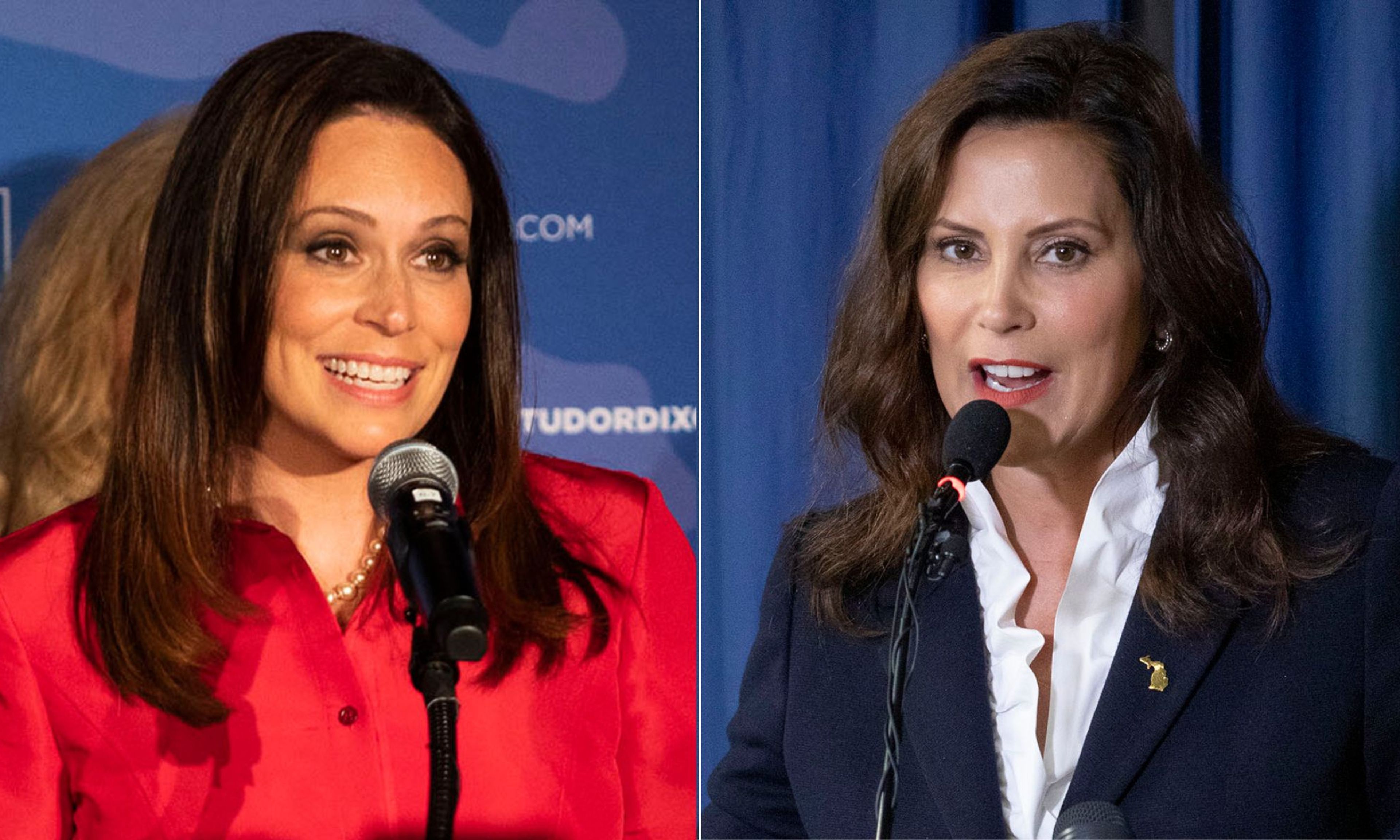
When 22 county sheriffs in Michigan endorsed Republican candidate Tudor Dixon for governor on September 14, one of the names on their joint letter came as a small surprise: William L. Federspiel, of Saginaw County. He’s a Democrat, which means he crossed party lines. “I take it seriously, the fact that he would do this,” says Dixon in an interview. “It shows that public safety is key.”
As Dixon’s underdog campaign tries to gain traction among voters and defeat Democratic governor Gretchen Whitmer on November 8, she’ll need to attract more of these Dixoncrats who worry about cops and crime. Violent crime in Michigan has risen in recent years, according to FBI data, jumping about 12 percent in 2020 — the year of loud demands from protesters to “defund the police.” Back then, Whitmer briefly backed this progressive cause: “I do support the spirit of it,” she told the Root. She quickly realized her blunder, however, and informed the Michigan press that she hadn’t really meant what she just in fact had said to a website that describes itself as delivering “black news and black views with a whole lotta attitude.”
Dixon’s hope is that Whitmer will pay for missteps such as these. “‘Defund the police’ has emboldened criminals,” says the Republican. “Police officers need to feel they’re supported.” She has pledged to boost law-enforcement spending by $1 billion. She also has called for cutting taxes and rolling back regulations, plus cracking down on critical-race-theory and transgender radicalism in public schools, in a strategy that combines traditional Republican approaches to government with a couple of trending issues that have helped conservatives in recent state and local elections. Dixon’s success or failure could provide lessons for a GOP presidential candidate who aspires to carry midwestern swing states in 2024.
Will any of it matter in Michigan in 2022? In the polls, Whitmer has held a steady lead. The governor enjoys an even bigger advantage in the money race: At the end of August, she reported having $14 million in the bank, compared with $523,000 for Dixon. Most of Whitmer’s donors live outside the state, suggesting that Democrats regard the 51-year-old Lansing native and former state lawmaker as an emerging national figure — possibly even a dark-horse candidate to seek her party’s presidential nomination.
It’s hard to turn on a television in Michigan these days without seeing advertisements on Whitmer’s behalf, and many of them involve the subject that unites Democrats more than any other: abortion. In the aftermath of the Supreme Court’s Dobbs decision, the governor has promised to “fight like hell” for abortion rights. She also has embraced Proposal 3, a ballot initiative that would create the most extreme abortion-rights law in the country, permitting the procedure at any moment from conception to birth, wiping out parental notification and consent for minors seeking abortions, and exempting abortion clinics from health-and-safety regulations. Elections are often referenda on the performance of incumbents, but Whitmer is trying to use abortion to turn her reelection into a referendum on pro-life Republicans such as Dixon. There could be lessons in this as well.
Michiganders haven’t ousted an incumbent governor in more than three decades, but Whitmer has given them plenty of reasons to boot her from office. Four years ago, she rode to her first election as governor by pledging to “fix the damn roads.” It was a snappy promise to solve a problem that frustrates drivers of all political persuasions when they thump through potholes or suffer from flat tires and chipped windshields. In office, she proposed a near tripling of the gas tax, which would have given the home of the Motor City the highest gas tax in the nation. The Republican-controlled legislature objected, and Whitmer eventually resorted to a borrowing program through executive action. The latest state review reports that nearly 26 percent of roads are in “good” condition, up from about 21 percent during Whitmer’s first year in office. Yet 32 percent of roads are rated as “poor,” and a forecast predicts that this will increase to 48 percent in about a decade, making it hard for Whitmer to claim that she has fixed a damn thing.
Other evidence suggests that she’s less of a fixer and more of a breaker. During the early months of the Covid-19 pandemic, she became America’s queen of lockdowns, imposing some of the country’s harshest orders. About 32 percent of Michigan businesses were required to shutter — a greater share than in any other state, according to the Bureau of Labor Statistics. (The national rate of government-mandated business closures was less than 19 percent.) Meanwhile, employment in much of the nation has bounced back to pre-pandemic levels, but not in Whitmer’s realm. “Michigan has fallen behind in the pandemic recovery, and the governor stands in the way of progress,” says James Hohman of the Mackinac Center, a free-market think tank in Midland.
Whitmer’s lockdowns not only were strict — they also were more arbitrary than those of perhaps any other governor. She banned lawn services, even though mowers work outside and could avoid contact with other people. She prohibited motorboating, camping, and golf. Barbershops and hair salons had to close, but liquor stores did not. Hardware stores could open their doors, but Whitmer told them not to sell paint or garden equipment. The governor rarely explained her reasoning as she released a series of executive orders that sparked confusion and outrage.
One of her most capricious restrictions involved a ban on driving between residences. Many Michiganders own second homes and hunting cabins in the northern part of the state, but Whitmer insisted that visiting these rural getaways posed a hazard to public health. Even when she eased the order, she warned against travel — and then got caught in a flap when her husband went to their own second home in Elk Rapids, where he asked a local marina whether it could rush his boat into the water. “I am the husband to the governor, will this make a difference?” he supposedly said. His wife claimed he was joking, but the incident became one of the first prominent examples of a public official’s lockdown hypocrisy.
Then came two more cases. In the spring of 2021, just as Whitmer urged people to “delay travel and stay home,” she jetted to Florida to see her father. She didn’t announce the trip, but MIRS, a Lansing-based news agency, exposed it. Annoyed by the revelation, Whitmer grumbled that if she had not gone, critics would have accused her of lacking family values. A few weeks later, a photograph showed her in an East Lansing bar, smiling at a table with more than a dozen people. At the time, her rules limited indoor dining to six people per table. She apologized for the transgression: “I am human. I made a mistake.”
The 45-year-old Dixon was born in Sharon, Pa., grew up around Chicago, and attended the University of Kentucky. She moved to Michigan in 2002, when her father bought a steel foundry in Muskegon. She worked in this blue-collar industry, started a family, and beat breast cancer. In 2017, she founded Lumen Student News, a service she has described as providing “pro-America, pro-Constitution morning news programs” to grade-schoolers. This is the first time she’s run for any political office, and she says that she felt compelled to become a candidate because of the Whitmer-imposed woes borne by businesses and children. “We’ve lost one and a half to two years of learning,” she says.
Dixon has searched for ways to generate enthusiasm among parents upset about school policies, much as Glenn Youngkin did last year when he won a surprise victory to become Virginia’s governor. On September 14, Christopher Rufo of the Manhattan Institute delivered Dixon a gift when he released videos showing how the state department of education under Whitmer, in his words, “has adopted a radical gender theory program that promotes gender ‘fluidity’ beginning in elementary school and encourages teachers to facilitate the sexual transition of minors without parental consent.” This is the sort of scandal that could help Dixon gain a hearing among women who lean toward Whitmer because they think she kept them safe during the pandemic but also have apprehensions about the sexual indoctrination of children.
Two days after Rufo’s report ran in City Journal, Dixon’s campaign website linked to it. Dixon blasted the education department and put forth a challenge: “Does Gretchen Whitmer agree with me? Will she condemn this radical and dangerous nonsense? She owes parents an answer.” Parents received at least a partial one the next day, when a Whitmer official criticized the videos in a letter to the state superintendent of public instruction. It was a mild rebuke of the education department from a Whitmer subordinate, but it did show that Whitmer has studied Youngkin’s race and knows that Democrats must try to guard against the worst excesses of left-wing identity politics, especially when they target kids.
Dixon has pushed the controversy about as far as she can without much campaign cash, and the media are happy to let it pass. As the race moves into its final weeks, Whitmer appears to have hit her cruising speed. A poll of likely voters released on September 22 gave her a comfortable advantage, 55 percent to 39 percent. If this is accurate, Dixon probably can’t overcome it.
Yet older Michigan Republicans remember another race they weren’t supposed to win, and many younger ones have heard the legend. In 1990, a late poll showed Democratic governor James Blanchard ahead of his Republican rival by 14 points. When the votes were counted on Election Day, however, John Engler prevailed by less than a point. He went on to dominate Michigan politics across three terms.












Comments