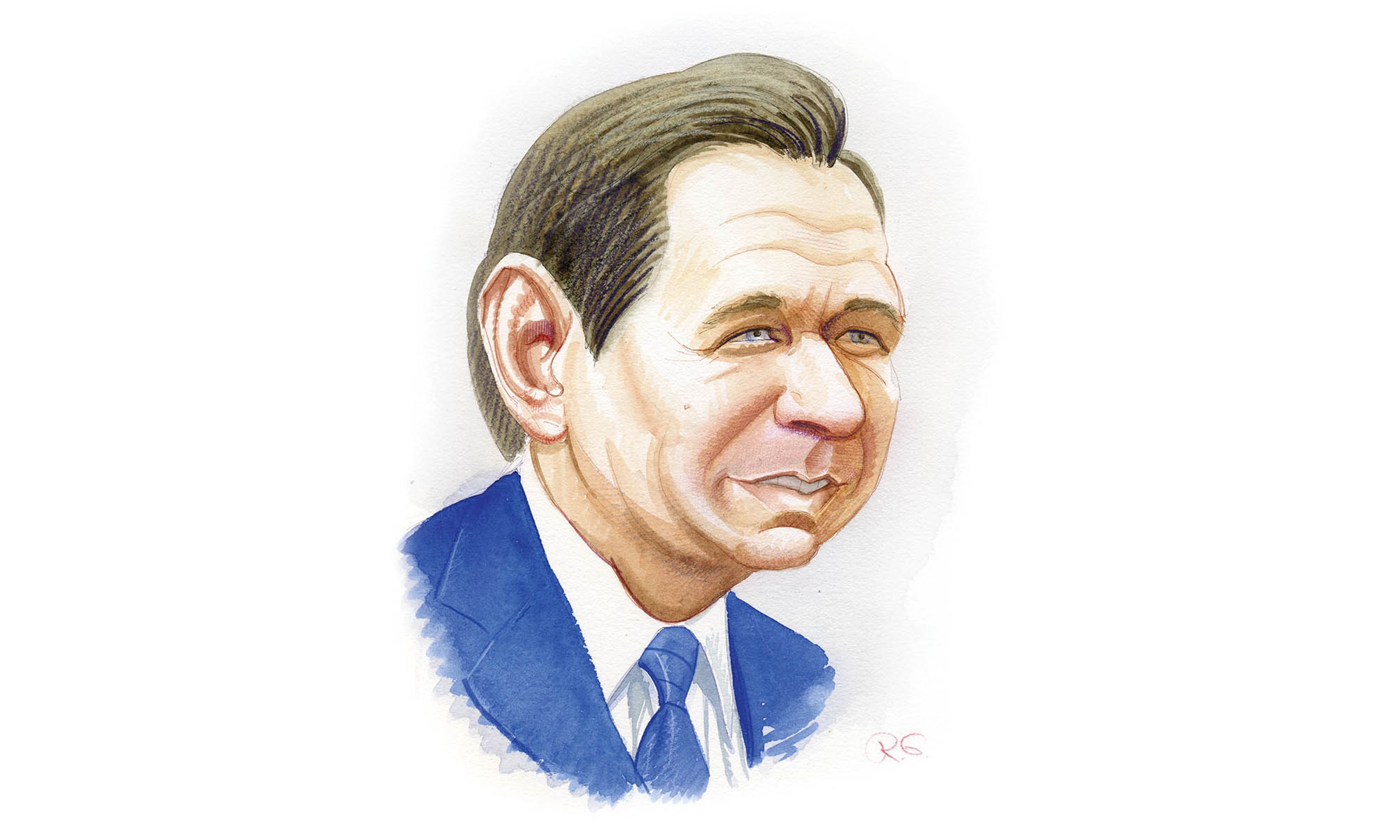
For almost the entirety of 2022, the news about Florida governor Ron DeSantis has been about where he stands in relation to Donald Trump and the Republican primary heading into 2024. Has DeSantis promised to stand down if Trump runs? No. How much money is DeSantis raising? Up until September of this year, a little more than Trump. Where is he polling compared with Trump among Republicans? Usually within striking distance.
But there’s one little matter before all that. Ron DeSantis has to win his reelection campaign to remain governor of Florida. He faces Charlie Crist, the one-time fixture of Florida’s Republican Party who is now a Democratic member of the House from the state’s 13th district. Crist’s campaign has been — and this is putting it nicely — abysmal. He lacks support from the national party, which is writing him off. DeSantis has maintained a polling lead of five to eight points, except for the occasional outlier. As of this writing, political forecasting from FiveThirtyEight finds that DeSantis has a 93 percent chance of winning reelection. Time magazine said that Democrats have given DeSantis “a pass” in 2022 and “seem powerless to stop him.”
It may be hard to remember now, but Florida was, until recently, considered a state up for grabs. And Ron DeSantis was, not so long ago, an untested, little-known congressman — a neophyte begging for Trump’s endorsement in an anti-Trump election year. Democrats hoped, with good reason, that Florida would finally break their way. Republicans had had a long run in the governor’s mansion, and 2018 was supposed to be a blue-wave year powered by the defections of suburban women from the Republican Party. These voters were disgusted by Donald Trump. They were bound to deliver the Democrats a congressional majority in the Midwest. And in Florida, Ron DeSantis had run as a mini-Trump in the Republican primary. Famously, he ran an ad that showed him acting like a Trumpy maniac in all his interactions with his infant child, first building a toy wall, then reading at bedtime from Donald Trump’s book The Art of the Deal, and then teaching baby’s first words: “Make America great again.”
This political environment seemed to create running room for progressives. The surge of Democratic optimism led them to nominate former Tallahassee mayor Andrew Gillum. Gillum’s campaign was backed by George Soros and hailed in the New Yorker as part of the vanguard of a progressive political revolution that had begun with Alexandria Ocasio-Cortez’s upset victory in a low-turnout Democratic primary. The theory was that Gillum could activate the coalition of the ascendant — the Obama coalition — in Florida. That would mean running up large numbers among “voters of color,” young people, and suburban women to overcome the older, white electorate that had given Republicans control of the governor’s mansion for two decades.
Since 2018, Gillum has been disgraced. First he was found by police in a hotel room with a male sex worker and another man who overdosed on crystal meth. More recently he was indicted for alleged wire fraud, conspiracy, and false statements. But in 2018, he was seen as formidable. Most polls in November of that year had him winning by three to five percentage points. Only one pollster, the Trafalgar Group, predicted a DeSantis win outright. In the end, Ron DeSantis won narrowly. Over 8.2 million Floridians voted. DeSantis cleared the hurdle by just 32,463 votes.
It is a testament to Ron DeSantis that all of this has worked to his advantage as governor. His initial weaknesses catapulted him to a position of strength. His temporary brand as a mini-Trump, and the competitiveness of Florida politics, baited Democratic opponents across the nation and especially in the media to put the spotlight on him during the pandemic. DeSantis staked out a reopening philosophy that defied Dr. Anthony Fauci and, at the time, seemed more Trump than Trump. Although he was not the first to reopen his state — that honor goes to Georgia’s Brian Kemp — DeSantis, by miles, got the most negative attention for doing so. He welcomed the scrutiny and has thrived on it.
The national media initially hailed New York governor Andrew Cuomo for his daily Covid press conferences and his vows to do everything possible to save every life. Cuomo, working from dire projections about the need for hospital beds, favored a policy of moving seniors on the mend out of hospitals and back to their nursing homes. This mistake, while somewhat understandable at the start of the pandemic, led to New York’s appalling rate of death in nursing homes. The governor’s office and New York’s department of health concealed 4,100 Covid-related deaths in senior-care homes while Cuomo collected an honorary Emmy for his leadership.
Meanwhile, DeSantis allied himself with the dissenting view in public health, against broad lockdowns and for a philosophy of “focused protection.” That meant intervening among the most vulnerable: senior citizens. The media accused DeSantis of gambling with people’s lives as beaches in Jacksonville and elsewhere reopened. Less attention was paid to his orders banning visitation in nursing homes and banning the return of nursing-home patients from hospitals until they were no longer contagious.
DeSantis went further than some conservatives would have advised. He banned vaccine passports in his state — not just for state government, but even for private businesses. He similarly prevented the imposition of employer vaccine mandates. In doing this, he reaped serious rewards in public approval.
At the end of it all, the national media have conceded defeat. “With his early bet on reopening and his concede-nothing posture, DeSantis has plainly won the political argument on Covid,” a recent profile in the New York Times Magazine noted ruefully.
Partly because of the way the national and international media highlighted Florida’s openness, 2021 was the best year for domestic tourism in the history of the state. Over 40 percent of international tourism to the United States in 2021 was to Florida. And since Covid, Florida has led the nation in net in-migration. Florida recently reported a $22 billion revenue surplus. In a state without an income tax, a surplus like that points to rapidly expanding economic activity.
The Covid era and a burst of progressive overreach have given DeSantis a chance to do something that very few conservatives have been able to do, which is to run on the broad issue of education. As one would expect from a rock-ribbed conservative, DeSantis is touting Florida’s expansive school-choice options on the campaign trail. Seventy percent of Miami-Dade County students do not attend a school they would be assigned by geography. But perhaps more important, his Covid strategy has made DeSantis the undisputed defender of public schools in his state. He pushed a state rule preventing “unnecessary” removal of children from in-person learning and championed face-to-face learning. The board of education under DeSantis docked pay from school boards that issued mask mandates in defiance of the governor’s policy, and those districts relented. DeSantis hammered school closures as “the biggest public-health blunder” urged by “flat-earthers.” While many states are struggling to cope with the scale of learning loss during the pandemic, Education Week recently ranked Florida third in K–12 achievement.
DeSantis has become a champion of what might be called traditional public schooling, against recent progressive revisions. His Stop W.O.K.E. Act removed unpopular critical-race-theory material from public schools. He followed it up with the Parental Rights in Education bill, which banned classroom instruction about LGBTQ issues through third grade and required schools to tell parents if children receive mental-health services through the school. He then gave the Walt Disney Company, the state’s largest employer, a serious brushback after company officials vowed to challenge the parental-rights bill. He and the state legislature revoked Disney’s special-district privileges, which allow Disney to operate as its own government, rather than under the counties where it’s located. By doing so, he proved to conservatives that he could take on the Left even in a corporate boardroom.
And of course there is the way that DeSantis has made headlines by jumping to the front of every conservative fight. Conservatives are concerned about radical prosecutors and defund-the-police agendas; DeSantis used his constitutional powers to remove a prosecutor who refused to enforce Florida’s laws restricting abortion. Conservatives want the media and the White House to acknowledge the border crisis; DeSantis chartered planes to take Venezuelan asylum-seekers to Martha’s Vineyard, knocking positive headlines for Democrats out of the news nationwide and putting the border back on the national agenda.
Against all this, Charlie Crist would have needed an absolutely pitch-perfect campaign. Instead, at his first stop in August, Crist decided to drop his own version of Hillary Clinton’s “deplorables” comment by telling DeSantis voters, “I don’t want your vote.” And he was expansive about it: “Those who support the governor should stay with him and vote for him. If you have that hate in your heart, keep it there.”
The only hint of a strategy for Crist has been to run on abortion rights. Polling indicates that Florida is the most pro-choice red state in the country, with 56 percent of respondents saying abortion should be legal in most or all cases. Crist accuses DeSantis of being an extremist on the issue. “If Ron DeSantis wins, and he will not, he will ban abortion completely.” For his part, DeSantis has signed a popular ban on abortion after 15 weeks’ gestation and remained focused on issues where he has the commanding heights.
At certain points it has looked as if Crist is just conceding the race. He has raised barely one-tenth of DeSantis’s campaign war chest of $180 million. A recently surfaced video has Crist calling his opponent “DeSatan.”
The big question of the DeSantis reelection campaign is how well the governor will do with Hispanic voters. Biden won 65 percent of Hispanics in Florida in 2020. DeSantis won 44 percent of the Hispanic vote in 2018, a 13-point improvement over Rick Scott’s performance in 2014. How much higher can he go?
Democrats have hoped to gain with this demographic after DeSantis’s attention-grabbing maneuver of flying migrants to Martha’s Vineyard. Crist called it an overreach, and the move was condemned in the media as treating Venezuelans as political pawns and as if they did not belong in the United States. But if polling is to be believed, Hispanic voters are less sure. A survey from Morning Consult showed that only 35 percent of Hispanics nationwide called sending immigrants to liberal U.S. states “inappropriate,” and 41 percent called it “appropriate.”
Gillum attributed his 2018 loss to DeSantis in part to Republicans’ preying on “sensitivities” of Latino voters in Florida. Namely, Republicans had tagged Gillum as a leftist and advertised themselves to Venezuelan and Cuban voters as anti-socialist and anti-communist. The Trump era saw Cuban voters, who had moved to the middle, swing back in large numbers to the GOP, followed by Venezuelans and even many Puerto Ricans.
Florida Republicans have been investing in outreach to Spanish-speaking voters since the governorship of Jeb Bush. DeSantis has hammered Crist with Spanish-language radio ads targeting his running mate, Karla Hernandez-Mats. The ads remind voters that Hernandez-Mats argued against reopening schools and that when Cuban dictator Fidel Castro died Hernandez-Mats tweeted: “Most in Miami rejoice, many in Cuba mourn Fidel Castro.” This attempt to acknowledge a pro-Castro segment of Cubans ended up provoking many Cuban Americans.
A strong showing by DeSantis would demonstrate that Democrats’ approach to racial issues — bundling a diverse set of voters as “Hispanics,” then re-bundling them as “people of color” — was a mistake, and it would provide a DeSantis 2024 campaign with an even more persuasive rationale.
But perhaps the clearest indication of how DeSantis’s campaign is going is the changed image of the state itself. Under his governorship, Florida has become synonymous with Republican government. New York’s governor, Kathy Hochul, recently told her Republican opponents they should “move to Florida, where you belong.” It was a nasty thing to say, but looked at one way, the numbers back her up. In 2018, Florida had nearly 300,000 more Democrats than Republicans. As we enter election season in 2022, Republican registrations in Florida now outnumber those of Democrats by over 271,000. Representative Val Demings, who is running for Senate against Marco Rubio and was once thought to be a strong candidate for Joe Biden’s vice-presidential slot, acknowledges the truth about the fourth-largest state in the country: “We’re a red state y’all. We’ve got some work to do.”
If DeSantis wins handily, as expected, the comparisons to Andrew Jackson will come naturally. If he can conquer Florida, perhaps the White House is next.












Comments