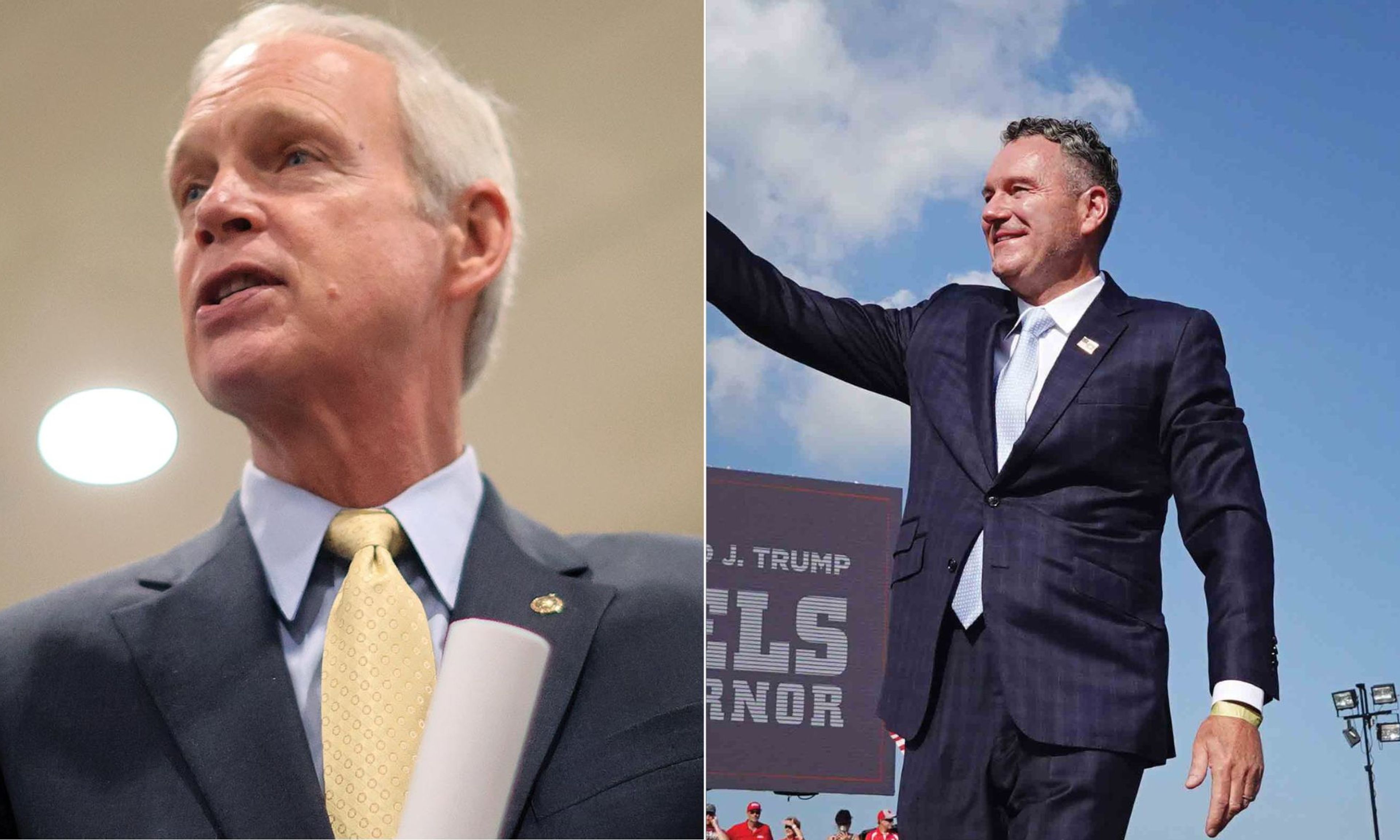
It was an election-season Saturday in Wisconsin. U.S. Senate incumbent Ron Johnson and GOP gubernatorial candidate Tim Michels were touring the state to whip up support for their campaigns. To hear their pitches and assess their fitness, I drove to Manawa, in the middle of the state, an hour west of Green Bay. Both Johnson and Michels would be delivering speeches and taking questions in the red-and-white Lions Club food barn beside the local rodeo facility — the heady filth of politics evocative of a different sort found on farms. Americana all the way down.
The day was drizzly and promised more rain as the afternoon progressed. Just shy of Manawa, on the other side of the swamps northwest of New London, is Pup’s Irish Pub, on the hill in Northport. As I had time to spare, lunch sounded good, so after pulling in next to the only other car in the lot, I ducked inside to be greeted by eye-wateringly vibrant Green Bay Packers décor and a buck’s head mounted above the bar. The guy behind the bar, Hunter, was not actually a bartender but was filling in because actual bartenders are scarce and mornings unprofitable. A process engineer for Kimberly-Clark, Hunter wasn’t yet qualified on the grill, but he was happy to serve a Miller High Life.
With bar nuts and pilsner in hand, I enjoyed a journalist’s lunch while we grumbled about the weather. I explained that I’d be talking with a couple of GOP candidates later that day and wondered what he was hearing at the bar. In a fairly conservative area where Trump 2020 flags outnumber yard signs for Tony Evers, the Democratic governor running for reelection, I expected to hear that customers were going on about CRT, Covid, or one of the many other pet obsessions for us politically chattery types.
Inflation and job vacancies were Hunter’s immediate responses, though, and answering my query of what I should ask the candidates, he offered, after a minute of consideration, “How the hell are they going to get frickin’ inflation down? It’s brutal right now.” Many people from the area work in Appleton or Green Bay, he explained, and do their shopping in those larger cities. Locals talk about going to Costco and paying more every week for the same items. Hunter related a story of a guy he worked with whose family of eight had a monthly grocery bill of $2,100.
A skydiving instructor came in to get a drink and drop off his NFL winners for the week (three dollars per card) and I headed back out to my car. Scooting around tractors pulling hay trailers and managing to avoid oncoming Land Cruisers, I arrived in Manawa, which is not some forgotten holler. The economic and cultural diversity of this part of Wisconsin was evident: There is industry, construction, lumber, and agriculture all within a few miles. Major corporations have production facilities nearby. A motorcycle-saddlebag manufacturer and a furniture maker look across the road at a brand-new 60-unit apartment complex. Johnson and Michels would have to appeal to every one of these interests and more besides.
I had been in communication with Johnson’s people for the past month, and I was greeted at the police checkpoint by Mike Marinella, Johnson’s press guy. He explained that the senator had taken the stage early and was now finishing up his question-and-answer time. I caught the end of that, then watched as Johnson departed the three-foot-high stage and stopped to talk and take pictures with his supporters.
Dressed in the classic collared shirt and slacks of a politician on the stump, Johnson seemed nimble for a man nearing 70. Supporters would ping him with questions and requests, and he would offer enough to show he was listening while promising nothing more than that his team “would look into [the questioner’s concern].” Twelve years as a senator appeared to have sharpened this ability, and his people moved him through the photo ops and glad-handing with deft precision.
Eventually, Johnson was clear of the throng, and Mike introduced me to him as “Luther, writer from National Review.” “Senator Ron Johnson, running for his third term.” Charmed. Johnson’s handshake was firm.
Mike carved us out a spot under the ticket shack’s overhang where he could keep the senator out of the rain and supplicants at bay.
I started by asking him the bartender’s question, “What can be done about inflation?”
Johnson said, “So many of the people here, they’re concerned about that, they’re concerned about gasoline prices, they’re concerned about losing this country.” He then noted gender ideology in schools and political division as other items that those who came to speak to him were voicing as their primary concerns. I asked whether this was why he was asking for a third term, to address these issues.
In 2016, Johnson said he would retire after his second term, but in January he announced he’d changed his mind. Writing in the Wall Street Journal, he said: “In 2010 I promised I would always tell people the truth and that I would never vote with re-election in mind. When re-election isn’t your primary motivation, those are easy promises to keep. Today, I am announcing I will continue to fight for freedom in the public realm by running for re-election. It is a decision I haven’t made lightly.”
Responding to my query, he expanded on his Journal remarks: “Trust me, if everything is coming up roses here, I’d be looking forward to a really nice retirement. I did not intend to do this. It was my very strong intention — my wife’s very, very, very strong intention — to serve that second term and then go back and have a good life. I think my experience is going to make it an even more influential third term.”
Johnson speaks unhurriedly, often taking a moment to fix his eyes over your shoulder, searching for the correct words. His sentences end confidently, without fadeaway or the upward lilt that makes a question out of a statement. A supporter presses in to listen at my right elbow as I ask the senator about GOP priorities should they win back Congress.
“I want my colleagues to be William F. Buckley conservatives — this is what I’ve always said, I’m not just pandering — to stand athwart history yelling ‘Stop!’” he told me. “I want to force our leadership to have a better-functioning Congress.” He acknowledged honestly that the budget that would need to be passed in February would require further raising the debt ceiling. But it would be followed by a slate of fiscal controls and appropriations bills to stymie the growth of the administrative state — in this connection, he mentioned Kentucky senator Rand Paul’s REINS Act. Democrats would have to choose between responsibility for a government shutdown and accepting reasonable funding curtailments.
“Unlike when we only had a slogan for ‘repeal and replace’ Obamacare, just as an example,” Johnson continued, Republicans need to “have either the regulations or laws that we can pass and implement so we enact our agenda as soon as we take power.”
We then discussed how best to excise gender ideology from schools. I asked whether the federal government should be involved in such an endeavor, and Johnson was adamant that such matters are best handled by local authorities. His goal is to shrink the size and scale of the federal government — a slower but more conservative approach, preferable in his eyes to overbearing government and ideological meddling.
Sharp readers will have noted that Johnson did not answer my preliminary question about inflation in any substantive way. So, trying a different tack, I brought up the Jones Act. This protectionist scheme hamstrings shipping by artificially limiting which ships can be used to deliver goods; the act benefits U.S. shipbuilders at the expense of the public, who must pay more for those goods.
Here, Johnson was at his most uncomfortable, stuck trying to weigh this breach of the free market against national-defense considerations and Wisconsin’s shipbuilding industry in its Marinette shipyards. He tied shipbuilding’s challenges to problems with the private sector having moved much of its manufacturing of semiconductors and pharmaceuticals to destabilized nations. We need to maintain ship-construction capabilities on our shores, he said, while searching for a way to reduce protectionist policies’ inflationary effects.
“There are reasons for [the Jones Act], valid reasons,” he said, “but there are harms caused by it. Let’s lay these things out in a logical way. Then, potentially, do something different than what the Jones Act is and accomplish the same goal without creating the harm. That’s a businessperson’s way of solving the problem.”
The last sentence can be read as a dig at his Democratic opponent, Mandela Barnes, Wisconsin’s current lieutenant governor. Barnes has only ever worked as an organizer in and around politics, with no private-sector experience to speak of. Though I reached out to the Barnes campaign weeks ago for an interview, I have yet to receive a reply.
I thanked Senator Johnson for his time and turned to watch the upstart Tim Michels on the stage. He had managed to knock off establishment favorite Rebecca Kleefisch to secure the GOP gubernatorial nomination, partly because of his “stop the steal” messaging. Listening to Michels, a construction-company executive, I came to realize Johnson’s polish.
I met with the gubernatorial hopeful at the next campaign stop, a corn roast in Winnebago County Community Park, about an hour from Manawa. Michels is compact and ruddy-faced. Oddly, both his introductory and departing handshakes were pillowy soft.
He told me his top three priorities are election integrity, school choice, and a reduction in crime and affirmation of the necessity of police work. He added that “from my very first day in office to my very last day in office, it’s always going to be about jobs and the economy.”
Michels spoke rapidly, looking straight ahead and seemingly ticking off the boxes of what he wished to communicate about himself: “I’m an outsider. I’m a businessman. I’m a nonpolitician. I’m a veteran.”
I asked him about his references on the stump to “stop the steal.” If 2020 wasn’t a fair election, why should voters have faith in the 2022 election and come out to vote for him? What’s changed in two years, under Governor Evers, to give them faith? “Well, people are really fired up about the 2020 election and so am I,” he replied. “People have questions — I have questions — so what I get really fired up about is that this is the United States of America. I took an oath of office when I joined the Army to uphold and defend the Constitution. If we don’t have fair, open, transparent elections in this state, in the United States of America, then our entire constitutional system can come crumbling down. I’m going to make sure that that doesn’t happen.”
He went on: “We’re going to ban the Zuckerbucks, the out-of-state billionaires coming in . . . and taking control of our election system. We’re going to stop the ballot harvesting. . . . I’ve heard of multiple ballots being mailed to you for the rest of your life. It’s not right. This is not a Republican issue. This is an American issue.”
What Johnson and Michels have in common is bulldoggish confidence, along with years in business. Opposite them stand the community organizer in Mandela Barnes and the wispy bureaucrat in Tony Evers. In terms of disposition and professional background, there could hardly be a starker divide between the parties’ offerings, representing the breadth of Wisconsin’s political inclinations, from the progressivism of Dane County to the populism of Outagamie. In mid September, Wisconsin’s premier polling institution, Marquette University, had both races within one point among registered voters. While seemingly humble, events like these, at rodeos and corn roasts across Wisconsin, will decide the state’s — and the country’s — political fortunes.











Comments