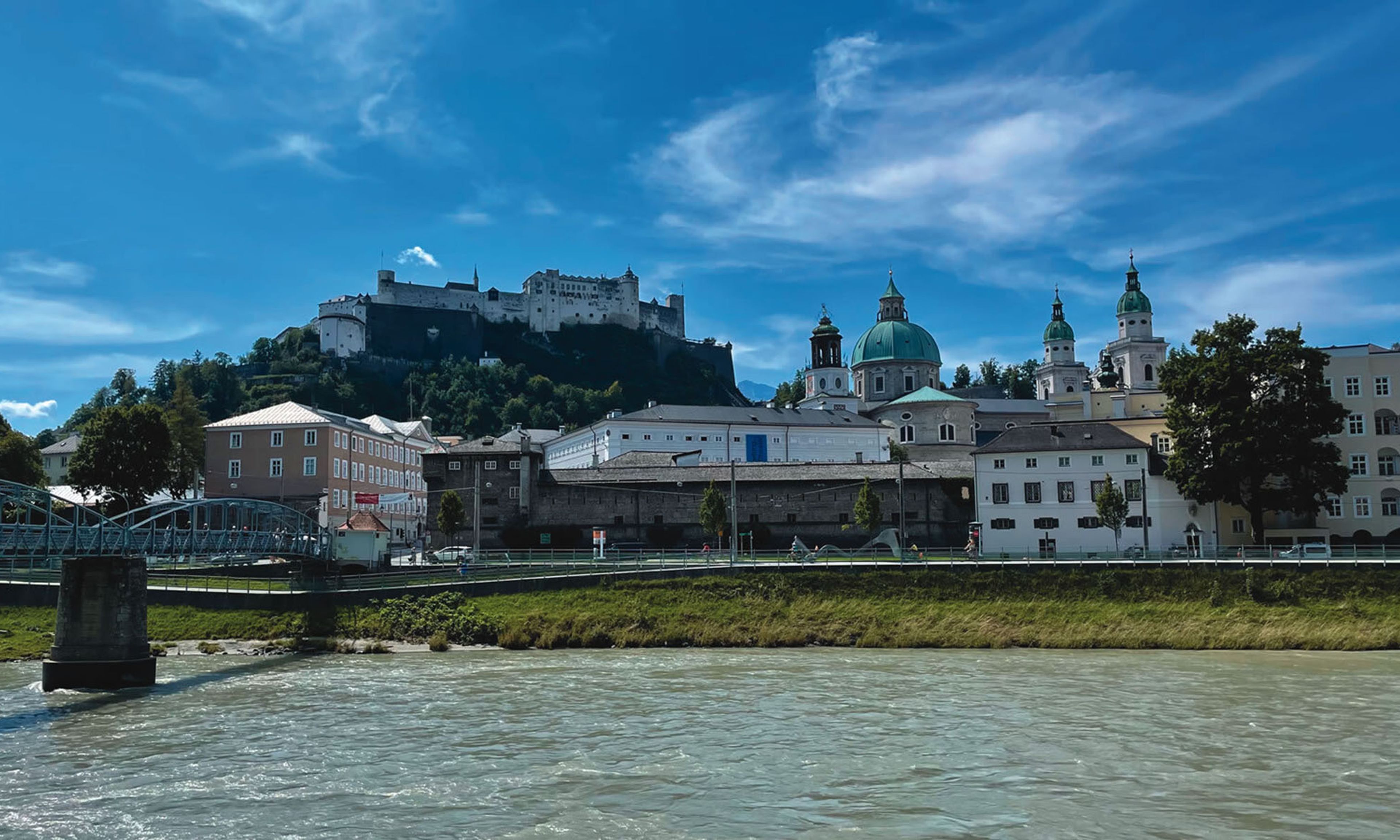
Salzburg, Austria
‘Say hello to music for me!” That’s what Bill Buckley once said to me, as I was heading off to the Salzburg Festival. I think of it every time I head back here. No one loved music more. You would just sit and listen to a recording with him, in silence. And every now and then he’d turn to you and say, “Isn’t it marvelous?” (Yes.)
Many of us were not able to say hello to Salzburg last summer — when the pandemic was roaring. But the show went on — the festival went on — though with fewer performances and fewer patrons. Last year was a lousy year for a pandemic, if you were the Salzburg Festival. Could there be a good year? No, but I will explain.
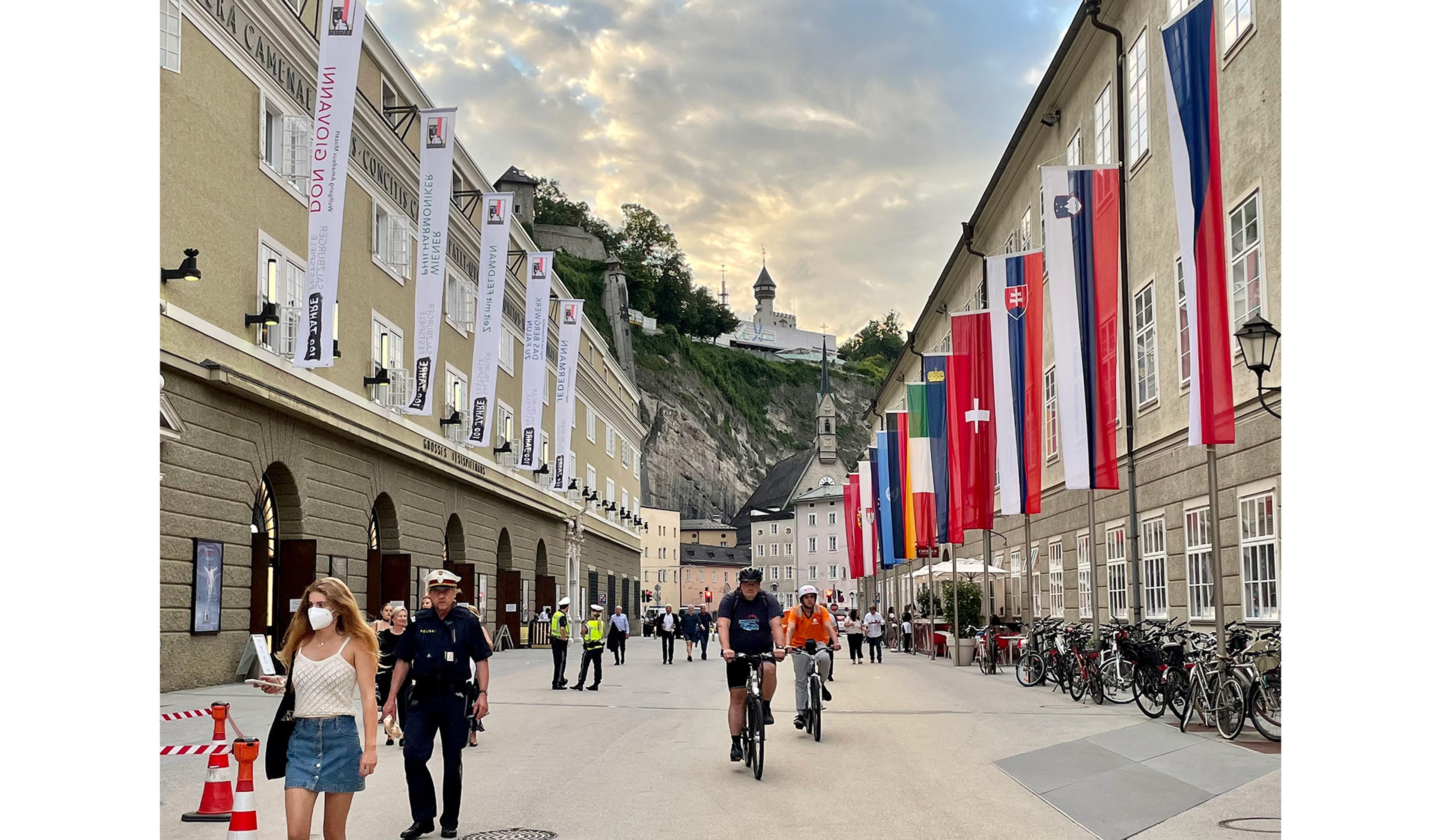
The year 2020 was a “Beethoven year” — the 250th anniversary of that composer’s birth. More important, if you’re Salzburg, it was the centennial year of the festival. The first performance took place on August 22, 1920. Onstage was Jedermann, the play by Hugo von Hofmannsthal, one of the festival’s founders. (Jedermann is his version of Everyman, the English morality play.)
I knew a man who attended that performance: George Sgalitzer, a Viennese-born gent who became an American and a U.S. Army doctor. He made his home in Seattle. George was seven years old in that summer of 1920. He was taken to the play — the new festival — by his grandparents. They weren’t crazy about music, but they loved theater. Their grandson became a devourer of both. He attended the Salzburg Festival every year — except for the war years — until he passed away in 2006.
This year, concert halls are full, pretty much, but the streets are less crowded than usual. The pandemic lingers on. (Far better to have a melody lingering on, as in the Irving Berlin song.) There are very few Chinese and Japanese, and very few Americans. “Yours is the first American accent I’ve heard here in two years,” a French colleague tells me.
Hang on, I have an accent?
Jay Nordlinger
To get into a hall, you have to show a vaccination card. Failing that, you have to show proof of a negative test (a very recent test, of course). Then too, you have to wear a mask — not just any mask, but an FFP2. I had brought surgical masks — the light-blue kind — and N95s. I had never heard of FFP2s.
Mine are white, and I keep getting chocolate on them. (Chocolatey fingers reach into my pocket for the mask.) One night, a courteous young woman, ushering, said, “Sir, you have blood on your mask. Perhaps you had a nosebleed. May I show you to the men’s room?” Thanks, but it was just the usual chocolate.
On another night — a morning, actually — the French soprano Sabine Devieilhe walked onstage wearing a mask. She took it off before she sang. (Isn’t there a popular TV show, The Masked Singer?) And put it on again as she walked off. Odd protocol, in odd, trying times.
If you’re a patron, in the audience, you do not remove your mask. The halls are hot, as usual, here in Salzburg. (AC is an American fixation.) And with those FFP2s, they’re all the hotter. I can see men and women suffer, in their suits and gowns.
In the opera productions, there’s plenty of nudity, which is de rigueur here. When I first started coming to the festival, almost 20 years ago, I observed, “Salzburg is a place where the people in the audience are overdressed and the people onstage are underdressed.”
There have always been giants — heroes, headliners — at the Salzburg Festival. Among conductors, you had Arturo Toscanini and Herbert von Karajan. Among singers, Elisabeth Schwarzkopf and Leontyne Price. Among pianists, Wilhelm Backhaus and Alfred Brendel.
Can Brendel be counted historic? I think so. He retired in 2008 and turned 90 last January. I have seen him in Salzburg, since his retirement, just attending — a nice sight. As for Backhaus (1884–1969), there is a little street named after him, just outside of town: Wilhelm-Backhaus-Weg. It says something about a locality that it honors a pianist.
Today, the big conductors are Riccardo Muti and Daniel Barenboim — at least those are two of them. Singers? I nominate Anna Netrebko and Elīna Garanča. And pianists? Here are four: Grigory Sokolov, Arcadi Volodos, Yevgeny Kissin, and Igor Levit. All of those are Russian-born, as it happens (though none has lived in Russia in a very long time).
The festival’s artistic director, Markus Hinterhäuser, is a pianist himself. He has good taste. When I said this to him once, he replied, “You know, that’s what it comes down to, doesn’t it? Taste.”
Grigory Sokolov is an odd duck — I say that with considerable admiration. He is his own man, going his own way. He is unconventional, idiosyncratic — you might even say eccentric. He won the gold medal at the Tchaikovsky Competition when he was 16. (The year was 1966.) He is the youngest person ever to win that medal.
Early on, he toured the United States and the world at large. Now he stays in Europe. He doesn’t play concertos, either — no engagements with orchestra. Just recitals. He plays about 70 of those a year, and they are all devoted to a single program: a single slate of pieces. (The slate changes each year, I should say.)
Typically, he walks onto a stage rather grim-faced and bows solemnly. Then he begins. He maintains his demeanor all through an evening. A Sokolov recital is like a religious rite. The pianist plays as though he were doing the most important thing in all the world — and his audience listens in hushed wonder.
In the Great Festival Hall this year, he played Chopin on the first half and Rachmaninoff on the second. I was nervous before he began. Would he be “on”? No one can be on every night — that’s asking too much. When I was a youth, I heard two Horowitz recitals, a couple of years apart (1978 and 1980). I was nervous before each one. The first recital was bad, or mediocre. (Horowitz could be like that, which is forgotten now.) The second one was — out of this world.
I have never heard Sokolov bad or mediocre. But, naturally, he has more inspired nights and less inspired nights. This time — August 5, 2021 — he was mainly inspired. On, we can say.
In that first half, he played four of Chopin’s polonaises, ending with one of the most famous ones: the Polonaise in A-flat, Op. 53, nicknamed the “Heroic.” All of Chopin’s polonaises, heroic or not, go beyond a mere folk dance. They have invention, swagger, songfulness — myriad qualities. Sokolov is well aware of this. I will cite a few of his strengths.
He listens to himself very carefully — “voicing” each note the way he wants. At the same time, he does not fall into preciousness. He has no end of virtuosity — yet a live performance has mistakes, which distinguishes it from a studio recording, with its doctoring. Thank heaven for live. Any mistakes are “plums in the pudding,” as David Pryce-Jones says (borrowing a phrase from his friend Peter Levi).
Above all, maybe, Sokolov has soulfulness. He has everything implied in that somewhat mysterious, though certainly useful, word “musicality.”
I have one major criticism of Sokolov’s Chopin, and it concerns the “Heroic.” The piece was simply too sleepy. Even bland. It has to be played with more panache, more dash, more flair — even a bit of showmanship. No doubt, Chopin played it that way. If you won’t lend it fire, you should leave it alone, contenting yourself with other repertoire.
The Rachmaninoff on the second half of the program was his Op. 23 — the ten preludes that are grouped under that opus number. To play these, you have to sing. The piano is a keyboard instrument, and a percussion instrument, sure. But you must wring every ounce of lyricism out of it. “It don’t mean a thing if it ain’t got that sing,” as Duke Ellington did not quite write. (Actually, I should refer to his lyricist, Irving Mills.)
Well, Sokolov got the sing.
As he was playing the final prelude — in G-flat — I was struck by something: Sokolov was expressing what I can only call “complete balance of mind.” He may be idiosyncratic — but I never heard greater balance of mind.
About the Rachmaninoff set, I have a complaint, and it’s similar to the one above. The big, fast, rhapsodic preludes — the one in B-flat, the one in C minor — Sokolov used to play with thunder and lightning. I once wrote a piece about this, titled “When Sokolov Was Lit.” These days, he plays them rather more sedately — which I believe is inadmissible. Those pieces need their fire, dash, speed. Rachmaninoff wrote them that way. You can impose autumnality on a lot of music — but some pieces, no.
Never mind. Sokolov was magnificent, not least in his encores, of which he played a slew, as usual. The recital began at 9 o’clock (nearing my bedtime). The printed program ended about 11. Sokolov played on until 11:40. Most of the crowd would have stayed till 6 a.m., if Sokolov had been willing. I’d have stayed till noon.
Oh, is he good — great, in fact. So is music (“Say hello to music for me!”). And so is the Salzburg Festival, now 101 years old. If it lives another hundred years, that won’t be enough.











Comments