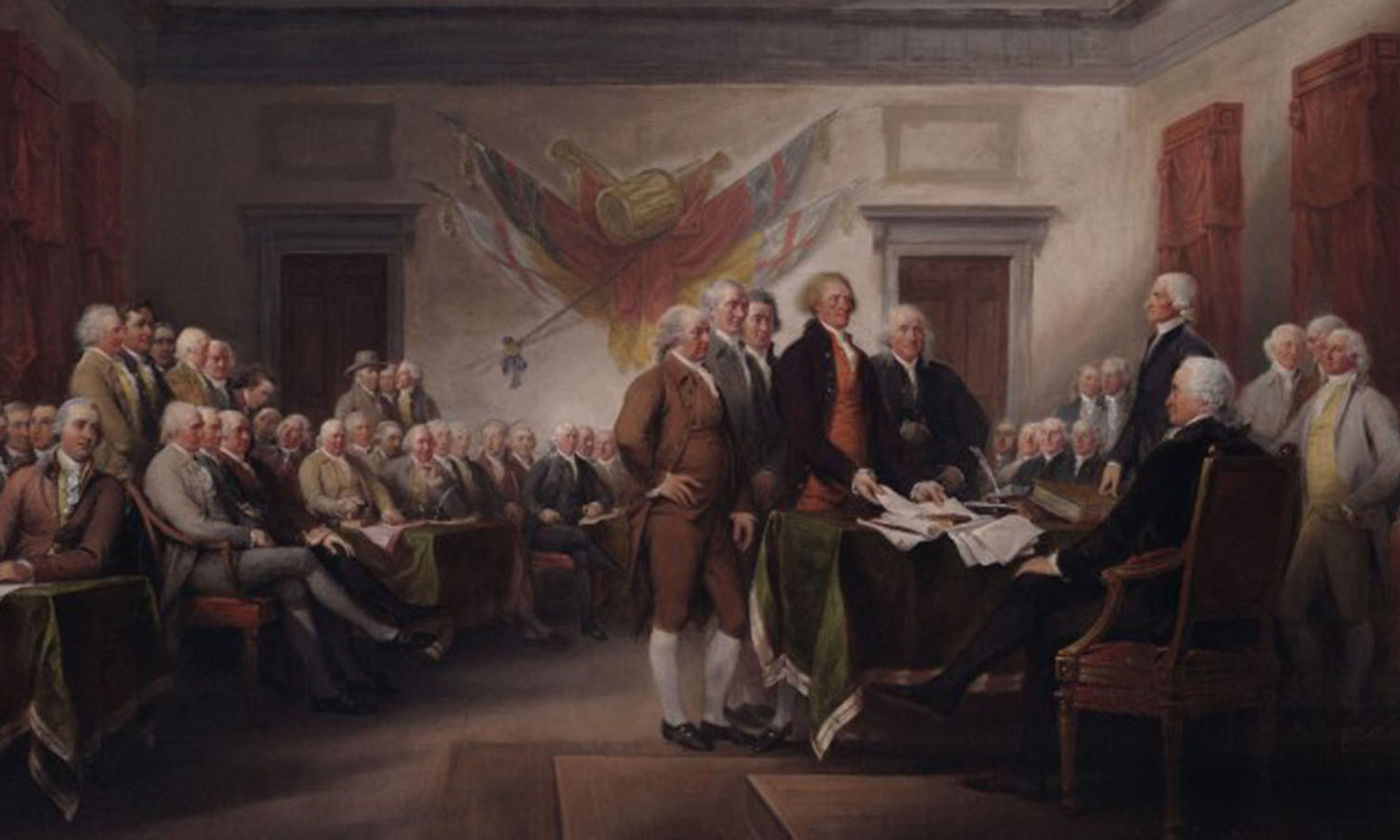
‘With all our divisions,” asks George Packer, “what do we have in common? Is there some underlying adhesive that can make us one country again? Can we still call all to the duty we owe to each?” In his new book, the Atlantic writer tackles these questions with honesty and palpable devotion to the American ideal — or his version of it, anyway.
Packer looks across America’s increasingly fractured politics and fears that we have lost “the first truth of our founding document, the one that leads to all the others,” namely the principle of equality. “At the heart of our divisions,” he writes, “is rising inequality and declining social mobility.”
If he’s right about that, his explanation of how America got here is marred by a blind spot for the downsides of progressive policies, and by too little appreciation for the enduring legacy of America’s founding.
Packer sees an ominous warning in the pandemic:
It was never going to be easy to negotiate the trade-off between the physical health of teachers and the mental health of children, between the guidance of scientists and the livelihoods of waiters, between being alive and being OK. All of this required a society where people encountered one another as fellow citizens of goodwill and a government that heard them, and we had neither.
Maybe. But maybe democracy is inherently “untidy,” as Donald Rumsfeld liked to say. Maybe it worked out in the end about as well as could reasonably be hoped. Certainly, more lives could have been saved, but people disagreed vehemently about the best response. Packer thinks “our economic system makes national solidarity in a crisis impossible.” But nothing could be further from the truth. The American system gives our society a collective power that is unequaled in human history, precisely because free societies have far more solidarity than collectivist ones, as the 20th century showed. Divisive issues divide people. The question is whether they can be overcome.
Packer compares America’s COVID-19 experience to the fall of France in 1940, lamenting America’s “strange defeat.” But a much better analogy is to America in 1941. America was caught almost totally unprepared by the start of World War II, but before long Detroit alone was producing as many tanks and bombers as all the Axis powers put together.
American society was susceptible to COVID-19 because of its mobility, interconnectedness, and bewildering distribution of health-care agencies. (When you really need a lockdown, few strategies work better than North Korea’s.) But American ingenuity and industry quickly sprang to life, and with government backing (in the form of the Trump administration’s Operation Warp Speed, which curiously goes unmentioned in Packer’s account) it took just months to develop the vaccines and therapeutics needed to tame the pandemic. Far from a strange defeat, America has once again saved millions from a global scourge.
Packer argues that America has become divided into four countries and describes each one’s “narrative”: the “Free America” of traditional conservatives and libertarians, the “Real America” that is Donald Trump’s hardcore base, the “Smart America” of globalist technocrats like Bill Clinton, and the “Just America” of Black Lives Matter and critical race theory.
According to Packer, these four narratives have taken root in soil prepared by the broken promise of equality: “All four narratives are driven by a competition for status — the consequences of this broken promise — that generates fierce anxiety and resentment. They all anoint winners and losers.” And, grumbles Packer, “I don’t much want to live in the republic of any of them.”
Packer tries to be fair but doesn’t always succeed. Of Free America he writes: “Some of them interpreted the Constitution as a libertarian document for individual and states’ rights under a limited federal government, not as a framework for the strengthened nation that the authors of The Federalist Papers thought they were creating.” But The Federalist Papers were published precisely to convince skeptics such as Patrick Henry that the framework of limited federal powers in the proposed Constitution would strengthen the nation without infringing on individual rights or state prerogatives.
Packer draws on familiar caricatures about conservatives being heartless egoists who couldn’t care less about society. But as Yuval Levin and others have shown in these pages, it is progressives who, in their absolute devotion to central government, have systematically hollowed out the republic by weakening its civic institutions. Packer’s youthful hatred of Ronald Reagan has mellowed, he says, but he still implies that the former president was at least a soft racist, with a “half-spoken message to white Americans: government only helps those people.” But Reagan’s message was precisely that government in fact hurts those people most of all.
Packer long identified as a socialist, which is perhaps why he has some sympathy for the working-class orientation of Real America: “The idea that the authentic heart of democracy beats hardest in common people who work with their hands goes back to the eighteenth century.” Yet he hardly hides his scorn for Sarah Palin and the white Evangelicals so “hostile to modern ideas and intellectual authority.”
Still, Packer is often on the mark: “When Trump ran for president, the party of Free America collapsed into its own hollowness. The mass of Republicans were not constitutional originalists, libertarian free traders, members of the Federalist Society, or devout readers of The Wall Street Journal. They wanted government to do things that benefited them.” Trump didn’t talk about self-government, much less “the majesty of democracy” held in such awe by presidents such as George H. W. Bush. He talked about “culture, faith, and tradition” and appealed most of all to whites who were undereducated, underemployed, and overly aggrieved.
He doesn’t say so, but Packer seems to identify most with the progressive elites of Smart America, though he thinks they have also failed the American ideal. “You have a hard time telling what part of the country they come from,” he writes, “because they speak in the same public radio accents and their local identities are submerged in the homogenizing culture of top universities and elite professions.” Smart America believes in social safety nets and the idea that workers dislocated by globalization should be retrained for new kinds of jobs. (Of course, conservatives largely support those things, too; they just don’t share progressives’ boundless faith in government.)
Packer reserves some of his harshest criticism for Just America, a pleasant surprise from a writer for The Atlantic, which has done so much in recent years to mainstream Black Lives Matter, critical race theory, and the revival of militant socialism. He slams the BLM agenda: “Instead of a political agenda and strategy, it pursued a mystical vision that freezes us all in the ice of our own identity and makes ordinary communication with one another nearly impossible.” Packer thinks it’s understandable that “the bland promises of middle-aged liberals” leave the youngsters of Just America “furious,” but he has less sympathy for Just America’s attempt to dismantle the Enlightenment, including America’s founding, which they condemn as a Trojan horse for modern racism and imperialism.
Packer often seems close to grasping a more ominous division that is clearly visible in his Four Americas: the one between those who still believe in the American idea and those who don’t. The divide runs through Left and Right, pitting Free America against Real America, and Smart America against Just America.
For Free America, whose most prominent symbols now are perhaps Mitch McConnell and Liz Cheney, American democracy depends vitally on our modest institutions and their precious procedures. Decorum and compromise give life and breath to the Constitution and our founding principles. To such conservatives, the halls of Congress are hallowed ground, and the Capitol’s ransacking by a mob on January 6, 2021, was a horrifying warning of how fragile our democratic institutions are.
Real Americans would defend the original Constitution if they thought it was still salvageable. But they think we are way past all of that. To them, a globalist-socialist dictatorship is materializing before our eyes, and the GOP establishment is complicit. They are fighting to save America itself — not the ideal but the “culture, faith, and tradition,” and in that fight to the death, anything goes.
Over on the left, there is a parallel if not similar debate. Smart America believes in the Constitution, at least as reshaped by the New Deal’s expansion of federal power. Just America, on the other hand, has planted its flag on the proposition that the American ideal was always rotten, starting with the first colonial assembly and first importation of slaves in 1619. Seeking “equity” above all, they make their every cause a dagger pointed at the heart of the one constitutional principle that was most fundamental to America’s founding: the principle of equality before the law. It would be no surprise to hear one of them label the equal-protection clause itself as a “racist construct.”
Packer, paradoxically for a fervent progressive, is a great admirer of Alexis de Tocqueville. Perhaps that is why it is sometimes hard to follow exactly what sort of equality Packer champions — the conservatives’ equal opportunity or the socialists’ equal outcomes.
Packer approvingly notes that when Tocqueville marveled at American equality, “he didn’t mean equal results, which, given the diversity of human talents and pursuits, could only be imposed by a state that made some more equal than others. He meant equal status in society — the desire to be no one’s inferior.” There Packer sounds like a conservative. But then he blames our current predicament on “rising inequality,” and his prescriptions are a familiar basket of progressive proposals that would all tend to restore Democratic dominance of the government, dramatically expand the welfare state, or both.
These days, one may be forgiven for wondering whether there are still any truths that Americans hold to be self-evident. Packer scoffs at conservatives who believe that the New Deal was a constitutional catastrophe. But it’s easy to understand why they feel that way. The truths Thomas Jefferson immortalized in the Declaration of Independence were also the premises of the Constitution, which enshrined a government of limited and enumerated powers, local self-government, and equality before the law, and it took a civil war to remove the shameful exception of slavery.
The New Deal fundamentally transformed that understanding by giving the federal government the power to enhance the rights of some groups at the expense of others — and left America with a constitutional arrangement that was never ratified and never could have been. The cause sounded noble — social justice — but its animus was fundamentally socialist and collectivist, a point that Walter Lippmann and Friedrich Hayek agreed on. And the effect was a body blow to the principle of equal protection, the very principle that Packer, like the Framers, exalts above all others.
Since that time, it has not been very clear exactly what version of equality Americans hold to be self-evident. Packer dates rising inequality to the 1960s, without much explanation, but that happens to be when the welfare programs of the Great Society were born. It’s not a coincidence. “We have to create the conditions of equality and acquire the art of self-government,” he writes, but he could just as well have said that we have to re-create those conditions and reacquire that art.
If Packer understood conservatives better, perhaps he would realize that they share both the truths he holds to be self-evident and his aspirations for a more equal America. It’s frustrating to read along as he very nearly connects those dots. But, like the country he loves, George Packer is still young enough, and there’s hope for him yet.











Comments