
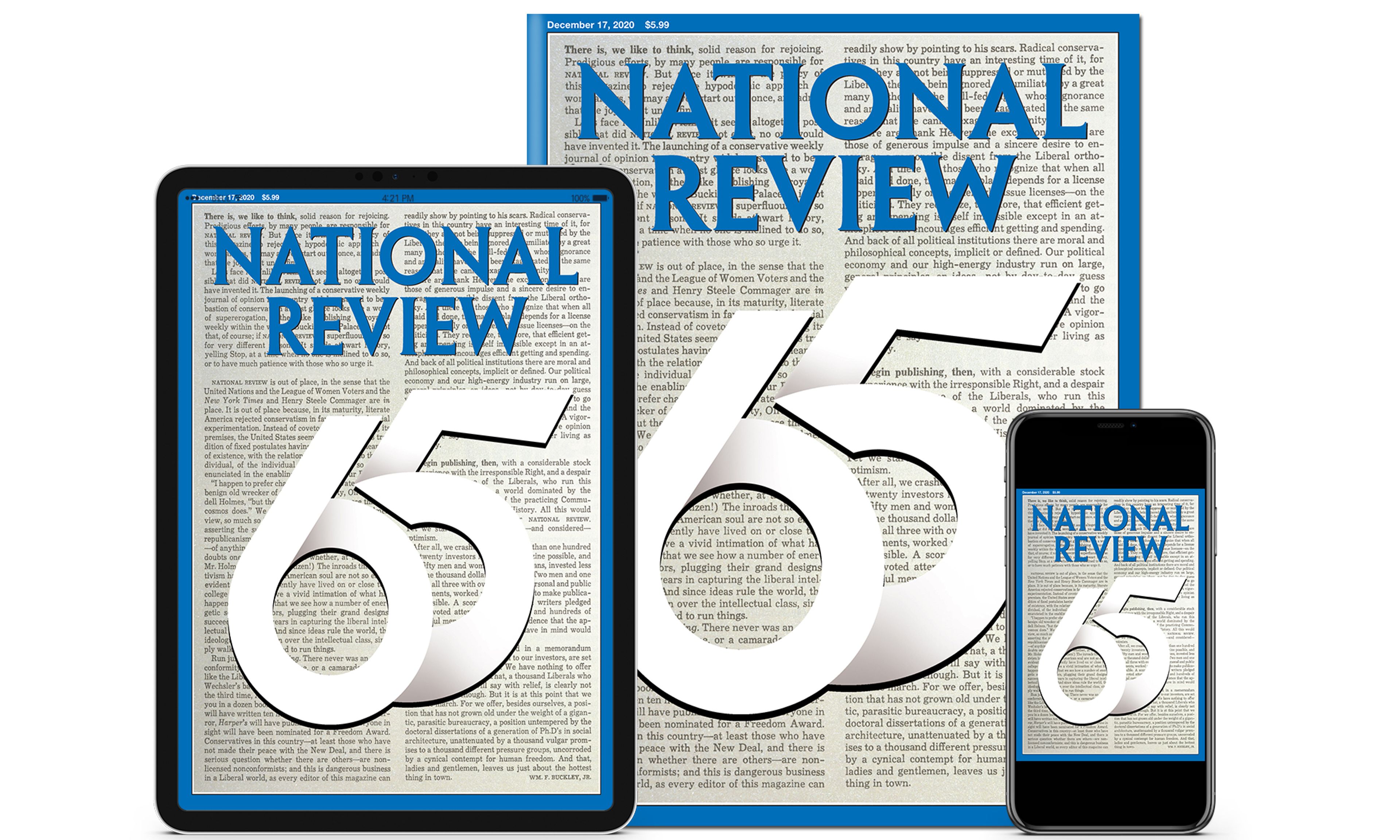
So much younger than our actual years, NR marks the 65th anniversary of its 1955 founding by William F. Buckley Jr. with a spectacular celebratory issue. The thing of ink and paper is now off the presses and in the mail, heavier than usual at 120 pages, counting the covers. Of course, all its goodness is available, in toto, now to NRPLUS members. In addition to The Week, the Table of Contents of the December 17, 2020, issue boasts 38 articles, essays, reviews, and a rare work of fiction (this by acclaimed novelist Mark Helprin; it’s titled Anna, Dressed in White and Blue).
Our fortnightly custom is to recommend five pieces from the new issue. This being a special occasion, we will triple that.
Matthew Continetti leads off the issue’s initial section (“Conservatism and the State of the Debate”) with a reflection on conservatism’s past triumphs and current challenges. The following pieces include Richard Brookhiser’s article charging that statue-toppling is also an attack on principles, Ross Douthat’s piece lamenting the decline of the Christian consensus, and Terry Teachout’s essay on America’s widening — and unbridgeable — cultural chasm. Next is a section on “Politics and Policy,” and among its offerings are Nicholas Eberstadt’s analysis of the folks overlooked by Big Government, Amity Shlaes’s Coolidge-channeling call to benefit the working class by austerity and tax cuts, and Yuval Levin’s plea for entitlement reform as an obligation to the future. The section on “The World” leads off with Niall Ferguson’s piece on the second Cold War (with Red China) and closes with former editor John O’Sullivan’s analysis of the state of the European Union, post-Brexit. From there the special issue takes up Culture, with a trio of pieces: Armond White considers the collapse of journalism as seen through the ’90s movie, Up Close and Personal, Andrew Roberts reflects on wokery’s infection of the business of history writing, and Joseph Epstein chronicles the decline of literature and the novel since this journal’s founding.
Next is a pleasant memory-lane stroll. Leading off: Lee Edwards’s remembrance of the conservative movement some six decades ago. John J. Miller follows with a piece praising the movement’s chronicler, the esteemed George Nash, which in turn is followed by Neal B. Freeman’s article reminding us of the giants — Chambers, Burnham, Schlamm, Meyer, Bozell, Kendall, Rusher, Rickenbacker, and of course, WFB — on whose shoulders we stand now. (Also, do not miss Mark Wright’s briefing on the current Who’s Who of NR.)
And then the pageantry is capped with a delightful and ingenious book-review section, one that takes fresh looks at such classics as John Locke’s Two Treatises of Government (thoroughly reexamined by Jason Lee Steorts), Edmund Burke’s Reflection on the Revolution in France (aced by Gregory M. Collins), William Blackstone’s Commentaries on the Laws of England (given its due by Adam M. Carrington), Alexander Hamilton’s The Federalist Papers (approved by Charles C. W. Cooke), and Alexis de Tocqueville’s Democracy in America (a rave review from none other than Harvey Mansfield).
That has been more than the 15 promised suggestions. Good! Let’s end where the December 17th issue itself began, Rich Lowry’s kick-off, which along the way reminisced:
The occasion has got me thinking of my memories of NR as a reader. I can still recall reading as a high schooler our 30th-anniversary issue, easily as thick as this one, with a pen in hand to underline what seemed the particularly important passages. NR wasn’t just a magazine for me, it was an education, an introduction to a broader intellectual, political, and cultural world — and a completely exhilarating one.
Whether you are a high-schooler or an old-schooler, be assured: This very special 65th anniversary issue will provide you, too, with an exhilarating experience.





Comments