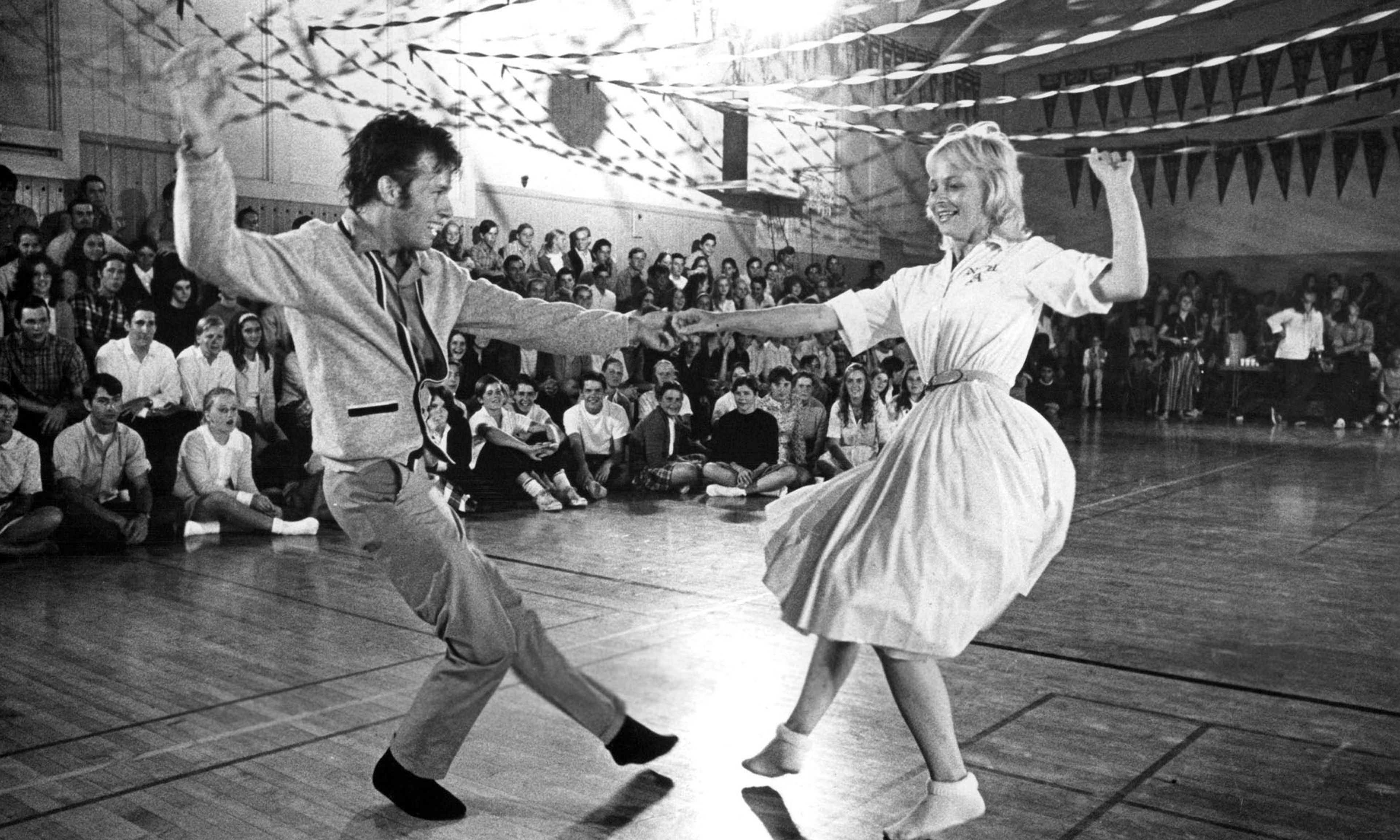
Sometimes it seems as though the human race is cursed by hindsight.
With the passage of time, nearly all of us come to regard earlier periods in our lives through a certain golden-hued haze. After all, who among us wouldn’t wish to be younger, sharper, or fitter? Naturally, our nostalgia often encompasses the particular era in which we were young: the then-dominant movies, music, fashions, attitudes, and so on. Given the inevitable subjectivity of looking back, though, we should exercise caution in extolling the culture of our own youth.
At the same time, should it not be possible to assert that one age is objectively superior to another? What if the specific time of one’s youth was, in fact, better, purer, kinder, more innocent, and less degraded? Such is the argument advanced implicitly in George Lucas’s masterpiece American Graffiti, which celebrates its 50th anniversary this year. The film — starring Richard Dreyfuss, Ron (styled as “Ronny”) Howard, and Cindy Williams as adolescents knocking on the door of adulthood in California’s Central Valley in the early 1960s — entered the world in the summer of 1973, a year when the country was tormented by the accumulated horror of the Vietnam War, transfixed by the unseemly spectacle of Watergate, jolted by a series of political assassinations, unnerved by general unrest, and loosed, abruptly and uncomfortably, from long-standing social and sexual norms.
In response to this period of tumult, Lucas proposed that an Eden was not around the corner but in the rearview mirror — namely, in his hometown of Modesto about eleven years earlier. Lucas, who was 29 years old when the film debuted in theaters, has spoken about American Graffiti as a deliberate course correction following the box-office failure of his 1971 debut effort, the cheerless science-fiction parable THX 1138. “All that movie did was to make people more pessimistic, more depressed, and less willing to get involved in trying to make the world better,” he told journalist Stephen Farber in 1974. “So I decided that this time I would make a more optimistic film that makes people feel positive about their fellow human beings.”
This proved to be a commercially advantageous notion. After American Graffiti emerged as a sensation with the public, TV shows and movies that fled the current moment for a romanticized version of the barely bygone days of the 1950s and early ’60s became numerous enough to constitute their own sub-genre, including the sitcoms Happy Days and Laverne & Shirley and a number of strikingly directed feature films, such as James Bridges’s September 30, 1955 (1977), John Milius’s Big Wednesday (1978), and Philip Kaufman’s The Wanderers (1979).
In truth, though, Lucas was less a trend-setter than a cultural meteorologist: Even before his cameras began rolling, Happy Days, which also starred Howard, was being prepped as a pilot, and Peter Bogdanovich’s elegy for early-1950s Texas, The Last Picture Show (1971) — considerably franker than Lucas’s film but a template in its melancholy tone and imaginative use of period-appropriate songs in lieu of a traditional score — had already been acclaimed as an instant classic. Even the 1950s-set musical Grease, later to become a successful film starring John Travolta and Olivia Newton-John, had already been conceived as a stage show.
American Graffiti, then, must be viewed as part of a constellation of shows and movies made in the early to mid 1970s that, independent of one another, correctly, if counterintuitively, guessed that the long-haired dropouts wanted nothing more than to luxuriate in the time of sock hops, carhops, and classic rock and roll. That Lucas’s film did not create this need but merely fed it does not diminish its accomplishment.
Yearning for that era emanates from every frame of American Graffiti, which Lucas co-wrote with Gloria Katz and Willard Huyck. Staying up late during one long summer night, a group of high-school graduates (and those just younger or a bit older) sort out their feelings about the imminent arrival of adulthood. Despite having his ticket booked for college, Curt Henderson (Dreyfuss) is rueful about what he is leaving behind, while his pal Steve Bolander (Howard), also college-bound, is perhaps too eager to move on from what he characterizes as a “turkey town” — and from his longtime girlfriend, Curt’s younger sister, Laurie (Williams). Throughout the night, the trio crosses paths with a wider network of peers — among them the ineffably cool twentysomething drag racer John Milner (Paul Le Mat) and glasses-wearing geek Terry Fields (Charles Martin Smith) — while scooting into and out of the preferred means of conveyance among middle-class suburban adolescents in post-war America: the car.
In Lucas’s rendering, the car is not only an object of beauty worth beholding for its own sake — in this, American Graffiti is reminiscent of Kenneth Anger’s experimental automotive-worshiping masterpiece Kustom Kar Kommandos (1965) — but the vessel in which young people make or renew acquaintances, kindle romances, or terminate relationships. “How’d you like to ride around with me for a while?” John asks a girl in an adjacent car. Taking this method of dating as a given, she replies, “I’m sorry, I can’t. I’m going steady.” It is in a car that Curt catches sight of a blonde bombshell — in a T-bird — whom he deems a goddess (a cameo by Suzanne Somers), and it is in a car that Steve, selfishly and shortsightedly, suggests to Laurie that their relationship would benefit from becoming nonexclusive at the start of his college career. (Later, Laurie expresses her anger and disappointment in Steve by shoving him out of a car.) The headlights of the assorted vehicles suggest sexual potency; the slowness with which the cars turn corners or come to a halt echoes the choreography of a mating dance.
Indeed, Lucas approached American Graffiti less as a poet than as an anthropologist (his major at Modesto Junior College before he moved on to the University of Southern California film school). “I was always fascinated by the cultural phenomenon of cruising, that whole teenage mating ritual,” Lucas told Farber. “It’s really more interesting than primitive Africa or ancient New Guinea — and much, much weirder.”
All of this might suggest a certain clinical chilliness, and it’s true that American Graffiti lacks the lush grandeur of Bogdanovich’s The Last Picture Show or Robert Mulligan’s Summer of ’42 (1971). Cinematographer Haskell Wexler, who receives a credit as visual consultant, prefers utilitarian, cinema-verité-style camera work that only rarely makes allowances for poetic digressions; perhaps the film’s most expressive recurring image is that of the pitch-black night sky broken up by the bright glare of street lights or store signage. As presented in this film, 1962 isn’t merely 1973 with more-melodic music and cooler wheels, but a time as finite, specific, and remote from the present as, say, Queen Victoria’s England. When John says, “Rock and roll has been going downhill ever since Buddy Holly died,” he is expressing, in a modern idiom, the same sentiments that exercised Edmund Burke.
The teenagers in American Graffiti are amazingly clean-cut: well-groomed, well-mannered, sincere, honest. Class president Steve (earnestly embodied by Howard) and chief cheerleader Laurie (given a plain-Jane winsomeness by Williams) might as well be Mr. and Mrs. All-America. Curt is a wanderer who could have been dreamt up by Salinger. If this crew sometimes makes trouble, it is broadly within the boundaries of tolerated teenage misbehavior. For example, Curt participates in some pranks with the Pharaohs gang, and Terry, trying to win the affections of a sweet, mildly wild blonde named Debbie (Candy Clark), attempts to purchase a few bottles of Old Harper whiskey from a convenience store, but, on the whole, this is a good group. These kids may seem boy- or girl-crazy but, in reality, they are reckoning with maturity — preparing for the coming romantic carousel of adulthood.
The car-crazy drag racer Milner, rougher hewn than the rest, is nonetheless the personification of a good-natured older male pal: single, stoic, intensely competent, utterly immersed in his passion for automobiles but almost paternal in his concern for the young girl (Mackenzie Phillips) he has been unexpectedly (and unhappily) charged with shepherding around town. Lucas contrasts Milner with the nauseating Bob Falfa (Harrison Ford), a fellow drag-racer who goads Milner into going head to head but is interested only in bragging rights. Debbie, more worldly than Terry, shows a sense of old-fashioned propriety when she objects to her beau’s asking her for a few bucks amid their adventure: “Come on, girls don’t pay — guys pay!” And even Wolfman Jack, the renegade DJ sought out by Curt for help in pursuit of the Suzanne Somers character, is a bearer of fatherly advice. He offers Curt not grass, not booze, not hard drugs, but a Popsicle.
What speaks best of these characters, though, is their sincere, if conflicted, attachment to the place that made them. “You know, it doesn’t make sense to leave home to look for home, to give up a life to find a new life,” Laurie says at one point, inadvertently expressing the age-old human longing for home. By the end of the film, Steve has not only reconciled with Laurie but has reconciled himself to a life with her in plain-vanilla Modesto. Curt makes up his mind to continue with his college plans — or, at least, a life beyond the Central Valley — but, while seated in an airplane on the way to wherever, he cannot help but steal one last glance at the kith and kin who have come to see him off and who have chosen to stay behind.
A series of title cards that report on the fates of the characters suggests the fragility of their existence. Curt is said to be a writer making his home in Canada, but the big wide world came even for those who remained in Modesto: It turns out that Milner met his end at the hands of a drunk driver — some Bob Falfa–like figure, no doubt — and Terry, through no fault of his own, was dispatched to fight in Vietnam, where he was reported missing in action. That Steve has the most outwardly stable outcome — he is said to be working as an insurance agent in Modesto, presumably married to Laurie — does not necessarily confirm that he was right to stay home but suggests that, somehow, he has managed to hang onto the past longer than most. But for how long?
Many of those who see American Graffiti five decades after its release will have little or no firsthand memory of either the time period it re-created or the one in which it was produced, but, if anything, a contemporary perspective enriches it. Modern audiences with the advantage of not being attached to either era can simply watch American Graffiti, follow it with a viewing of the sort of movies that were popular at the time of its release — Woodstock or Midnight Cowboy or Klute — and then ask themselves: “Which world would I rather inhabit?











Comments