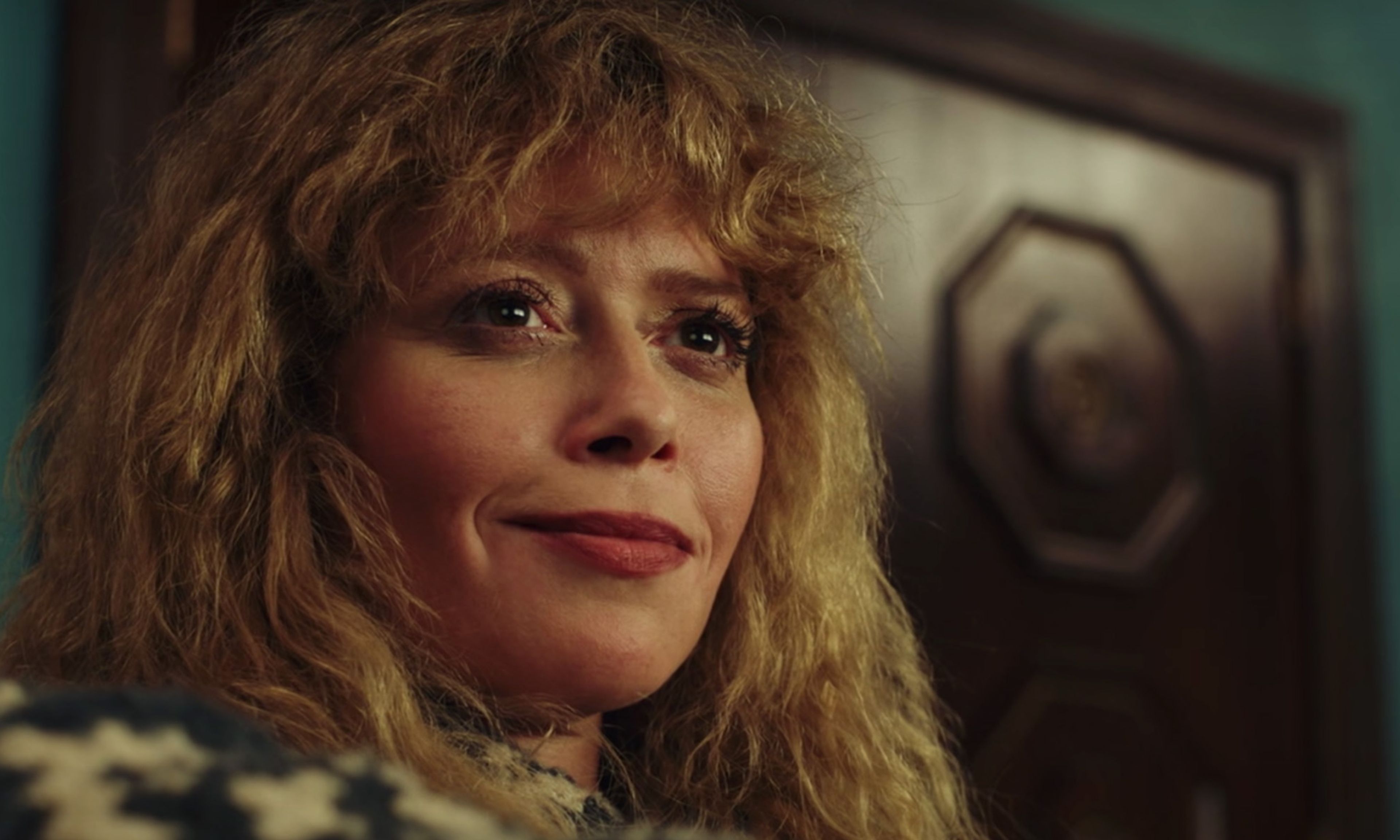
The Ring of Gyges allowed its wielder to turn invisible, and, in Plato’s telling, it drew Gyges into lust and murder. The ability to deceive others puts us at moral risk — it’s harder to act rightly when no one can see you erring. In Rian Johnson’s streaming series Poker Face, his protagonist Charlie Cale (Natasha Lyonne) has the complementary gift — no deception can be concealed from her. Charlie is a human lie detector; she may not know what truth is being concealed, but a lie stands out to her with all the subtlety of an air horn.
Each episode opens with a homicide, then rolls back the clock to show us Charlie on the scene at the periphery of the crime. She never goes looking for mysteries to solve — she is always present before the murder is committed. Johnson draws from Columbo for the murder-as-cold-open structure, in which the central mystery is not whodunit, but how Charlie will catch them. Knowing that someone is lying doesn’t mean she knows what the truth is. And, more than that, Charlie has no official role in investigating murder. While Columbo was a homicide detective, Charlie is a drifter.
She blows up her life in the pilot episode when she figures out a truth that a dangerous casino boss (Adrien Brody, wheedling, weak, and all the angrier because he knows it) doesn’t want her to discover. She goes on the run and works jobs at the margins, the kind that pay in cash. In the aftermath of a murder, no one has to submit to her questioning. Even when she figures out what has happened, she has no power to make arrests, and she can’t stick around to testify.
Natasha Lyonne’s Charlie doesn’t have Columbo’s authority, and she doesn’t have Peter Falk’s slouchy, inconspicuous mien. When she rolls into a new town, she’s friendly, open, and conspicuous, sticking out her hand and saying, in Lyonne’s warm, sandpaper voice, “Hi, I’m Charlie Cale,” even though she is in hiding. One of the season-spanning mysteries is why a woman who can hear every lie would move through the world with such a total lack of cynicism.
The show never gives a reason for why Charlie can tell when someone’s lying. There’s no childhood in a lab and injections with a mysterious serum; no training montage with a mystic who is definitely not from Tibet; no pseudo-scientific explanation about micro-expressions. She just knows.
In the world of the show, she has a knack, not a superpower. Her travels bring her into contact with other people who have a distinctive way of seeing the world (and who sometimes end up dead).
While roadie-ing for a metal band, Charlie drives with the new, overenthusiastic drummer who collects possible beats and lyrics like a magpie. He can’t sit still in the front seat but leans forward, attentive to the particular swish of her windshield wipers, wanting her to hear what he hears. She talks her way into an assistant job with a stop-motion-movie maker, delighted by how he builds a world in miniature and thinks through action one tiny step at a time.
At a barbecue restaurant, she washes dishes for a pit master who shows her the different woods he uses in the smoker, urging her to taste a little splinter of each. “Good barbecue is like a symphony of all five senses,” he tells Charlie, and the show’s soundtrack begins scoring each type of fuel with its own instrument. Unraveling the murder in this episode requires not just her lie-detection skills but her ability to look at a wood splinter and be curious about it rather than see it as undifferentiated and dull.
A superpower might set you above the world, but Charlie’s knack and those of her friends make them more susceptible to the world’s enchantment. Because they are attentive and turned outward, they embody the virtue that G. K. Chesterton described as levity: “Solemnity flows out of men naturally; but laughter is a leap. . . . One ‘settles down’ into a sort of selfish seriousness; but one has to rise to a gay self-forgetfulness.”
As she crisscrosses the country, her blurted “Bullsh**!” is sometimes how she makes friends. There are people she encounters who visibly relax when they’re called out on a lie like “. . . but that doesn’t bother me” or “[My business’s gimmick?], I think it’s great.” Suddenly, this stranger knows them in a way that their family and friends do not, and they seem liberated and lightened by being able to tell the truth. Our communities can bind us to certain lies, and it takes the intervention of some outside force or grace to set us free.
Charlie doesn’t go looking for lies, but she encounters them more often because she forgoes the polite elisions that might not rise to the level of lie but protect us from seeing an uncomfortable duty to another person. Charlie asks blunt questions, and worries at incomplete answers like a terrier. In the pilot, her best friend Natalie tells her, “I think in another life you were, like, a knight,” and addresses her as “Lady Galahad.”
The better analogy is Don Quixote. While Galahad was the exemplar of the virtues of King Arthur’s court, Charlie is as countercultural as Quixote, someone who takes seriously, for her whole life, the basic moral injunctions we teach children. She’s more self-aware than Quixote, sometimes teetering on the edge of walking away from a case, but unable to choose her own safety at someone else’s expense.
The duty that binds her is to speak for the dead, not to save them. Beyond the questions of whodunit and how they’re caught, each episode thrums with a deeper mystery: “What could justice look like after a killing, when restoration is impossible?”
Sometimes Charlie succeeds in getting what she terms “cop evidence” and passing it on. Sometimes she works outside the system, finding a way to strip the murderer of the thing he hoped to gain from killing. He’s left with only his guilt, no gilding. But sometimes she solves the mystery and still loses.
Twice over the course of the series, when she tells the full truth to a murderer, she winds up standing over his or her dead body. Forced to live with the truth, the people she’s exposed decide they’d rather not live at all, and they step out a window, off a balcony, into the void. Their suicides are violent acts of self-erasure — as the show emphasizes, this method of self-murder means obliterating their own faces, adding one last grief for the person asked to identify the pieces.
It isn’t enough for Charlie to uncover the truth or to find a way to tell it. She struggles with the consequences of telling a partial truth. When the murderers are exposed, they can’t go on with the lives they’ve built, but they could recognize the justness of exposure and work to make amends. The murderers’ suicides are their own reflexive “Bullsh**!” in reply to Charlie’s faith that it’s worth doing the hard, right thing.
In the final episode, we catch a glimpse of Charlie’s family and learn she’s been on the run for much longer than we’ve known. She’s been out of touch with her sister, except for sending money, and when she’s forced to seek shelter, the sister (Clea DuVall) calls her and her gift “ruinous.”
The sisters make reference to their father in the past tense, and it’s impossible not to wonder, Did Charlie expose a truth that her father couldn’t live with? Is there one more body in her backstory? One additional death that grew out of her inability to live with the lies other people depend on?
As her sister sees it, the casino kingpin did Charlie a favor. His threat to pursue her gave her a reason to drift without having to explicitly say no to commitment and continuing relationships. “You chose [this life],” her sister tells her. “This is not just a series of situations you keep getting reeled into. . . . You got a good heart. You choose to spend it on strangers and then breeze on down the highway.” Imagining she would settle and stay if she could is the one lie Charlie may have hidden close to her own heart.
Johnson and the show are a little too enchanted by Charlie to make her stay with this challenge or her sister. By the end of the season finale, Charlie has made a dangerous new enemy. When that enemy calls her and begins laying out threats, she smiles peacefully, smashes her phone, and slides comfortably back into her car.
Many crime procedurals offer the viewer a double, unpleasant pleasure — luxuriate for a little in the glamour and evil and violence, but let yourself off the hook by taking even more pleasure in seeing the perpetrator punished. Poker Face’s first season rejected both these temptations, treating violence seriously but without a frisson of fascination. Becoming a murderer doesn’t make you more interesting — frequently on the show it’s the result of letting a singular pettiness eclipse every other good thing in your life. And neither the murder nor the murderer can be neatly fixed by punishment.
In a second season, Johnson might need to break the structure of crime procedurals in order to give Charlie the challenge she deserves. Can her rejection of lies be sustained in relationship and in community? Can she tell the full truth — about lies and about hope — somewhere without having to be a stranger to do it? Do lies accrete inevitably the longer we’re yoked to someone else and the more conflicting promises we make?
Poker Face’s procedural, episodic structure was an asset to its first season, allowing Johnson to stud episodes with phenomenal guest actors. But I hope that, in a second season, Charlie and the show will accumulate regulars. Charlie is a good friend to a corpse; let’s see how she does with solving the howdunit of sustaining a friendship.
We don’t spot every lie the way Charlie does, but we each see enough of them that it takes an active effort to extend trust to our neighbor. It’s the open door and the open hand that Charlie offers that give our neighbor a reason to turn away from the temptations to despair when he sees his lies clearly. It’s rare to hear someone say “Bullsh**!” as warmly as Charlie, turning away from the lie while ready to welcome the liar.











Comments