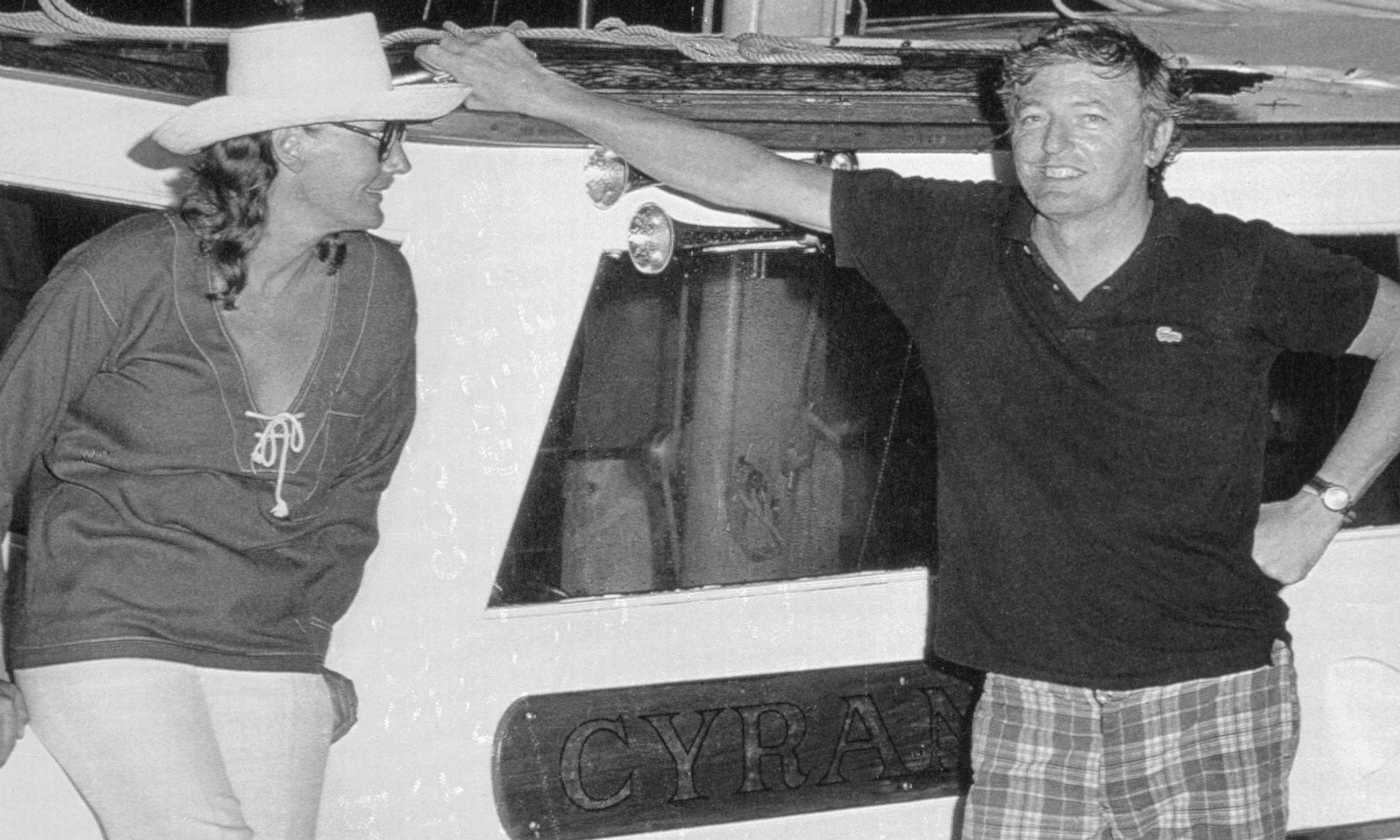
William F. Buckley Jr.’s father once sent a note to his son’s future father-in-law: “You will find it very easy to entertain Bill when he visits you. You need only provide him with a horse, a yacht, or an airplane.”
Buckley never became an avid equestrian, and there’s barely a mention of horses in Getting About, a new collection of his travel writings. Yet there’s plenty on sailing and flying. The first was a great love of Buckley’s, and the second a great necessity. In boats, he raced to Bermuda, cruised the Caribbean, and crossed oceans. Below water and in a submersible, he plunged to “a part of the planet heretofore thought totally inaccessible,” where he became one of the first and only people to see the sunken Titanic. He also skied in Switzerland and Utah, rode the Orient Express and the Trans-Siberian Railway, and zipped around the world by Concorde, flying 39,000 miles in 23 days and producing ten columns from far-flung outposts such as Tahiti, Sri Lanka, and Kenya. Getting About, containing more than a hundred entries and edited by Bill Meehan, recounts a life in constant motion: “I sometimes wake up at home and find myself reaching sleepily for the flight attendant’s button,” wrote Buckley in 1994.
To relieve tedium on long voyages, Buckley gave this recommendation in 1980: “read gluttonously.” Later, in reviewing two volumes, from the Library of America, of travel writings by Henry James, he wrote: “You can close your eyes and open either volume at any page and find yourself reading prose so resplendent it will sweep you off your feet.” The same can be said of Getting About, which deserves a place alongside Buckley’s other travel books (Airborne, Atlantic High, Racing through Paradise, and Windfall), as well as his posthumous anthologies (Athwart History, edited by Linda Bridges and Roger Kimball, and A Torch Kept Lit, edited by James Rosen).
The book begins with a bang, with an essay from Motor Boating, a now-defunct magazine. “Sailing has always had an allure for me which I have found irresistible,” wrote Buckley in 1958. The experience of amateur ocean racing comes to life even for a reader like me, who doesn’t know the difference between a boom vang and a jib sheet. The dash across the waves is “a contest with oneself” whose challenge depends on more than technical skill. It also lies “in keeping your temper, and your disposition; and above all things, in keeping your perspective, and bearing in mind, always, the essential beauty of the experience.” Nearly four decades later, in 1995, he expanded on his sense of wonder: “The sea is the last area on earth where total spontaneity of movement is possible, and it’s a glorious feeling to use the elements — the wind — as propulsion. Another benediction is the absence of noise on a sailboat, except for the amiable conversation of your friends and family.”
The watery world also holds horrors: “Do you worry, crossing the Atlantic? In a way. If, when the sea is exercised, someone should fall overboard, the chances are fearfully high that you have seen the last of him.” Buckley leavened the fear with humor, relating his wife’s reaction to his announcement that he would traverse the Atlantic: “If you survive this, I’ll kill you.” By 1990, in a piece for Cruising World, he was more reassuring: “The ocean likes to practice terrifying its clients, pushing them to the brink of destruction, . . . and then, grudgingly, it will pull back, sullen for a few hours, but then before you know it, it is smiling sweetly at you as if to say: there there, we didn’t really mean it.”
Sea stories are the best sections of Getting About. Yet in the early 1970s, Buckley declared his “resolution occasionally to write about airline travel.” Whereas he often skippered his sailboats, on planes he was merely a passenger — and then he became a critic. A pet peeve involved heavy baggage. “No one should resent paying overweight. It is the paying of overweight at the current preposterous scale that boils the blood of free men,” he wrote in a 1973 column. He described an exchange with an airline agent, who informed Buckley of the need “to pay us for overweight.” Buckley retorted: “How much do you pay me for being two hours late?” In 1976, he complained of “the biggest rip-off in government-regulated industry: the overweight baggage charge.” In 1981, he reported on his latest dissatisfaction, but with a rhetorical smirk: “I regularly travel with excess luggage, required as I am to carry the burdens of the world with me wherever I go.” By the 1990s, he was on to an associated concern: baggage inspections, which he condemned as “a creeping servility to bureaucratic make-work.” (And this was before the advent of the Transportation Security Administration.) He also suggested a way to cope with the unpleasantness: “practice stoicism.”
Mostly, though, his travels delivered delight. “Switzerland is the way station to Paradise,” he wrote in 1970, and Getting About includes several dispatches from Gstaad, where Buckley often played on the slopes and worked on a book. In the warmer climes of the Caribbean, he discovered “a little cove on the west side of Anguilla, which is, I think, the only piece of property that has ever inclined me to imperialism.” The Azores, he wrote in 1984, are “the most beautiful islands in the world,” in a line that he immediately amended: “the most beautiful islands I have ever been to in this world.” The people of the Maritime Provinces of Canada “are the most pleasant breed of men and women I have encountered in a lifetime of pretty hectic travel.”
Several pieces include colorful anecdotes about famous people. His single encounter with Princess Diana was at a state dinner at President Reagan’s White House. Buckley passed on advice he had heard on beating jet lag by drinking a cup of coffee with a tablespoon of salt: “She looked me square in the face, stuck out her tongue, clutched her throat, and made a gagging noise.” Two days later, when Buckley tried the concoction on a flight to Madrid, it failed. In Barbuda, he encountered the popular novelist Ken Follett and mistook him for another popular novelist, Frederick Forsyth. The economist Milton Friedman was an annual ski companion who enjoyed talking “about his Mickey Mouse watch with the calculator game on it, which keeps him occupied on long ski lines or during Democratic speeches.”
This is one of the few comments in the book that might be labeled “political.” Buckley’s life was full of politics, but he often cited Winston Churchill’s definition of a vacation: “doing something else.” Getting About is mostly free of “the world I inhabit, creepy-crawly with things like Republicans and Democrats.” Sometimes, though, Buckley just couldn’t help himself, such as in 1994 when he called the retired Democratic senator George McGovern, who had become a friend, “a fountain of wisdom on all matters not touching on public policy.”
The prose of Getting About contains Buckley’s stylistic hallmark: hard words. On these pages comes “demisemiquaver” in one sentence and “chiliastic” in the next, and elsewhere stumpers such as “asymptotic,” “sempiternally,” and “wrother.” Yet Buckley is not difficult to read. He is easy to read, and looking up unfamiliar words is part of the fun. So are the observations, which are by turns amusing (“There isn’t actually that much to do on a beach, is there?”), homespun (“The best pizza in America is at the corner bakery”), idiosyncratic (“James Bond is okay once, disastrous the second time”), acute (“Men in high office do not answer questions, they maneuver”), and metaphorically rich (“Race your boat hard. And pay no attention to the results”).
In the book’s opening piece, a 32-year-old Buckley delivered one of his nuggets: “Second only to the fear of God, the beginning of wisdom is the knowledge of one’s limitations.” An occasional criticism of Buckley, even among his fellow conservatives, is that his limitations included the fact that although he wrote many good books, he never wrote what might be called a big book — a magisterial tome that will endure.
This is to make the mistake of assuming that big is better. Journalism was Buckley’s métier — his “cruising speed,” as he wrote in a 1972 memoir — and the concluding essay in Getting About shows how much an excellent writer can accomplish in a few pages. “Aweigh,” published in the summer of 2004, is a poignant masterpiece by a 78-year-old that involves a recognition of limitations, and especially the ultimate limitation. Buckley has decided to sell his boat and not replace it, in what he calls “a self-inflicted privation.” He reviews his history on lakes and seas with the Sweet Isolation (whose name “reflected my father’s political leanings in the pre-war years”), The Panic, the Suzy Wong, the Cyrano, and, finally, the Patito. In the end, it is merely an unexpected but banal interruption of his Friday-evening sail that leads the ageing Buckley to his renunciation. “The time has come to sell the Patito and forfeit all that.” The decision “brings to mind the step yet ahead, which is giving up life itself.”
Less than four years later, he was gone.












Comments