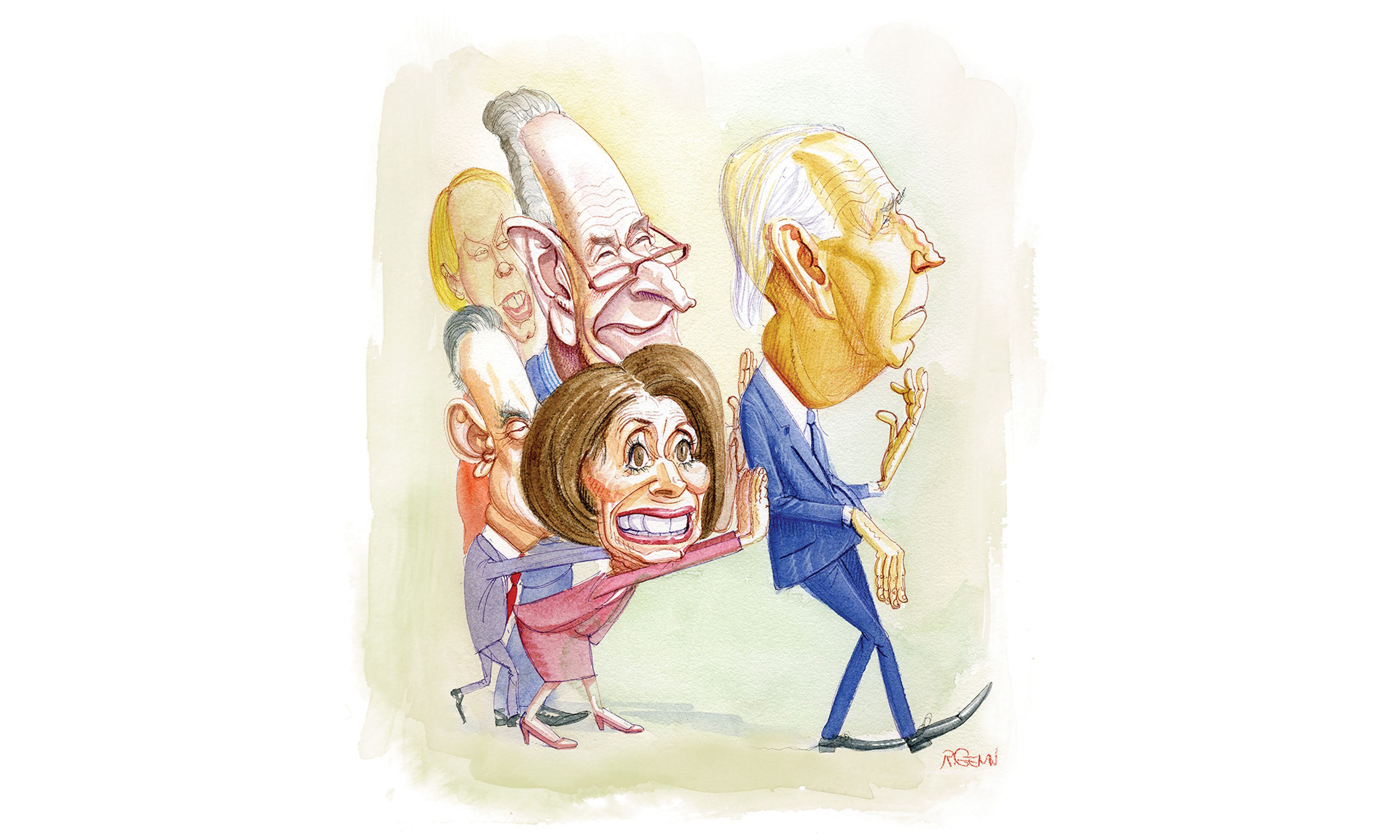
• When we said the campaign should be shorter, this wasn’t what we had in mind.
• In 2009, a couple not on the guest list attended Barack Obama’s first state dinner as president and shook his hand; their credentials were never checked. In 2011, someone fired a rifle at the White House and the Secret Service learned of it only four days later, when a housekeeper found the damage. In 2012, agents were drinking and visiting prostitutes in Colombia hours before duty. In 2014, a man with a knife jumped the fence at the White House and reached the East Room before being apprehended. In 2015, two off-duty Secret Service agents drove drunk and collided with a security barrier at the White House. In 2017, a man jumped the fence at the White House and wandered around the grounds for 16 minutes. In 2019, a Chinese national with a malware-infected flash drive passed a Secret Service checkpoint at Mar-a-Lago and was apprehended only at the club’s front desk. In 2022, two Secret Service agents were sent home from Joe Biden’s trip to South Korea after an alcohol-fueled altercation with a taxi driver. And in 2024, the Secret Service’s total failure at a rally in Butler, Pa., would have resulted in Donald Trump’s head being blown off on live television if he had not slightly turned as the bullet whizzed by. Director Kimberly Cheatle’s resignation is welcome but insufficient. Congress should go back to the authorizing statutes and reform the Secret Service from the ground up.
• Trump tapped Ohio senator J. D. Vance as his running mate. The choice wasn’t a surprise and completed a shockingly rapid political ascent for the 39-year-old Vance, who has gone from being an outspoken Never Trump author to joining Trump on a national ticket in eight short years. A former Marine, the author of the best seller Hillbilly Elegy, and a success in the world of venture capital, Vance is smart and sure-footed. He is a MAGA pick for an increasingly MAGA party. In 2016, Trump believed it necessary to reach out and reassure the Reagan GOP by choosing Mike Pence. Now he appears to feel that no such gesture is necessary. His team believes that Vance can help in the blue-wall states, but it’s doubtful that he’s going to win voters whom Trump wasn’t already going to win himself. More important, Vance’s skepticism of markets and trade and of U.S. engagement abroad would make America less wealthy and secure. Vance has now climbed the greasy pole of Republican politics in the Trump era. This is quite the political achievement, although, as Pence found out, it can be treacherous up there.
• The last time there was a Republican platform, in 2016, its discussion of abortion policy was a model of succinct good sense. It needed updating, given events since then: the overturning of Roe v. Wade, the passage in multiple states of protections for unborn children, and the political backlash to both. Team Trump has come up with new language that attempts to sound conciliatory without containing concessions intolerable to pro-lifers. That language, though, includes logical and factual errors. It claims, for example, that states’ authority to restrict abortion comes from the 14th Amendment. Serious students of the topic have conflicting views on what the amendment means for abortion, but none of them think that. The platform no longer endorses federal legislation on abortion but does not rule it out, either — which raises the question of what the drafters think they have accomplished politically. Democrats will continue to say that Republicans will ban all abortions nationwide if they can, and nothing in the platform contradicts them. The revisions advertise the party’s (and Trump’s) obvious fear of the issue while doing nothing to address that fear.
• “I know nothing about Project 2025,” Donald Trump posted on his social-media platform, Truth Social. His political opponents and the media insist, for once, that Trump is much more knowledgeable than he claims. Several former Trump-administration officials are associated with the project, organized by the Heritage Foundation, that seeks to inform the policy agenda of the next conservative White House. Its proposals fall squarely within the mainstream of modern conservative thought, with an added emphasis on the president’s rightful power over the executive branch and a random walk through social issues. (The drafters would enforce the law against interstate shipment of abortion agents and ban pornography but otherwise leave abortion unregulated at the federal level and leave governmental recognition of same-sex marriage undisturbed.) “Some of the things they’re saying are absolutely ridiculous and abysmal,” said Trump. Democratic officials and the media have referred to the project in such terms as a “dystopian plot” and a “deranged plan for a far-right authoritarian government.” These critiques would benefit from specificity about discrete items in Project 2025’s nearly 1,000-page plan. But that would require reading it.
• The House of Representatives passed the Safeguard American Voter Eligibility (SAVE) Act with the support of 216 Republicans and just five Democrats. It is already illegal to claim falsely to be a U.S. citizen when registering to vote, but currently federal voter-registration forms do not require documentary proof of citizenship. Evidence suggests that instances of noncitizens’ voting are extremely few. But what’s the case against it? Democrats and the White House claim that the law would impose a severe burden on many American citizens who don’t have documentary proof of citizenship, particularly many black Americans, and effectively disenfranchise them; never mind that evidence has not borne out similar claims about states’ voter-ID requirements. One could as easily say that the law would encourage those Americans who lack documentary proof of citizenship to obtain it — a reasonable price for the health of our democracy.
• Not at all chastened by the failure of his tariffs when in office, Trump seeks a much larger trade war if he becomes president again. The tariffs on China have not changed Chinese behavior, but they have raised prices for Americans, and the retaliation from China has harmed American exporters, especially in agriculture. Biden thinks they’re a good idea and has extended them — which should at least be a warning that maybe they aren’t a good idea. Yet Trump says he wants to go even further, with a minimum 10 percent tariff on all imports, completely belying any of the “strategic” justifications for “targeted” tariffs that protectionists invoke when they want to sound sophisticated. He now says he wants tariffs to replace the income tax. The individual-income tax raised about $2 trillion last year, and total U.S. imports were valued at around $3.5 trillion. Squeezing $2 trillion in revenue from a $3.5 trillion tax base is economically impossible, and attempting to do so would be economically destructive. Trump’s biggest legislative accomplishment, the Tax Cuts and Jobs Act, was a solid conservative tax reform that lowered rates and broadened the base, making the tax code less economically distortive. He should seek to build on that, not undermine it with Smoot-Hawley 2.0.
• Teamsters general president Sean O’Brien was the closing speaker on the first day of the Republican National Convention. His speech could have been delivered by Bernie Sanders with few alterations, which makes sense given that Sanders invites O’Brien to testify before his Senate committee and headlines rallies with him. The speech at times left the GOP audience cold, unsure whether to clap for intended applause lines vilifying business and free markets. They were right to hesitate. The Teamsters have a long and rich history of stealing from their members, fomenting violence, partnering with organized crime, and making the trucking industry inflexible and expensive. Since 1990, 94 percent of their campaign contributions have gone to Democrats, and the union spends millions more on other forms of left-wing activism. When in power, Democrats reward them with pension-fund bailouts, unconditionally giving them billions of dollars to avoid consequences for their criminal mismanagement. Workers, aided by Republican legislators, have been fleeing the Teamsters for decades and demanding transparency on union operations. That’s the pro-worker legacy that Republicans should be proud of.
• Court-packing is a menace, no matter how it comes dressed. President Biden, while he was still fighting to hold on to his party’s nomination, reportedly told the Congressional Progressive Caucus that he would unveil “a major initiative on limiting the Court,” as the Washington Post described it. “Limiting” is the key word. The press has gone along with the conceit that this is “judicial reform.” Pending details, per the Post, include “legislation to establish term limits for the justices and an enforceable ethics code.” The constitutionality of either is dubious. The Constitution makes judicial “offices” life-tenured, subject only to impeachment. The obvious goal of the proposal is to break the Court’s conservative majority in order to undo recent rulings, possibly by forcing Justices Clarence Thomas and Samuel Alito and Chief Justice John Roberts off the Court immediately. As Alexander Hamilton wrote, “the complete independence of the courts of justice is peculiarly essential in a limited Constitution,” and “nothing will contribute so much” to this as “the permanent tenure of judicial offices.” The plan remained formally unannounced when Biden left the race, but Kamala Harris is on record favoring more-direct forms of Court-packing. The Senate Judiciary Committee warned of Franklin D. Roosevelt’s 1937 Court-packing plot that it “should be so emphatically rejected that its parallel will never again be presented to the free representatives of the free people of America.” It seems a reminder is needed.
• Biden’s student-debt intransigence lost again in the courts when federal judges in Kansas and Missouri issued preliminary injunctions against the administration’s plan. Pursued notwithstanding the Supreme Court’s ruling against a previous iteration, the plan would have cost as much as $500 billion over the next ten years. The clear lack of constitutional authority for wide-ranging student-debt forgiveness without Congress has not kept the Biden administration from cobbling together $167 billion in debt transference from borrowers to taxpayers. That’s greater than the entire 2023 budgets of the Department of State, Department of Justice, and Department of the Interior combined. Secretary of Education Miguel Cardona continues in his job, violating the oath he took to uphold the Constitution. The courts have prevented the worst of the attempted abuses, but this saga has proven how much damage a federal department can still inflict so long as its leadership is determined. Reducing and circumscribing the Department of Education’s power would be good; eliminating it entirely would be better.
• “In many cases rent control appears to be the most efficient technique presently known to destroy a city — except for bombing,” wrote Swedish economist Assar Lindbeck in 1971. He saw the social degradation that came with social democracy in his native land in the post-war decades. Sweden turned from that history in the 1990s, in part following recommendations from a government commission that Lindbeck led. Determined not to learn from the past, or from the copious economic literature on rent control, the Biden administration is proposing to make federal housing tax credits conditional on the capping of rent increases at 5 percent per year. What housing needs is deregulation at the local, state, and federal levels, to allow more of it to be built in more places. Lower prices will follow — without the perverse and well-documented effects of rent control.
• A jury of his peers found Senator Bob Menendez (D., N.J.) guilty on all counts in his federal corruption trial. The charges ranged from bribery and extortion to wire fraud and obstruction of justice to acting as a foreign agent. Most Senate Democrats called on Menendez to resign from the body immediately, belatedly following their colleague Senator John Fetterman (Pa.), who did not need a jury to conclude that Menendez was unfit to serve. Menendez has said that he will leave office on August 20. Presumably, his exit from the Senate will be accompanied by the suspension of his long-shot independent bid for reelection. When he gets out, Menendez will take the GOP nominee’s slim hope for a possible pickup in the Garden State with him.
• Jamaal Bowman, incumbent Democratic representative for New York’s 16th congressional district, was thrashed in his primary on June 25 against Westchester County executive George Latimer, losing the nomination by 17 points. It was a richly deserved defeat for one of the progressive Squad’s most noxious and juvenile members. Prior to the Hamas attack on Israel of October 7, Bowman was known primarily as the only member of Congress to have pled guilty to yanking a House fire alarm in order to delay a vote. Since that day he has been a fount of some of the basest antisemitism in Congress. A mere month after the attacks he was denying Hamas rapes and atrocities as “lies” and “propaganda” disseminated by the Jewish state. (He belatedly apologized, with manifest insincerity.) He fulminated conspiratorially to Politico about “the certain places where the Jews live and concentrate” in his district. He ended his campaign by shrieking vulgarly at a rally about how AIPAC was “coming for my family.” The voters were unpersuaded. Nobody doubts that George Latimer will be a partisan Democrat; that he is not a deranged antisemite is still a victory.
• In July, Governor Gavin Newsom (D.) signed a law that prohibits elected school boards and other educational entities in California from enacting or enforcing policies that mandate parental notification if a student desires to transition genders or adopt nonstandard pronouns in the classroom. Activists have promoted the bill as banning “forced outings.” In reality, California has decided that the state and its officers know better than parents not only what’s best for their kids but whether parents should be in the loop at all. Governments should not try to take the place of parents — and if one did, it should definitely not be the government of California.
• Ben Sasse, the former U.S. senator from Nebraska, announced that he would step down from his current post as president of the University of Florida to focus on caring for his wife. “My wife Melissa’s recent epilepsy diagnosis and a new batch of memory issues have been hard, but we’re facing it together,” Sasse wrote in a statement. “Gator Nation needs a president who can keep charging hard, Melissa deserves a husband who can pull his weight, and my kids need a dad who can be home many more nights.” Sasse’s decision to place his family and marriage above his career is courageous and praiseworthy. It’s also countercultural: In an age that celebrates personal autonomy and professional success, Sasse is an exemplar of commitment, fidelity, and sacrificing one’s desires for the good of another. He has been a voice of reason and levelheadedness in the face of campus chaos and indoctrination, and his leadership at the University of Florida will be missed, but he is doing the right thing, and we predict that his contributions to public life are not finished.
• The National Education Association, the country’s largest teachers’ union, was set to hold its annual convention in Philadelphia from July 4 to July 7. Then the NEA’s staff union went on strike against the NEA on July 5. Thus the NEA found itself receiving the same sort of nonsense it consistently dishes out in school districts across the country. It said the staff union was spreading “misinformation” that “not only misrepresents the facts but also undermines the integrity of our ongoing efforts to honor a fair bargaining process.” Of course, when the NEA cries that every school district is “underfunded” despite the steady increase in average school spending over the past decade and the current record high, it’s also “misinformation.” But because that misinformation helps the NEA raid taxpayers, it’s good. This misinformation is helping the NEA staff union raid the NEA, which is bad.
• Chief Justice John Roberts, writing for a 6–3 majority in Trump v. United States, held that presidents have absolute immunity from criminal prosecution for “official acts” within their “core constitutional powers,” such as decisions about prosecutions, military force, and pardons. While the Constitution says nothing about presidential immunity, the Court recognized that criminalizing the discretionary powers vested by Article II in the president is tantamount to Congress’s unconstitutionally restricting those powers. The majority was adamant that courts must “not inquire into the President’s motives” in exercising them. While the decision does not immunize presidents from prosecution for private misconduct even if it may tangentially relate to a president’s status, the Court extends “presumptive” immunity to other official acts. And it draws the “official acts” line so broadly that it may include even presidential tweets. Discerning that line will likely require protracted proceedings that will make trying Trump before the election infeasible. It may even complicate Trump’s New York conviction, because the Court restricted the use of presidential official acts as evidence. The Court soundly rejected, however, Trump’s theory that he was immune from prosecution because he was acquitted by the Senate in his second impeachment trial. Elections, impeachment, court decisions, and the power of the purse remain available tools to restrain presidential abuses. It marks a failure of our system that it was necessary for the Court even to address this question.
• Jack Smith’s special-counsel appointment is unconstitutional. So concluded Judge Aileen Cannon in dismissing what once seemed the strongest of the cases against Donald Trump: his retention of boxes of classified and sensitive documents at Mar-a-Lago after leaving office. The D.C. courts handling Smith’s other Trump case may disagree with Cannon, whose order isn’t binding there, but that would set up a likely Supreme Court showdown. Instead of reviving the case under a properly appointed prosecutor, the Department of Justice is appealing. That suggests that the Biden administration would rather campaign against the courts than ensure the law is enforced. It also means no trial before the election. Judge Cannon’s thorough 93-page opinion agrees with Clarence Thomas’s concurring opinion in Trump v. United States and cites a 1998 law-review article by Brett Kavanaugh. Her conclusion: that Smith was never properly appointed as an officer of the United States and therefore cannot constitutionally oversee an indictment and federal prosecution. In short, the appointments clause of Article II vests executive power under the president in “officer[s] of the United States,” who can become so in one of two ways: either by presidential appointment and Senate confirmation or by filling an office “established by Law,” i.e., created by statute with powers defined by Congress. The special-counsel role is created by regulations written by Janet Reno. And while many special counsels are already sitting United States attorneys (and thus officers in their own right), Smith was a private citizen when appointed by Attorney General Merrick Garland. Now, he may be one again.
• Scarcely anything was more central to the framers of the Constitution than the separation of powers as the core safeguard against the erosion of all our other guarantees of liberty. Woodrow Wilson and other Progressive Era intellectuals thought this old-fashioned, inefficient, and an obstacle to rule by experts. Wilson’s heirs still defend the bureaucratic administrative state, which interprets its own laws, runs its own courts, and is insulated from removal by the executive. In a series of decisions this term, the Supreme Court struck back. In Loper Bright Enterprises v. Raimondo, the Court overturned the Chevron rule, which allowed agencies not only to exploit statutory ambiguities but to demand that courts defer to their legal interpretations. As Roberts detailed in an opinion for another 6–3 majority, Chevron, minted only in the mid 1980s, never sat comfortably with the traditional law-interpreting role of the judiciary. It also clashed with the Administrative Procedure Act, passed in 1946, which provided that a court’s review of agency action must “decide all relevant questions of law” and “interpret” the relevant “statutory provisions.” If the ruling revives in Congress the habit of writing laws, and in agencies the habit of obeying them, it will have served the country well. Agencies are but creatures of law, and law is but a creature of the sovereign people’s right to self-government — a government of laws, and not of men.
• Voice of America (VOA), Radio Free Europe/Radio Liberty, and other U.S.-funded international broadcasters exist to bring truthful, reliable news to millions of people living under authoritarian repression. This can be a wise investment of taxpayer dollars that advances U.S. foreign-policy interests, not to mention a moral good. But lapses by the leadership of the U.S. Agency for Global Media — the federal agency that funds and oversees that journalism — are undermining this enterprise. During recent congressional testimony, CEO Amanda Bennett ducked accountability and provided inaccurate information. After the October 7 massacre, VOA’s acting standards editor, Carol Guensburg, directed reporters to “avoid calling Hamas and its members terrorists, except in quotes,” a policy allegedly consistent with other major U.S. outlets and a desire not to “demonize” people. This violated VOA’s statutorily enshrined mandate to provide news that is “accurate, objective, and comprehensive,” which fueled concerns of an anti-Israeli bias at VOA. After National Review exposed the policy, Republican congressmen successfully pressured USAGM and VOA into reversing course. Before Congress, however, Bennett recently declined to admit any wrongdoing and spun a misleading narrative that Guensburg was merely issuing opinion, not policy. This is not true. She is VOA’s top editor responsible for ensuring compliance with journalistic standards and provides detailed instructions for reporters to maintain the outlet’s journalistic objectivity. Bennett also inaccurately claimed that VOA does “not shy away from using the word terrorist in conjunction with Hamas or referring to any other terrorist organization.” Even after the policy had officially been reversed, a senior editor told his reporters to stick with it; VOA stories still very rarely refer directly to members of Hamas as terrorists. Congress is now poised to pass a budget that imposes cuts to the media agency’s funding. Bennett’s performance is sadly representative; she has allowed VOA to drift toward being just another left-leaning news outlet. Congress needs to use every tool at its disposal to right the ship.
• When asked about defending Taiwan, Trump usually talks of microchips. He did again in an interview with Bloomberg Businessweek. “Taiwan took our chip business from us,” he said. “I mean, how stupid are we? They took all of our chip business. They’re immensely wealthy.” Clearly, he does not regard Taiwan as a U.S. interest. He wants Taiwan to pay the United States for protection. “I don’t think we’re any different from an insurance policy,” he said. “Why? Why are we doing this?” His words are in line with his attitude toward NATO. In the recent interview, Trump added, “Taiwan is 9,500 miles away” (from American shores). “It’s 68 miles away from China.” The Taiwanese, like the Ukrainians, ought to prepare for a future without American support. Such a future would be immensely challenging for Taiwanese and Ukrainians, and, eventually, for Americans as well.
• A news report began, “Ukraine’s largest children’s hospital was destroyed by a Russian missile on Monday, shaking Kyiv, the capital, with images of bloodied and injured children, and sending hundreds racing to the scene to help clear twisted metal and smashed concrete in a desperate search for survivors.” The Kremlin’s assault on Ukraine is, simply, evil. That very day, the Indian leader, Narendra Modi, sat down to tea with Putin. Three days before, the Hungarian leader, Viktor Orbán, had gone to see Putin on a “peace” mission. To appease the likes of Putin is often a fool’s errand. The Ukrainians have asked their allies for permission to use long-range missiles, supplied by those allies, to attack launching sites in Russia before Russian missiles can strike Ukrainians. This seems a reasonable and obvious means of self-defense.
• After spending nearly 16 months in detention in the basement of what used to be the KGB’s headquarters at Lefortovo Prison, Wall Street Journal reporter and American citizen Evan Gershkovich was sentenced by a Russian court to 16 years in a maximum-security prison on charges related to espionage. But what Moscow pretends is spycraft, rational observers would call journalism. The Russian court has failed to produce any supporting evidence substantiating its claims against Gershkovich. His detention and conviction aren’t justice. They’re hostage-taking, which has become a profitable enterprise for the Kremlin in the Biden era. Other recent instances include Women’s National Basketball Association player Brittney Griner, whose freedom the Biden administration secured at a heavy cost (an illegal-weapons merchant and a hit man in exchange for a basketball player). Others — onetime U.S. security contractor Paul Whelan, Staff Sergeant Gordon Black — still languish in Russian custody. The list of American captives of the Russian state continues to grow. The injustices the Russian justice system has meted out to them aren’t just expressions of the Kremlin’s desire to inflict pain on the American government. Their mistreatment serves Moscow’s geopolitical interests. Gershkovich’s ordeal is particularly infuriating. The abuse imposed on a reporter on assignment just so he might serve as “a bargaining chip,” as a National Security Council spokesman described it, is grotesque. Gershkovich’s torment illustrates the lengths Vladimir Putin’s regime is willing to go in its effort to antagonize the United States.
• Britain’s Conservative Party finished a national election with the fewest seats it has ever held as an official political party. But although there can be no doubt that the result revealed what everyone knew — that voters were sick of the Conservatives — looking deeper reveals a more complex picture. There was no wave of enthusiasm for Labour, although, sadly, it will govern as if there were. The party won an overwhelming majority of seats (63 percent) with an underwhelming share of the vote (34 percent), only two percentage points more than in 2019, when it suffered a crushing defeat (Britain’s electoral system is what it is). The Tories were shattered by defections both to the left-wing Liberal Democrats and to Nigel Farage’s populist-right Reform UK. Reform took 14 percent of the vote but only 1 percent of the seats. Working out what the Conservatives should do next is trickier than some think, particularly the merge-with-Reform boosters, except in one respect: If the Tories persist with their Labour-lite mode, it will do no favors either for them or for their country.
• The decision by France’s President Macron to call snap parliamentary elections after the strong showing by Marine Le Pen’s Rassemblement National (RN) in EU parliamentary elections looked unwise at the time. It looks worse now. The populist-right RN, which has struggled to dislodge the antisemites and other bigots from its ranks, topped the poll in the first round of voting, followed by the left/far-left Nouveau Front Populaire (NFP) coalition. Macron’s Ensemble was reduced to third place. Horse-trading before the second and decisive round of voting between Ensemble and NFP led to a “republican front” that blocked the possibility of RN government. Who will form a government instead is still unclear. Neither Ensemble nor the NFP has the seats to rule by itself, and a straightforward partnership between the two seems inconceivable. The largest party in the NFP, the far-left LFI, is led by a former Trotskyite with a habit of making “misunderstood” comments antisemitic enough to reinforce LFI’s appeal to Muslim voters. Current political maneuverings point to an ineffective minority centrist government. That would likely mean that the next presidential election would be fought out amid unresolved and deepening financial woes and a hardening political divide.
• Bob Newhart was part of the furniture for 60 years. He was as familiar as the president, or more familiar, because they came and went while he stayed. He made comedy albums. He starred in sitcoms. He was on talk shows, endlessly. Improbably, he was best friends with Don Rickles. Rickles was known as an insult artist (“Mr. Warmth”); Newhart was known as a thoughtful, wry fellow. The way Rickles liked to put it was: “Bob does the kind of humor that is cerebral; I do a kind that gets laughs.” Yet, as Don knew, Bob got laughs too, plenty of them. What a delight, even a comfort, he has been for all this time. Bob Newhart, born George Robert Newhart, has died at 94. R.I.P.
• It “must have been an optical illusion to a lot of people,” said the TV announcer after the Catch, the most famous defensive play in baseball history. Racing backward, the New York Giants’ center fielder had snagged a fly ball well over 400 feet from home plate, spun around, and fired a long strike to second base to stop the Cleveland Indians in Game 1 of the 1954 World Series: Willie Mays’s glove was golden and his arm a rocket. He also had a bat, hitting for both average and power. The leg speed that served him in the outfield did so on the base paths too. Let historians bicker over whether he or Babe Ruth is baseball’s greatest of all time. Few would dispute that Mays was the consummate five-tool position player. In 23 years in major-league ball, most of them with the Giants, he hit 660 home runs. His career in his prime was interrupted by two years of service with the U.S. Army. Born in Westfield, Ala., during the Great Depression, he played briefly in the Negro Leagues and outlived Jim Crow. Godspeed to the Say Hey Kid, dead at 93. R.I.P.
Politics
A New Election
In less than a month, Biden fell, Trump lived, and Harris rose.
The Bidendämmerung began with the presidential debate on June 27. It was a snap contest, a dare by President Biden that was promptly accepted by former president Trump. Biden muttered, fumbled, lost his train of thought, fell silent. All the blunders of age that his supporters in and out of government had explained away were paraded before a national audience. It seemed less a debate than elder abuse. His subsequent interviews and press conferences, designed to show that the debacle had been a one-off, were excruciating — just better enough to persuade him and his handlers that he could go on, not good enough to assure Democratic donors and officeholders that a Biden campaign would neither waste their money nor risk their jobs.
On July 13, 16 days into Biden’s agonies, Donald Trump escaped death at an outdoor rally in Butler, Pa., north of Pittsburgh. Armed with a rifle, 20-year-old Thomas Matthew Crooks sprayed the podium from the roof of a nearby outbuilding, killing one Trump supporter, Corey Comperatore, injuring two others, and clipping Trump’s right ear. Secret Service agents killed Crooks and whisked Trump to safety, but the failure to have secured such an obvious vantage point and to have heeded the warnings of spectators who saw the would-be assassin creep up to it requires serious institutional rebuilding. If Trump had not turned his head at the right instant, he would be dead. His family and his supporters are grateful for his life; the country also for being spared the fear, wrath, and recrimination that would have followed his murder.
July 15–18 saw the Republican convention in Milwaukee. There were impressive moments: the tributes to the 13 American service members who lost their lives in the retreat from Afghanistan, and to the Americans held hostage since October 7 by Hamas terrorists. (Biden boasted during his disastrous debate that no American servicemen had died in combat on his watch, while a drinking game for the Democratic convention in Chicago will be to count the keffiyehs.) Impressive in a personal way was Trump’s pensiveness during his first march onto the convention floor. The rest of the convention was the apotheosis of politics as showbiz, from Amber Rose to Kid Rock to Hulk Hogan. They didn’t have OnlyFans models or professional wrestlers when William Henry Harrison ran for president in 1840, but the Log Cabin and Hard Cider campaign was as vulgar as politics could be then. The vulgus is the electorate. Roll over, John Adams, tell Jefferson the news.
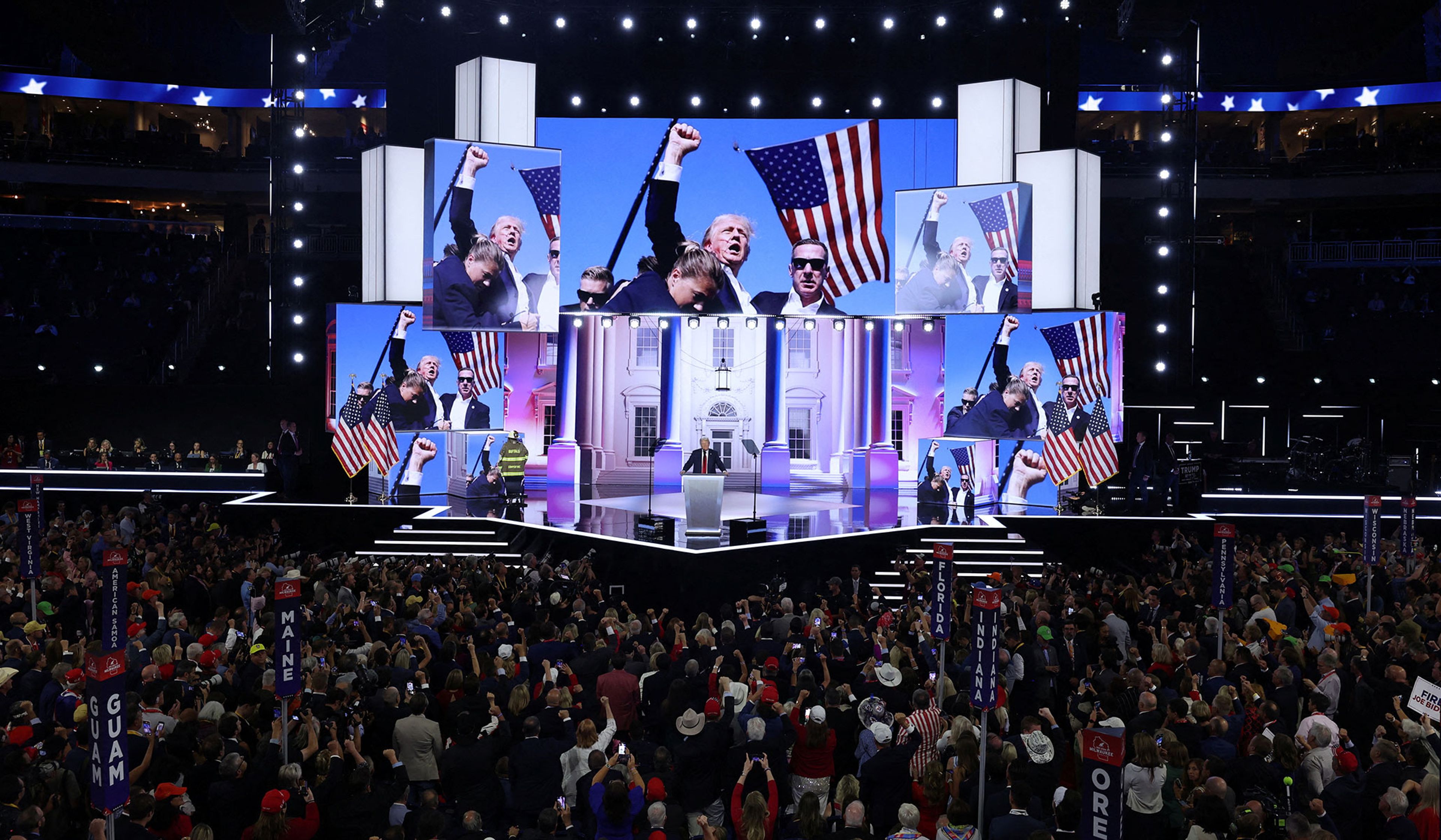
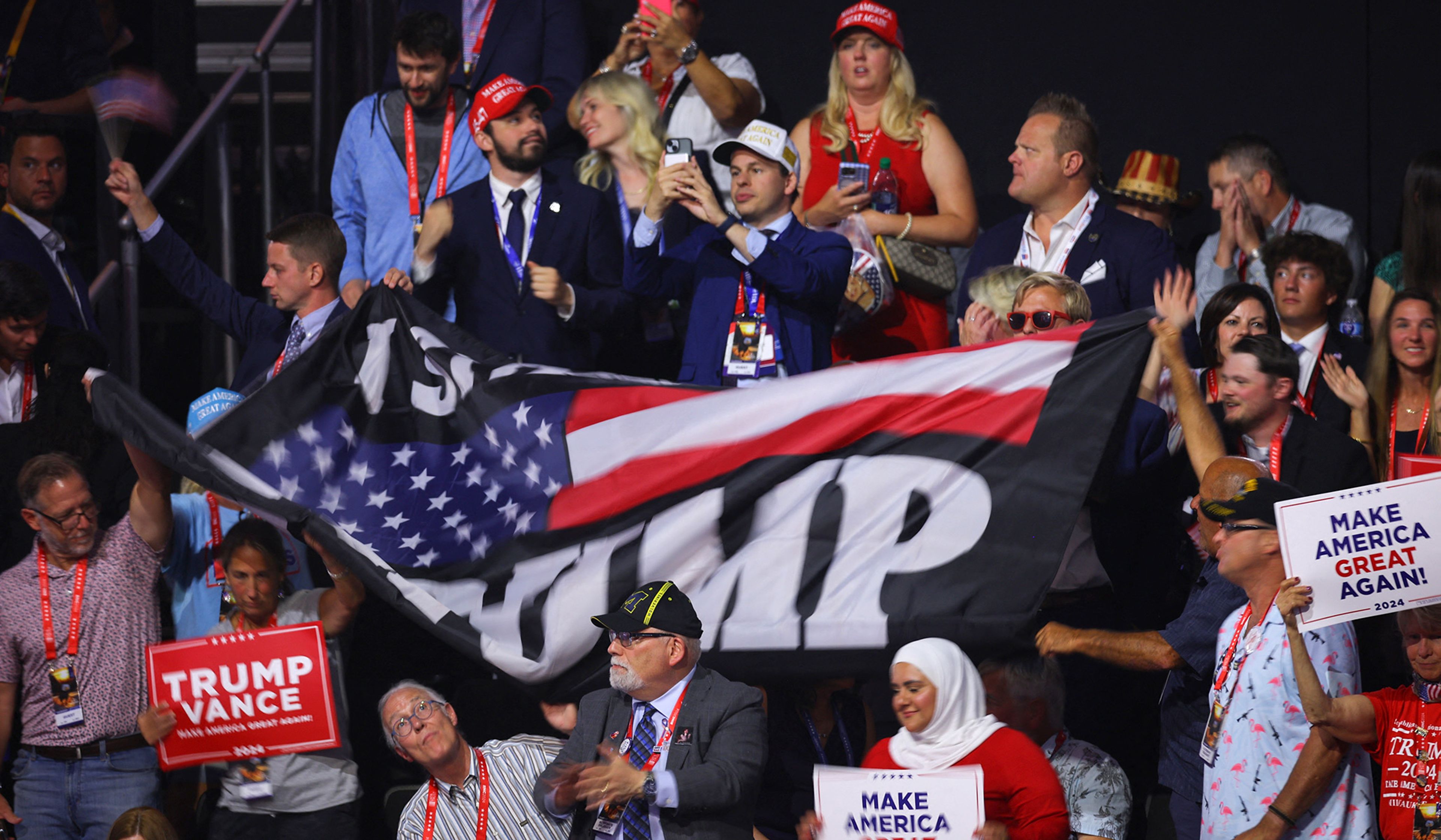


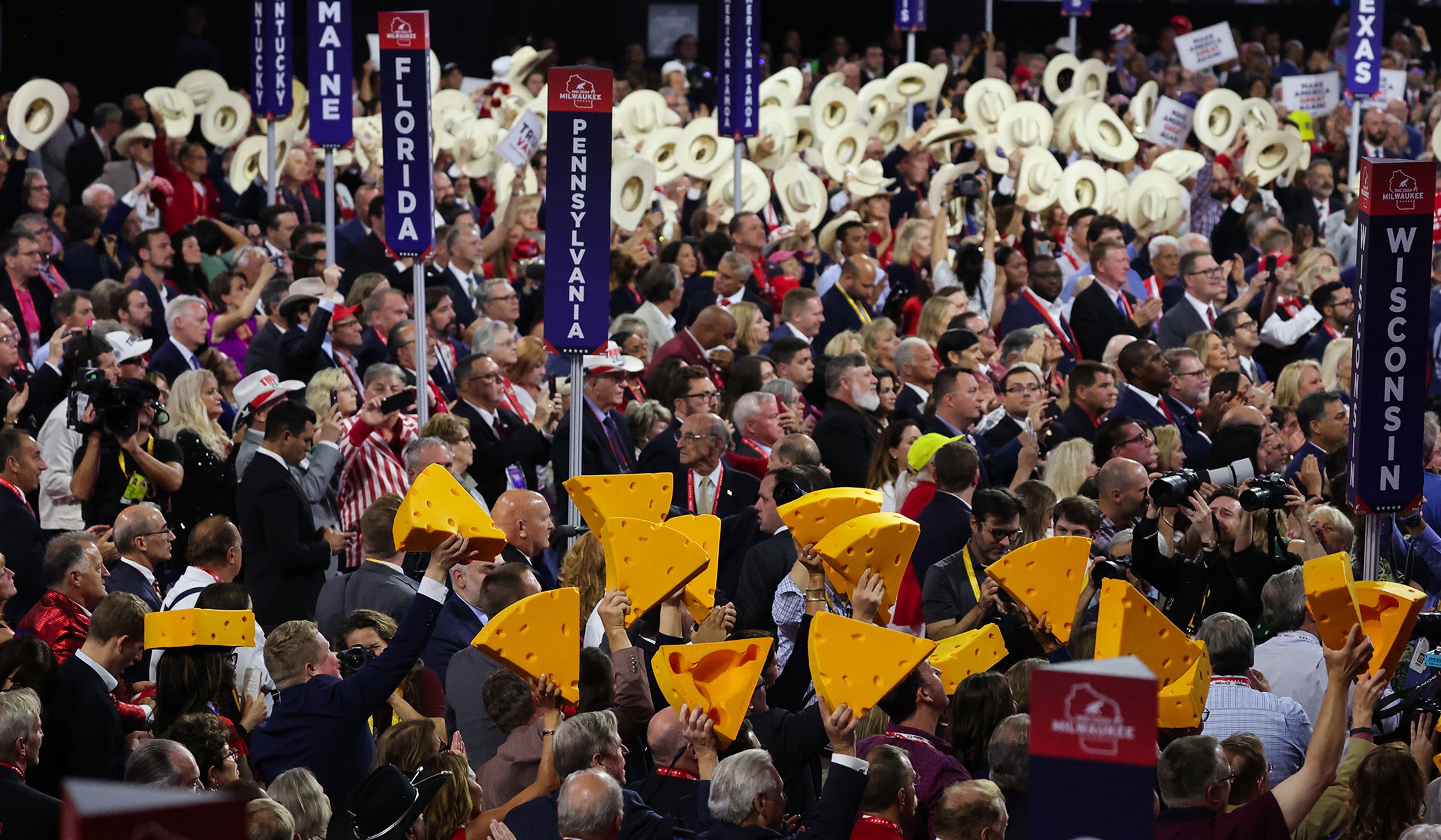




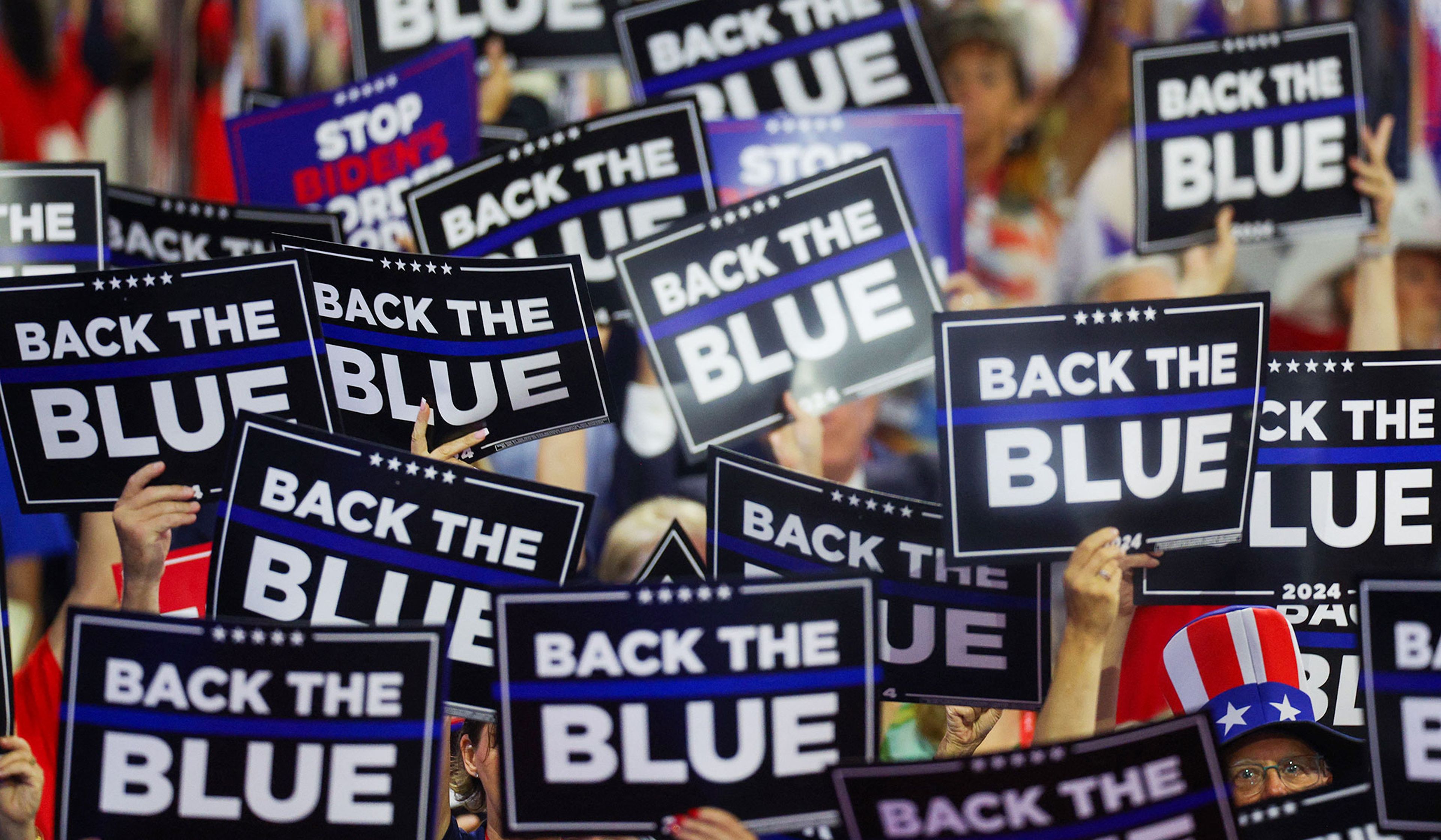
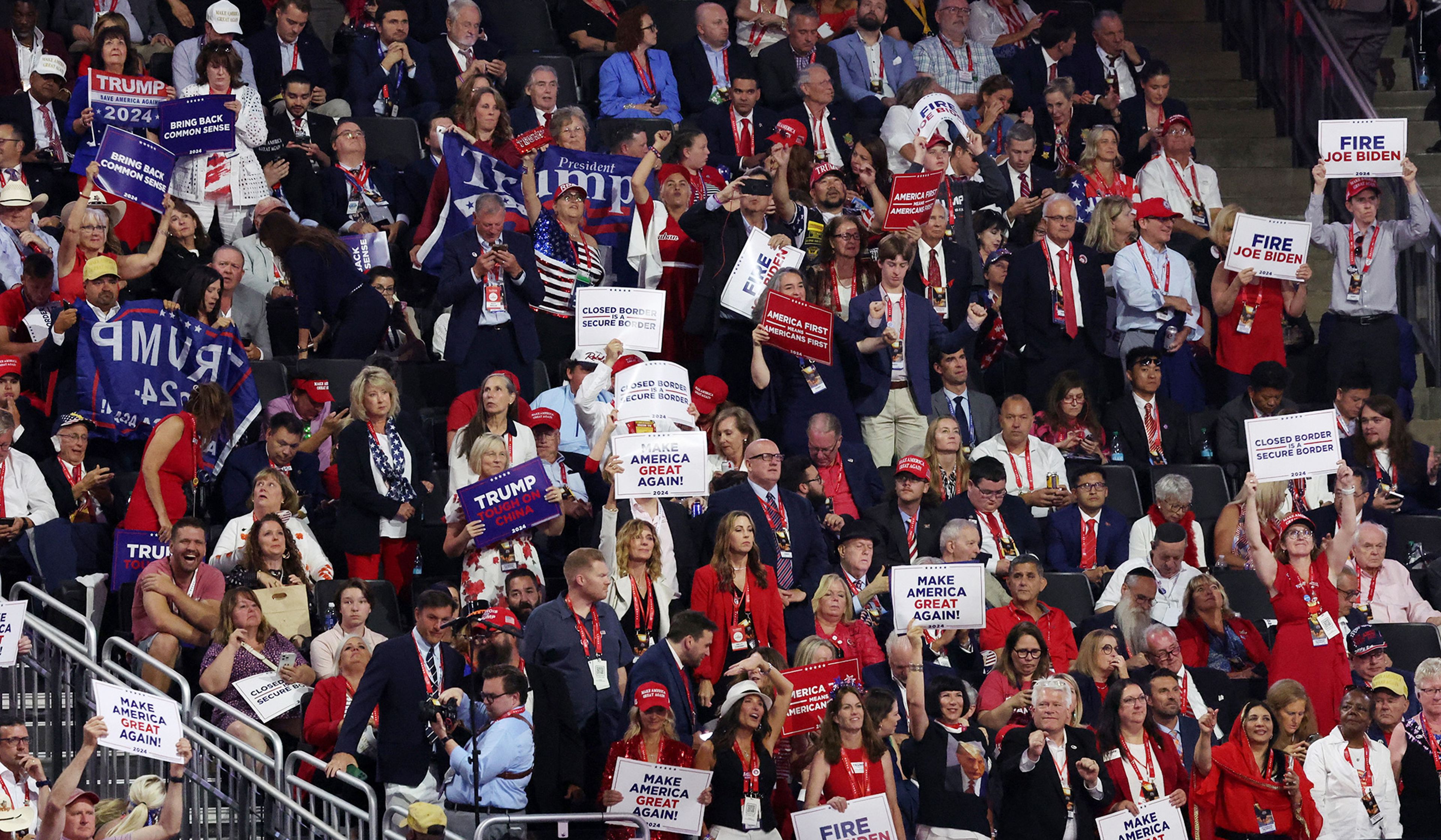

Republican presidential nominee and former president Donald Trump delivers his acceptance speech on Day Four of the Republican National Convention in Milwaukee, Wis., July 18, 2024.
Mike Segar/Reuters
On July 17, to add to his woes, Biden tested positive for Covid. Four days later, he announced that he would not seek renomination. So ended a 50-year career of mediocrity, malleability, nest-feathering, occasional geniality, and — what finally won him the White House — personal persistence. Sparing his party and the country a long march to November would have been statesmanlike if it had been done a year or — per a scathing Wall Street Journal report — two and a half years earlier, when symptoms of his incapacity first became evident. The scandal of Biden’s cling to power recapitulates Wilson’s and FDR’s. He and his enablers have a lot to answer for before the bar of history.
Biden followed his demurral by endorsing his vice president, Kamala Harris, to succeed him as presidential nominee. She was elected attorney general of blue California in 2010, trailing the rest of the Democratic ticket. Her presidential run in 2020 was so bungled that she pulled out before the Iowa caucuses. Biden tapped her to be his running mate, then saddled her with the task — impossible in his administration — of handling the southern border. But only a handful of political mavens know these facts. There will be a blizzard of stories focused on her sex, her immigrant parents (Jamaican father, Indian mother), the drama of assembling a campaign, and even overcoming intraparty obstacles. Her age — 59 — deprives the Trump campaign of one of its most lethal issues. The war they planned is not the war they will fight. Big-bucks wallets, shut to ailing Biden, opened for the party’s new face.
Trump will now be the oldest man ever to run for president. He serves his own helpings of gibberish (Hannibal Lecter?). The disdain for Ukraine that radiates from hard-core Trumpers appeals to themselves, though not to most voters. Trump finally remains himself, as do most men brushed by death. Andrew Jackson caned his assailant and blamed a senator for encouraging him. Theodore Roosevelt asked the angry crowd not to lynch his, and then gave a 45-minute speech. Ronald Reagan told jokes. Trump thought a bit — then three days later gave an endless acceptance speech, and may well commit blunders more serious. It’s a long, long while from July to November.
The Stat
$208 billion — how much money the federal government could save by implementing recommendations the Government Accountability Office (GAO) has already made.
The GAO makes about 1,200 recommendations per year about how to improve government services. Agencies and Congress are not required to make the suggested changes. A July report from the GAO found that 5,480 recommendations remain unenacted. Most aren’t about saving money, but 4 percent of them could save between $106 billion and $208 billion over the ten-year budget window. The bulk of those savings would come from just one recommendation: equalizing payment rates between places of service for Medicare recipients. The Congressional Budget Office estimated that this would save $141 billion over ten years. The GAO also projects billions in savings if the IRS recaptures Covid tax credits improperly distributed to employers and, in conjunction with the Office of Management and Budget, establishes performance reviews for tax expenditures. Other recommendations that would save money include having the Department of Education verify borrowers’ incomes when granting student loans, reauthorizing a broadband network for first responders, clarifying the Department of Energy’s responsibilities on nuclear-waste disposal, and setting up a permanent office to coordinate agency efforts to recover improper payments. Balancing the budget will be hard, and it will require actual spending cuts. But $208 billion in savings would be a good start, and Congress is making the job harder than it has to be by ignoring these recommendations that are sitting on the shelf.
by Dominic Pino












Comments